
This guide is for the agent working a queue. Your xMatix day is cases: they arrive routed to you, each carrying an SLA clock, and you work them to resolution — answering from the knowledge base, saving keystrokes with macros, and pulling in colleagues or escalating when a case outgrows you.
Where you work
Cases are records like any other, so they live in whichever app your administrator hosts the support desk in — the first-party CRM app carries Cases next to Leads, Opportunities, Quotes, Accounts and the Call Register, and the App Launcher's entity search opens the Case list whatever app is current. Everything you do to a case is an action on the record: Escalate, Route, Merge, Run Macro, Email Article, plus the status transitions of the lifecycle. Knowledge articles have their own list, macros are built under Setup → Feature Hub → Service → Macros, and the queues, SLA policies, business hours and skills that shape your day are configured by an administrator in the CRM Settings app.
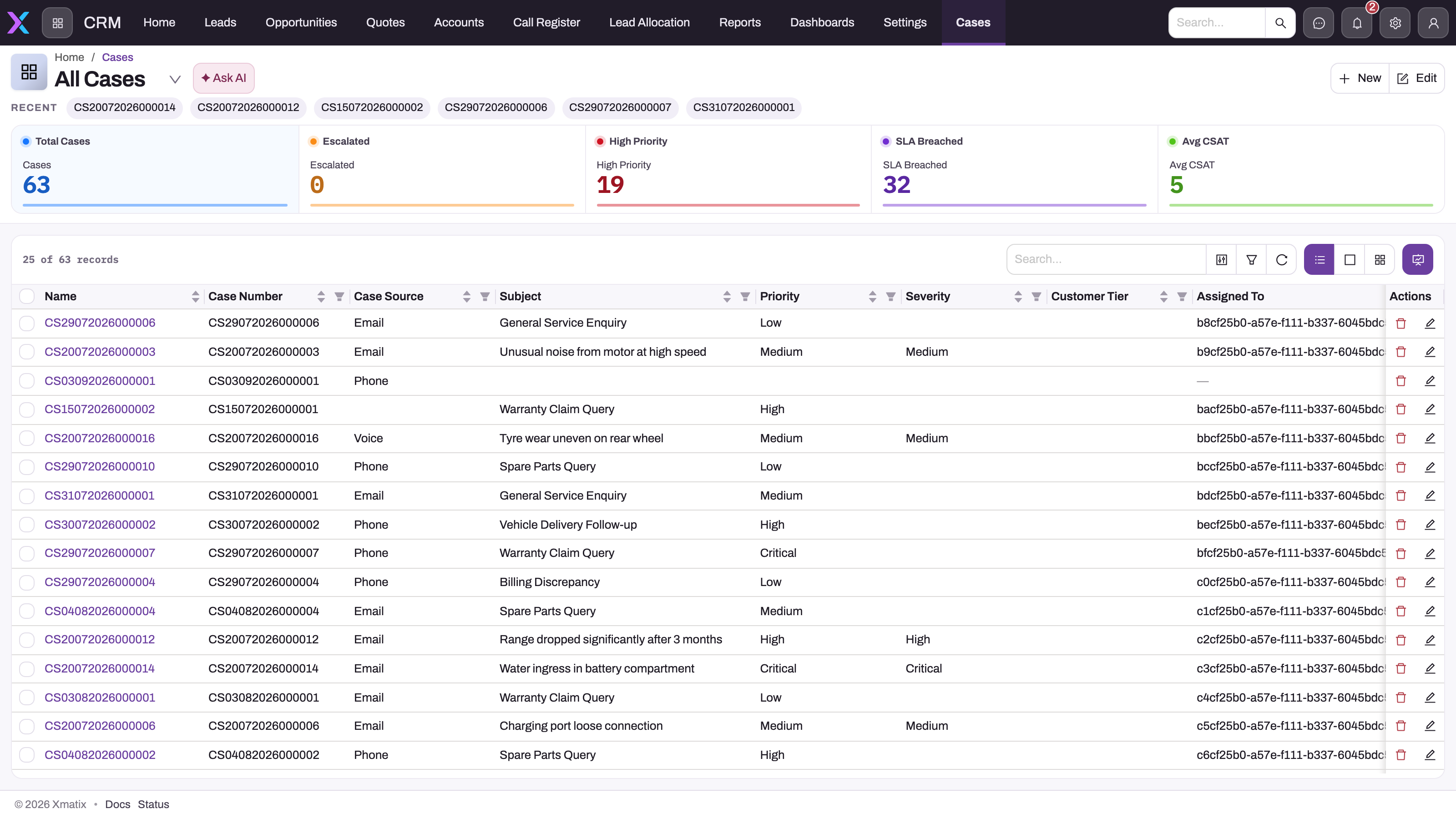
- 1
Cases live in the app that hosts your support desk — the CRM app here — alongside Leads, Opportunities, Quotes, Accounts and the Call Register.
- 2
All Cases is the active saved view; your queue views are other saved views of the same register, so check the view name before deciding a case is missing.
- 3
The cards are the desk's pulse: total cases, escalated, high priority, SLA breached and average CSAT. Click through a filter to turn a number into a working list.
- 4
Search, column filters and refresh find an existing case before you create a duplicate intake record.
- 5
Case Source, Subject, Priority and Severity separate where work came from, what it is, how urgent and how severe; Assigned To shows the working owner — as a user identifier in this list view.
The All Cases view is the register behind every queue. The cards above it summarize the desk — total, escalated, high-priority, SLA-breached and average CSAT — and the columns underneath carry what you need to choose the next case: source, subject, priority and severity, customer tier and the working owner. Your own queue is a saved view of this same register, so verify the view name and filters before concluding a case is absent, then open the record and read its details, activities and SLA tabs before acting.
Access you need
There is no shipped support-agent profile — the seeded profiles that carry case permissions are the administrative ones — so your administrator creates an agent profile that grants read, create and update on Case and its related records (case milestones and SLA events, knowledge articles, activities) and explicitly allows the case actions you may run. Each action is an entity action with its own grant: an agent who may Run Macro but not Merge is a normal configuration, and a team member's descriptive access level on a case does not grant an action. Being routable is a separate matter from permissions: the routing engine only offers work to a resource record that is active, linked to your user account, currently Available, and under its declared capacity — if any of those is false you can still open cases, but the queue will not push work to you. Support is licensed as part of the product your organization has enabled; a missing Cases entry or a greyed action is diagnosed with Troubleshooting: a user can't see something.
Your path
- xMatix Support — the product overview; how cases, queues, SLAs and knowledge fit together.
- The case lifecycle — the operational states, which transitions are allowed, owner versus assigned-to, and what a case creation stamps.
- Queues and omni-channel routing — who is eligible, the routing models, and what accept, decline, transfer and reassign do.
- SLA policies and milestones — how a policy is chosen, the first-response and resolution clocks, business hours, pausing, and how breaches surface.
- Build and run macros — ordered steps that update fields, add notes, send email or call a case action in one click.
- Author and share knowledge articles — finding answers, surfacing an article on a case, emailing it to the customer, and writing down what you discover.
- Collaborating on cases — following, team members, side conversations, duplicate detection and merging.
- Escalating a case — what Escalate changes, and how SLA breaches escalate automatically.
Day to day
Work arrives through queues and routing; your job is to keep each case moving through its lifecycle before its SLA milestones come due. The fast path on a familiar issue is a knowledge article plus a macro; the honest path on an unfamiliar one is collaboration early and escalation before the breach, not after. When a case is really a service job — a repair, a site visit — it becomes a service order that the service team executes while the case keeps the customer conversation. Every call and message along the way lands on the case as an activity, so the next agent inherits the whole story.
Common questions
Which case do I pick up first?
The one closest to breaching — SLA milestones, not arrival order, set the priority. SLA policies and milestones explains the clocks; your queue views can sort by them, and the SLA-breached card on the case list tells you how many are already over.
Does the SLA clock stop while I wait on the customer?
Only if the policy says so — pausing is a per-policy choice tied to specific statuses, and it does not apply retroactively. SLA policies and milestones covers pause conditions; the case lifecycle shows which statuses count as waiting.
The case was routed to me but still shows another owner — why?
Routing creates an offer; ownership moves when you accept it, and it moves to the user linked to your resource record. Queues and omni-channel routing walks accept, decline and transfer; if nothing ever reaches you, check with your administrator that your resource is active, linked to your account and marked available.
I solved something new — where should the answer live?
In the knowledge base, before you forget it — Author and share knowledge articles covers writing it once so every future case gets the benefit.
Related topics
- Troubleshooting the support desk — when routing, SLAs or case actions misbehave.
- Using the softphone — taking calls without leaving the case.
- Asking Sense about your data — quick answers about your own caseload.
- Support configuration reference — the settings behind your queues and policies.
- The service order lifecycle — where a case goes when it needs hands-on work.