
The xMatix support desk is built around the case: one record per customer issue, carrying its own number, lifecycle state, an owner and a working assignee, and a chronological timeline of replies, notes, status changes, assignments and macro runs, with SLA history kept alongside it as Case SLA Event records. Around the case sit SLA policies, queue-routing services, a knowledge base, macros and collaboration records. The handler recognises a seeded set of operational lifecycle states, but a tenant's metadata and business rules can expose additional values or restrict the transitions between them.
Read the workspace
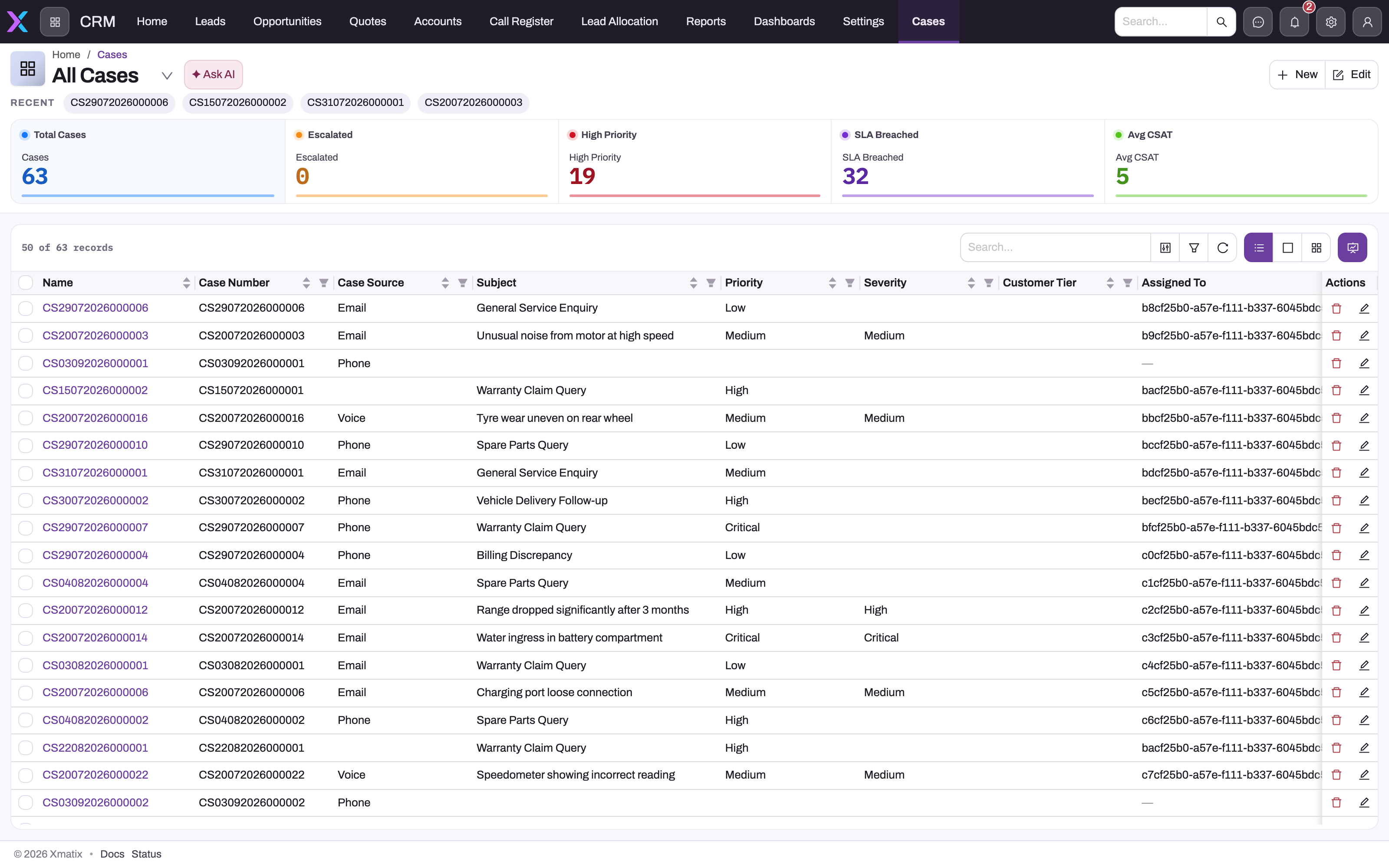
- 1
Total Cases sets the scale of the workload; the Recent row above it reopens the cases you touched last.
- 2
Escalated and High Priority count the cases that need active ownership now.
- 3
SLA Breached and Avg CSAT show whether promises and customer experience are holding together.
- 4
Register columns separate where the case came from (Case Source), the problem (Subject), urgency (Priority) and impact (Severity); Customer Tier adds commercial context.
- 5
Search, column filters, refresh and view switches narrow triage without changing any record.
- 6
New opens the case form; Edit switches the list to inline editing.
The Cases workspace joins management signals to the work register. Total workload establishes scale; escalated and high-priority indicators expose cases demanding stronger attention; SLA-breach and customer-satisfaction indicators show whether speed and experience are holding together.
The register columns make that move concrete. Case identity and source explain where work came from, subject supplies the immediate problem statement, priority and severity separate urgency from impact, customer tier adds commercial context and assignee establishes present responsibility. Use filters to turn a KPI into a review population—for example breached cases by assignee or high-severity cases by tier—then open the record and read its timeline before intervening. The dashboard tells you where to look; the case record provides the evidence for what to do.
Cases are opened from the Cases entry of the app that hosts your support desk (the CRM app in the demonstration tenant) or through the App Launcher search. Everything on a case is an action you run on the record — Escalate, Route, Merge, Run Macro, Email Article — so what your profile lets you do is governed the same way as everywhere else in xMatix.
What this section covers
The pages are ordered so that each builds on the ones before it:
- The case lifecycle — the seeded operational states, what key transitions require and stamp, record owner versus working owner, and what happens the moment a case is created.
- SLA policies and milestones — how a policy picks a case, the first-response and resolution clocks, business hours and holidays, pausing and resuming, and how breaches surface.
- Queues and omni-channel routing — how the routing service selects an agent by capacity, presence and optional skill; and what accept, decline, transfer and reassign do to Resource Work records.
- Author and share knowledge articles — write, classify and publish articles, surface them on a case, and email one to the customer.
- Build and run macros — ordered steps that update fields, add notes, send email or call a case action, run against a record in one click.
- Collaborating on cases — following, team members, private side conversations, merging duplicates, and how duplicate detection works.
- Escalating a case — what the Escalate action changes, and how SLA breaches escalate cases automatically.
- Support configuration reference — for administrators: queues and agent pools, skills, SLA policies, business hours and holidays, duplicate-detection rules.
- Troubleshooting the support desk — what to check when a case won't route or an SLA clock surprises you.
How the pieces connect
A case arrives and three things happen in the same save: it gets a number and opening timestamps, the best-matching SLA policy attaches and starts its milestone clocks, and an acknowledgement activity is recorded. When a contact email exists, dispatch is attempted asynchronously after the save; the activity's Sent status records that intent, not independently confirmed delivery. From there, routing can offer the case to an available, in-capacity agent — ownership transfers when the agent accepts. Resolving requires a resolution summary; closing requires a close reason.