
This guide is for the accountant. In xMatix, most entries post themselves — invoices, bills, receipts, payroll runs and stock movements all write the ledger when their posting action runs — so your day is what's left: the manual journals, the payments to apply, the bank to reconcile, the statements to read, and at month-end, the close.
Where you work
The first-party Finance app carries the documents and the finance-only screens on one bar: Invoices, Bills, Expenses, Payments, Journals, Adjustments (credit and debit notes), Banking (bank transfers, statements, cheque transactions and registers), Chart of Accounts and the Statements screens, plus Reports and Dashboards. Bank reconciliation has its own Banking app entry, and the masters that decide how things post — accounting books, fiscal periods, valuation policies — sit in the Finance Setup list. Documents that originate elsewhere are read in their own apps and reflected here: a supplier bill is raised in Procurement, a payroll run posts its accrual journal from the Payroll app, a customer invoice is generated from a sales order, and stock movements post from Inventory and Warehouse — each leaves a journal you can open from the Journals register.
- 1
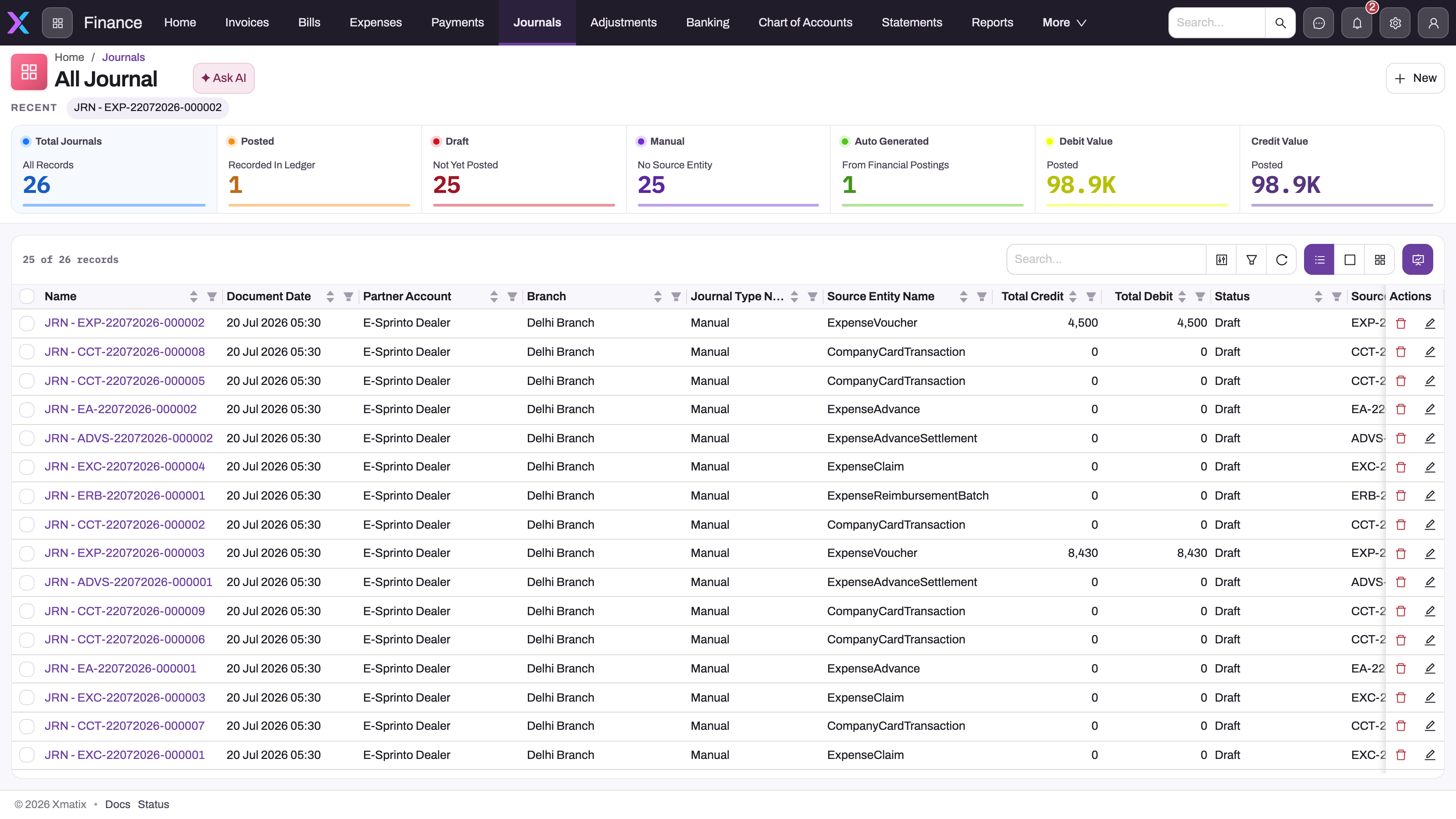
The Finance bar carries the documents and the finance-only areas — Invoices, Bills, Expenses, Payments, Journals, Adjustments, Banking, Chart of Accounts, Statements.
- 2
All Journal is the active saved view of the Journal entity; open an existing journal from here before drafting a possible duplicate.
- 3
The cards split the register by posting state and provenance — Posted versus Draft, Manual versus Auto Generated — and total the posted debit and credit values.
- 4
Journal Type Name and Source Entity Name together establish provenance: a Manual type with a source entity such as ExpenseVoucher is a document-generated draft, not a hand-keyed entry.
- 5
Total Credit, Total Debit and Status are the balancing and posting evidence — Draft journals are not yet in the ledger, and a posted journal is corrected only by a reversal.
- 6
Search, column filters and refresh narrow the review by period, partner account or source without changing any posting state.
The All Journal view is your evidence register. The cards split it by posting state and provenance — posted against draft, manual against auto-generated — and total the posted debit and credit values; the columns underneath locate each journal by document date, partner account and branch, and establish where it came from through Journal Type Name and Source Entity Name. Read those two together: Manual is the create-form default and document-generated draft journals can carry it too, so the source entity and narration, not the type, tell you whether a person keyed the entry. Posted journals are immutable; the supported correction is a linked reversal.
Access you need
Finance permissions follow the same profile model as everything else, with posting kept separate from editing: Post, Reverse, Close Period and the document posting actions are entity actions a profile grants individually, so an accountant can be allowed to draft and edit journals without being allowed to post them, and only a controller may close or reopen a period. A working finance profile grants read, create and update on Journal, Journal Line, Payment, Bank Account, Bank Statement and the adjustment documents, read on GL Account, Fiscal Period and Accounting Book, and the posting actions the person is trusted with. No finance profile ships in the seed — the seeded profiles that carry these entities are the administrative ones — so your administrator builds it; Finance is licensed as its own product. A closed or locked fiscal period refuses postings regardless of permission, which is the point of the close. If a screen or button is missing, start with Troubleshooting: a user can't see something.
Your path
- xMatix Finance & Accounting — the product overview; the mental model of journals, document-specific posting and statements read from the posted ledger.
- Chart of accounts, books and periods — the structure everything posts into.
- Working with journals — finding an existing journal, the manual entry, balanced lines, posting, reversal and recurring journals.
- AR and AP subledgers — how documents post, open items and settlement, ageing, and reconciling to the control accounts.
- Recording and applying payments — money in and out, matched to what it settles.
- Banking in xMatix Finance — bank accounts, statements, transfers, the cheque register and payment batches.
- Reconciling a bank account — the match workspace and its rule gates.
- Financial statements — trial balance, P&L and balance sheet, on demand from posted balances.
- Closing a period — reconcile, close through the Fiscal Period action, reopen only for an approved correction, lock after sign-off.
- Running payroll and payroll run approval — the accrual journal and payables the payroll cycle leaves behind, and the posting evidence to check.
Day to day
The routine day is exceptions and money: post the journals the automation can't know about, apply the payments that arrived, and keep the subledgers clean — unapplied cash and aged balances are tomorrow's problems arriving early. Supplier bills that failed the three-way match come to you as a question, not a block, so read the match before paying. Bank reconciliation is best done little and often. Month-end, the rhythm changes: check the payroll run actually posted (its posting status and linked journal, not its status alone), run the statements, chase what looks wrong back through the subledgers, then close the period so nothing can rewrite a month you've signed off.
Common questions
A statement figure looks wrong — how do I trace it?
Drill down, don't guess: statements break into account balances, account balances into postings, and customer or supplier lines into the subledger documents behind them. The wrong figure is almost always a real document, findable in a few clicks — and an inventory valuation figure traces the same way through the stock ledger.
Can anyone post into a closed period?
No — that's the point of the close. What the lock covers, who can reopen, and how late adjustments are handled are all in Closing a period; Troubleshooting inventory covers the stock-side refusal when the inventory period is closed.
A journal says Manual but nobody keyed it — is something wrong?
No. Manual is the create-form default and generated draft journals can carry it. Use Source Entity Name, Source Record and the narration to establish provenance, as Working with journals explains.
The bank reconciliation won't balance — what's usually the cause?
Timing, almost always: transactions in the books the bank hasn't cleared, or bank charges nobody recorded. Reconciling a bank account shows how to isolate and clear each difference.
Related topics
- Fixed assets in xMatix — the asset register and running depreciation.
- Budgets and budget control — plans against actuals, and spend control.
- Revenue recognition — when earned revenue differs from billed revenue.
- Interest on overdue payments — charging for late receivables.
- Statutory deductions and challans — the payroll-side payables that reach your books.