
A service order in xMatix is the job card for work on an asset: one document carrying the customer, the asset, the reported complaint, and lines for every part and every unit of labour. Its Status walks Draft → Work To Start → Work In Progress → Work Paused → Work Completed → Delivered (tenants may add an Invoiced step between the last two, as the demo tenant does), and the two kinds of line move through different machinery on the way — parts through inventory fulfilment, labour through time sheets. The status is a roll-up you read and, at the gates, a transition the platform validates; the work itself is recorded on the lines and their child documents.
Read the screen
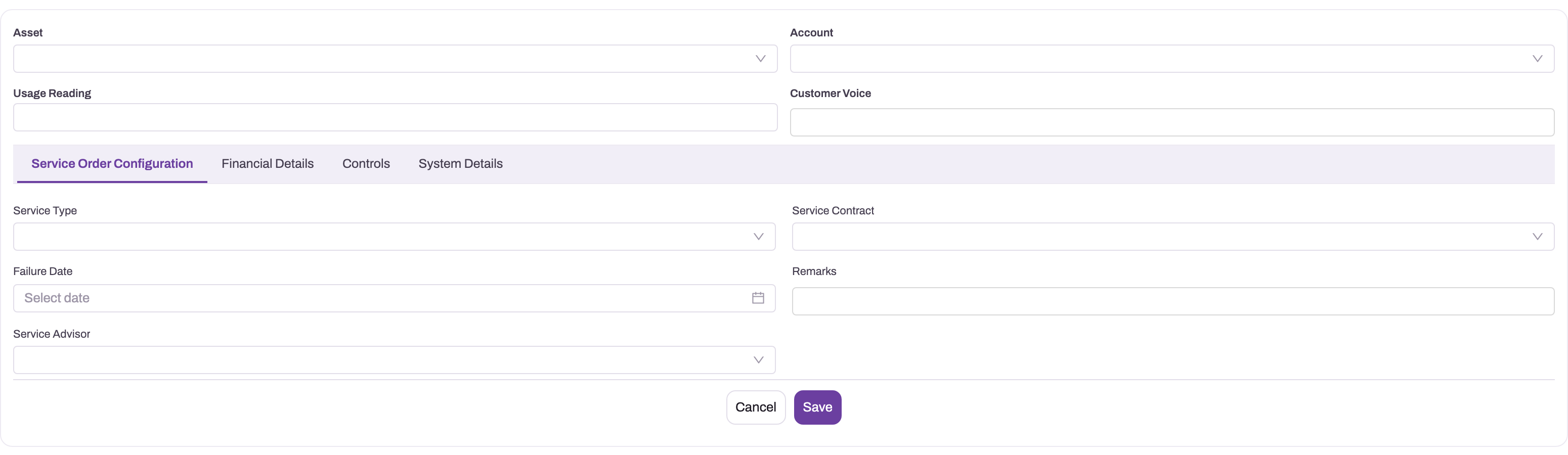
- 1
Asset identifies the unit being serviced; it fills the Account from the asset's owner, supplies the contract and maintenance context, and may have only one open service order at a time.
- 2
Customer Voice preserves the reported symptom in the customer's own words; structured complaint and fault codes go on the Complaints tab later.
- 3
Usage Reading is validated against the asset's last recorded reading on save and again whenever it changes.
- 4
Service Order Configuration, Financial Details, Controls and System Details are the tenant's create tabs; Partner Account and Branch live on System Details and are fixed once saved.
- 5
Service Contract pulls the asset's covered items in as lines and stamps each line's posting type (invoice or claim); Service Advisor owns coordination of the job.
The create form (Service → Service Orders → New) asks for the job's identity first: Asset and Account (picking the asset fills the account from the asset's owner if you left it blank), Usage Reading taken at reception, and Customer Voice — the complaint in the customer's own words. The Service Order Configuration tab holds Service Type, Service Contract, Failure Date, Remarks and Service Advisor; Financial Details holds the Price List, Price As On Date and Discount Group that price the lines; Controls holds Split Invoices and Skip Scheme; and System Details holds Partner Account and Branch. Tab names and grouping come from your tenant's layout and may differ.
- 1
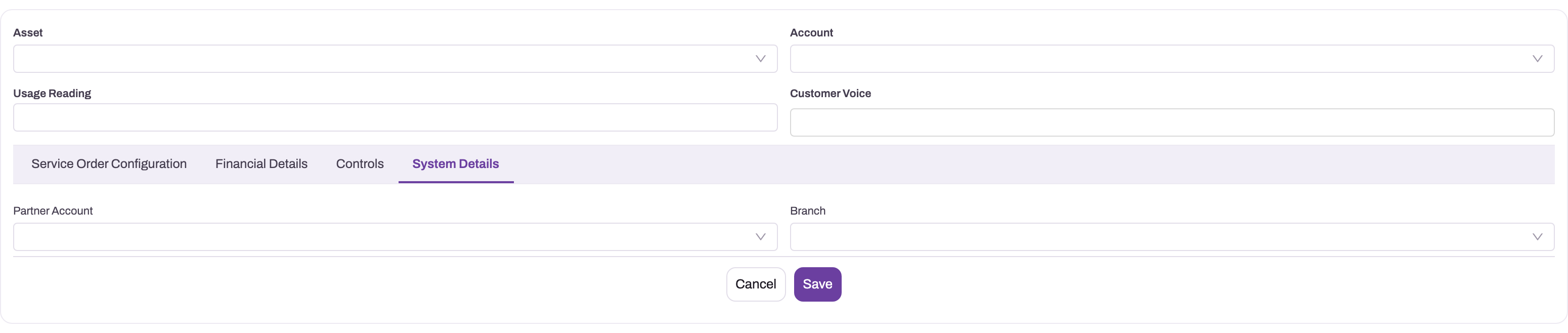
System Details sits last in the tab strip but must be reviewed before saving — the fields on it are key fields.
- 2
Partner Account is the operating company that owns the job's stock, price lists and accounting entries.
- 3
Branch must belong to the partner account; stock availability, VOR purchase orders and allocation all search this branch only.
- 4
Save creates the order in Draft; a wrong partner account or branch afterwards means cancelling and recapturing the order.
Confirm Partner Account and Branch before the first save. They are the operating company and branch that own the job's stock, pricing and accounting, and together with the opportunity link they are key fields that cannot be edited afterwards (Key fields are not editable once the related objects are added). The branch must belong to the partner account (Invalid Branch for Partner Account). A mistake here means cancelling and recapturing the order.
- 1
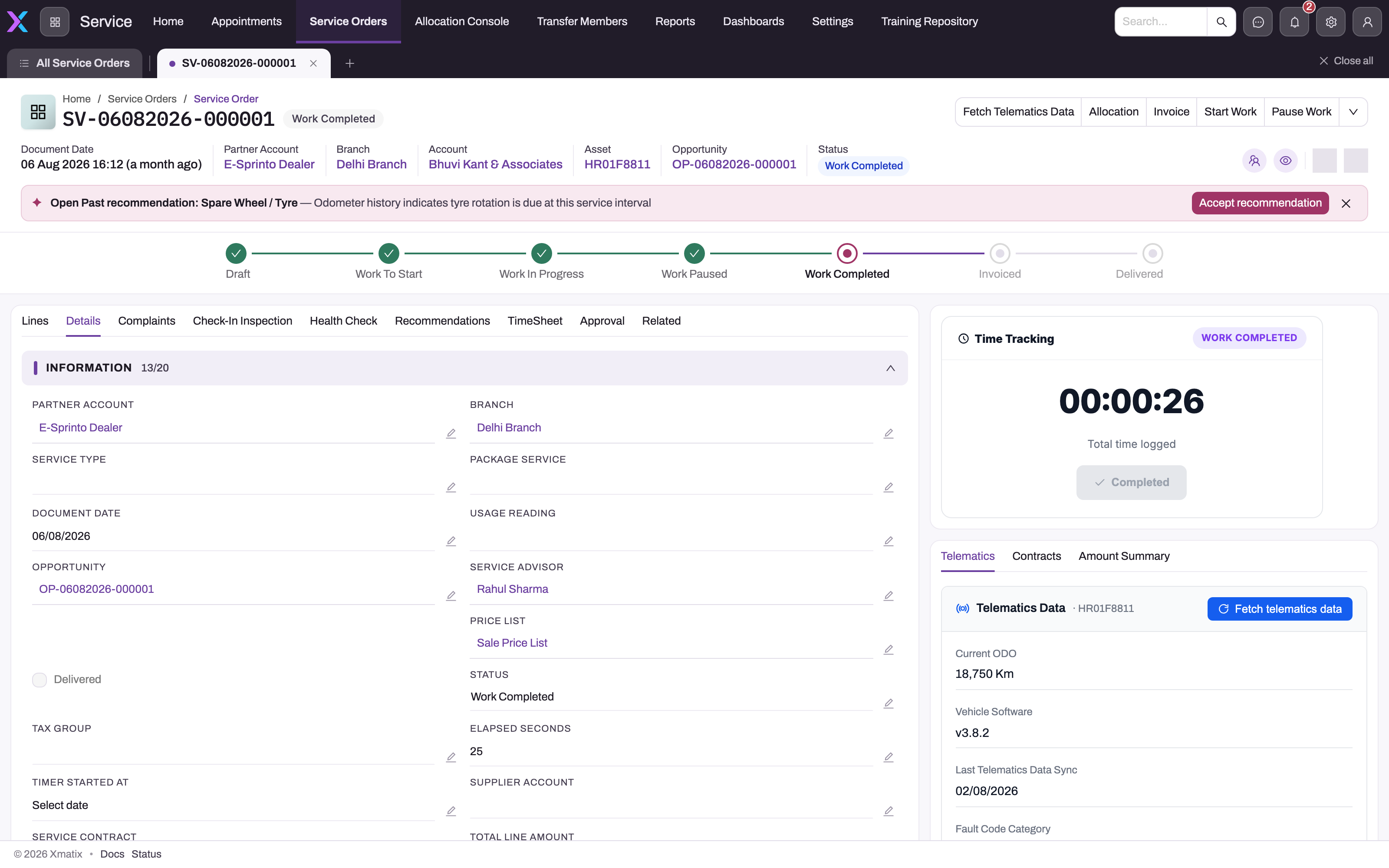
Header actions such as Allocation and Invoice run the lifecycle steps; Invoice is refused until all time sheets have ended and all part lines are allocated.
- 2
The stepper is the Status picklist — Draft, Work To Start, Work In Progress, Work Paused, Work Completed, Invoiced (tenant-added here), Delivered. Work Completed is validated against the Work Item lines.
- 3
An assistant banner can surface open recommendations or stale states above the stepper; the records themselves are on the Recommendations tab.
- 4
Partner Account and Branch on Details are the key fields fixed at creation; Service Type, Package Service, Usage Reading, Service Advisor and Price List explain how the lines were sourced and priced.
- 5
Time Tracking reflects the work flags recomputed from time sheet lines; it is a roll-up, not where work is stamped.
On the saved record the header shows the document number, status badge, document date, partner account, branch, account, asset and any source opportunity; the stepper beneath walks the Status picklist. Lines is the job itself; Details shows the header facts (partner account, branch, service type, package service, document date, usage reading, advisor, price list, status, the Delivered flag); Complaints, Check-In Inspection, Health Check, Recommendations, TimeSheet, Approval and Related hold the surrounding records. The Time Tracking panel on the right reflects the labour roll-up from the time sheets, and the assistant may surface open recommendations or stale states as a banner above the stepper. Read the job in two tracks: part lines through fulfilment, allocation, picking and inventory posting; Work Item lines through time sheets. The status is a gate and a roll-up, not a substitute for line evidence.
Where service orders come from
| Source | What happens |
|---|---|
| Manual entry | Create the order in the Service app; picking the asset fills the account from the asset's owner (an account you chose yourself is kept) |
| A service estimate | Accepting the estimate generates the order and copies its lines — quantities, prices, durations, contract links; the copy is repeated (without duplicates) if the estimate link changes |
| A service opportunity | Generating the order from the opportunity copies its lines, including campaign-mandated items |
| A service contract | Choosing the asset and a Service Contract on a fresh order pulls in one line per covered item with pending entitlement on the asset's contract |
| Asset maintenance | Due maintenance items on the asset are added as lines on a fresh order that has no opportunity |
| A case, lead or appointment | Generate Service Order on those records creates a linked order |
| A field visit | An order raised during a visit is linked back to that visit (one order per visit) |
| An inspection | An order raised from an inspection line marks that line closed when the order is delivered |
Only one source populates lines: an estimate wins over an opportunity, and an opportunity wins over the contract. An asset can have only one open (not yet delivered) service order at a time — a second is refused with An open service order already exists against this asset — {number}.
Header and lines
The header carries the account, asset, partner account, branch, service advisor and technician, the Service Type, usage readings taken at reception, and the customer's complaint. Usage readings are validated against the asset whenever they are entered or changed — Usage Reading cannot be less than the last recorded reading (n) — and, where a contract is attached, against the contract's usage band. Changing the Service Contract on an existing order swaps the contract-sourced lines, but only while no time sheet has started work and no part has been allocated (Item Service Contract can only be changed while no time sheet has started work and no part has been allocated).
Each line names an item, quantity, price and taxes. Pricing works as in sales — price list rules, discount groups, header taxes — and three header behaviours cascade: a header Discount is copied to every line, changing Price As On Date reprices all lines from the rules, and the Reprice action does the same on demand (it also re-derives hourly labour quantities and cost-plus prices; lines already invoiced or claimed are left alone). Two line fields decide the money flow: Invoice Group (Parts or Service) splits invoicing and claims into one document per group, and Posting Type — Generate Invoices, Generate Claims or Auto Generate Claims, normally stamped from the line's service contract — decides whether the line bills the customer or becomes a claim. The header's Skip Scheme switch bypasses trade-scheme evaluation for the whole document. Split Invoices is stored but read by nothing in the platform; use the lines' Invoice Group to split billing.
Parts and labour move differently
The item's type is the fork:
- Part lines flow through inventory: Release For Fulfilment (or Selective Fulfilment) sends pending quantities of inventory-tracked items to the warehouse as a fulfilment document, then Allocation reserves stock and Picking creates the pick, with selective and cancel variants for line-level control — the same machinery as sales orders. Post Inventory writes lines that have not yet been posted to the inventory ledger. A part with no available stock at the order's branch and partner account can be sourced with Generate VOR PO, which raises one purchase order (type VOR PO) for exactly the part lines that are short and not already covered by a purchase order, for the outstanding quantity only, linking each line to its purchase order line.
- Work Item lines are labour: Create Time Sheet puts them on a time sheet, where start, pause and end are stamped per line. Part lines are never placed on a time sheet, and a work item line that already has a sheet is not offered again (No service order line is pending time sheet creation).
The order's work flags — Work Started, Is Work Paused, Work Ended, Is Time Sheet Generated — are recomputed from the time sheet lines after every stage action: each is true only when every open Work Item line has reached that stage, and they move in both directions when a line is restarted.
Status and the Work Completed gate
Nothing in the platform writes the status for you: the shipped code stamps the work flags, and a tenant business rule (typically Set Service Order Status To Work Completed) or the user moves the status. Two validations guard it:
- Work Completed is refused while any non-cancelled Work Item line has not had its work ended — a line with no time sheet counts as unfinished. The message is Service order cannot be marked as Work Completed until all work item lines have work ended. {n} work item line(s) have not ended, {m} of which have no time sheet yet. The same check runs when the Work Ended flag is set directly. Part lines are deliberately not part of this gate; their allocation is checked at invoicing instead.
- Any status change is blocked while a subcontract purchase order raised from the order has not been checked in: Subcontracted work has not been checked in yet ({references}). Mark check-in on the subcontract purchase order before changing the service order status.
Reaching Work Completed or Delivered also releases the service bay the order occupied.
Invoicing and delivery
Invoice (and Selective Invoice) needs three things: pending invoice quantity on at least one line, every time sheet at Work Ended (Invoice cannot be generated until all time sheets have work ended), and every part line fully allocated (Invoice cannot be generated until all part lines are allocated. {q} quantity is still pending allocation). It then raises one invoice per invoice group and contract for Generate Invoices lines, raises warranty claims immediately for Auto Generate Claims lines, leaves Generate Claims lines for the claim batch, marks every line invoiced, and writes the asset's service history — last service date, branch and partner, and the usage readings — at that moment. See Estimates and invoicing.
Mark Delivered sets the Delivered flag, which marks the asset's pre-delivery inspection done and closes the inspection line the order came from; moving the status to Delivered additionally marks the campaign maintenance items on the lines as executed so they are not raised again. Delivery is the end of the lifecycle; the service history itself was written when the invoice was generated.
Common questions
Can different lines be at different stages?
Yes. Fulfilment, allocation, picking and invoicing each track pending quantities per line and each has a selective variant, so one part can be allocated while another waits for a VOR purchase order and the labour is still running on a time sheet. Invoicing is the point where everything must line up: all labour ended, all parts allocated.
What is the difference between invoicing and inventory posting?
Invoicing is commercial — it turns pending line quantities into invoice or claim documents and updates the asset. Inventory posting is physical — it writes the parts consumed by the job into the inventory ledger. They are separate actions because a workshop often consumes parts before the customer is billed.
Why is the order refused when I set Work Completed?
At least one non-cancelled Work Item line has not had its work ended; the message tells you how many, and how many have no time sheet at all. Create the missing time sheet, end the work, and set the status again. Pending part allocation does not trigger this validation — it blocks invoicing instead. See Troubleshooting.
Can I change the branch, partner account or opportunity after creating the order?
No — all three are key fields fixed at creation. Cancel the order and recapture it at the correct operating unit.
Why does the form show two fields called Executive in some tenants?
The service advisor and technician lookups share the label Executive in the shipped field metadata; layouts usually relabel them (the demo form shows Service Advisor). If yours does not, the first is the advisor who owns coordination and the second the technician who does the work.