
A knowledge article in xMatix is titled, categorized help content with a publish lifecycle — Draft → Published → Archived — and a visibility classification of Internal or Public. Published articles normally surface on cases through the knowledge panel, which suggests articles relevant to the case's content. Articles store view, helpful, not-helpful and deflection counters, but the current case panel updates only votes and explicit resolution deflections; opening or previewing an article does not automatically increment Views.
Prerequisites
- Permission to create and edit Knowledge Article records (they live in the CRM app; ask your administrator if the list is missing for you — this triage applies).
- To email from the case panel: the Email Article action on the case layout and a case contact email. Integrations calling the underlying server action may instead supply an explicit recipient.
Procedure
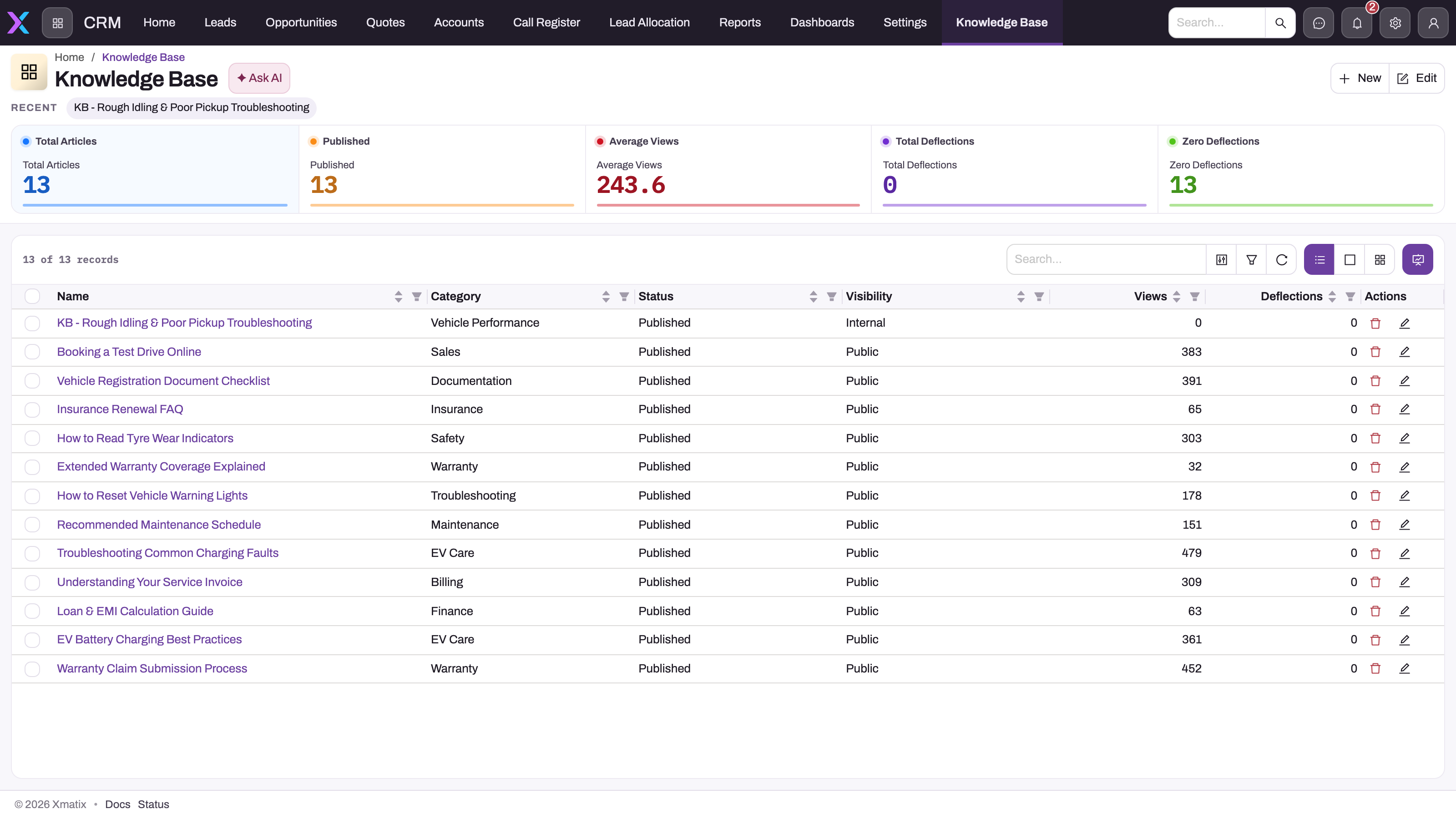
- 1
New opens a blank article: the name is the searchable title, then summary, body, category, keywords and visibility.
- 2
Total Articles counts every lifecycle stage; only Published ones surface in the case knowledge panel.
- 3
Average Views is a stored counter; the case panel's preview does not increment it, so treat it as imported or externally collected data.
- 4
Total and Zero Deflections show how many articles have ever been marked This resolved the case from the panel.
- 5
Category, Status and Visibility (Internal or Public) are the classification an author sets; sort or filter here to find drafts and internal-only content.
- 6
Views and Deflections per article; sort by either to find popular or ineffective answers.
Use the Knowledge Base as both an authoring queue and a quality dashboard. The article list exposes lifecycle and visibility beside views and deflections, while the summary cards show whether the collection is being published and used.
Step 1 — Create the article
Open Knowledge Base from the navigation of the app that hosts your support desk (or search for Knowledge Article in the App Launcher) and select New. The name is the article's title — write it the way a searcher would phrase the problem. Add a short summary (what the reader gets, in a sentence or two) and the full body. Summary and body are exactly what the customer receives when the article is emailed, so write both to stand on their own.
Step 2 — Classify it
Set the category (the subject area — for example troubleshooting, how-to, policy or FAQ, per your tenant's list), the visibility — Internal for agent-oriented content, Public for content reviewed as suitable to share — and keywords: the words agents and customers actually use for this problem. The panel's relevance check uses token overlap between the case's subject, label, name, description and category and the article's title, summary, keywords and category.
Step 3 — Publish
Set the status to Published and save. The panel requests Published articles first (sorted by view count); only if that filtered request fails does it fall back to the broader article list. When an article goes stale, set it to Archived rather than deleting it so its record and counters remain. Treat visibility as editorial classification: the current email service does not independently enforce Published status or Public visibility, so permissions and operating procedure must prevent unsuitable content from being sent.
Step 4 — Use it on a case
On a case whose layout includes the knowledge panel, the panel proposes published articles that match the case's content, with search across the rest of the base. From the panel an agent can preview an article inline, attach a rendered copy to the case as a file, mark it helpful or not helpful, or mark This resolved the case. Helpful and not-helpful actions increment their counters; the resolved action increments Deflections and records a case activity. Preview does not update Views in the current implementation.
Step 5 — Email an article from the case
Run Email Article on the case (or use the email button on the panel's article entry). The case-panel path resolves the recipient from the case's contact email; the underlying server action also supports an explicit to argument when another action surface exposes it. The customer receives the article's title as the subject with the summary and body as the message. If no recipient can be resolved, the panel can fall back to the browser's mail composer when an address exists; otherwise sending cannot proceed.
Expected result
The saved article has a search-oriented title, a summary that explains its value without opening it, a complete body, meaningful category and keywords, and the intended visibility classification. Once Published, it becomes eligible for normal matching in the case knowledge panel. Votes and an explicit This resolved the case decision update useful counters; attaching or previewing does not imply that Views or Deflections changed. If the article does not surface, verify status and overlapping terminology before duplicating it.
Common problems
- The article doesn't appear in the panel. It isn't Published, or its title, summary and keywords share no words with the case. Fix the status first, then the keywords.
- Email Article fails with "no recipient". The case-panel path found no contact email. Add the correct address to the case, or have an integration call the server action with an explicit recipient.
- The panel itself is missing. It is a layout component — your case layout doesn't include it. An administrator can add it; the Email Article action works regardless.
Common questions
What does Public visibility actually do?
It classifies the article as reviewed for customer sharing, separating it from agent-oriented content such as workaround notes or policy internals. It is not an access-control check in the current article-email service; permissions and review procedure still protect internal content.
What is the deflection count?
A per-article counter incremented when an agent explicitly chooses This resolved the case in the knowledge panel. Helpful and not-helpful votes have their own counters. Treat Views as stored data whose collection path must be verified separately, because panel preview does not increment it today.
Can I write an article while resolving the case that taught me the answer?
Yes — articles are ordinary records, so nothing stops you drafting one mid-case and publishing when it's polished. The discipline that pays: any resolution summary you found yourself writing twice belongs in the knowledge base.