
Read Sense on a narrow screen
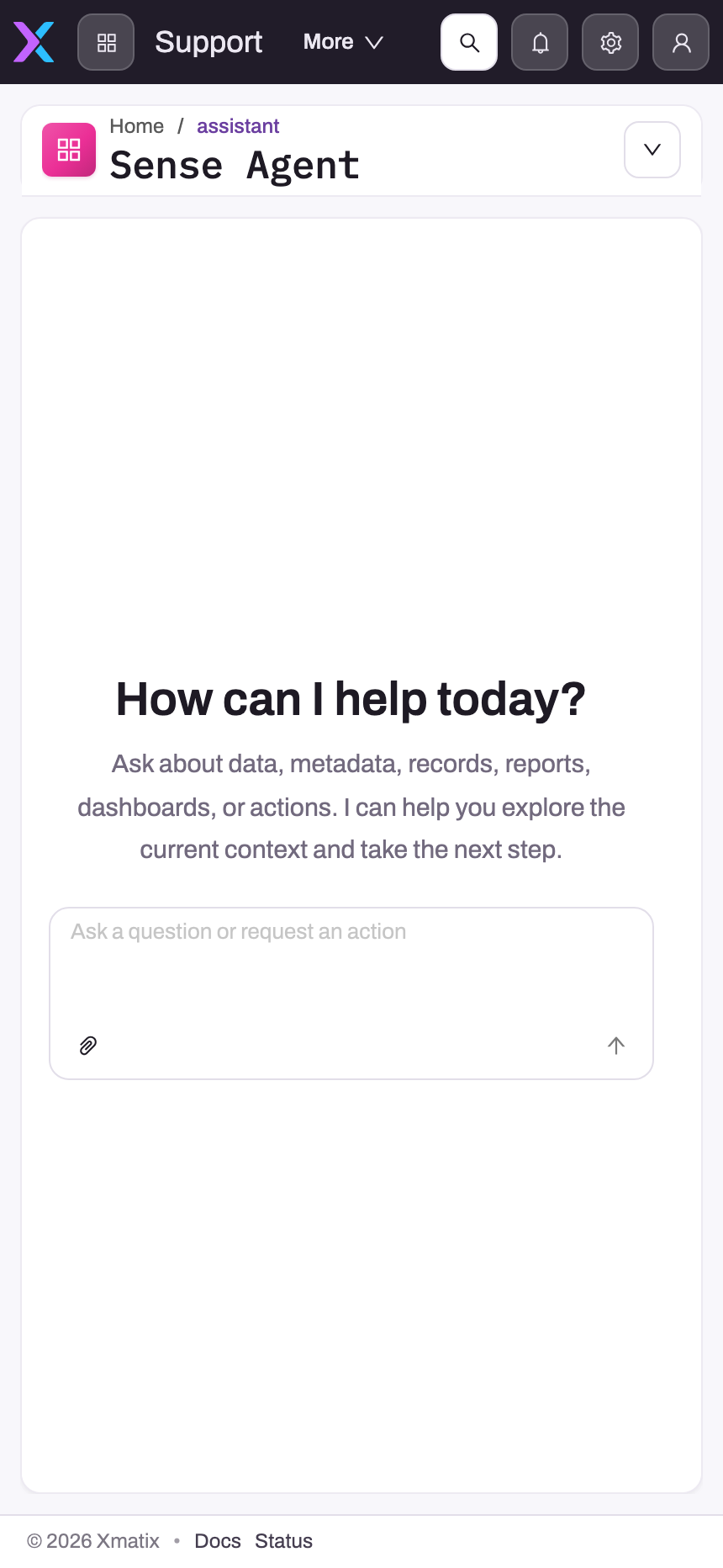
- 1
The app switcher and active-app label preserve the business workspace around the assistant on mobile.
- 2
More contains app navigation that does not fit the narrow top bar.
- 3
Sense Agent confirms the assistant context; the adjacent menu provides page-level session actions.
- 4
The empty conversation canvas avoids exposing earlier prompts, responses or attachments.
- 5
The composer submits the prompt; any later approval card depends on the deployment's runtime policy.
The mobile-width Sense Agent preserves the same conversation model as the desktop page: the active app and compact More navigation remain available, the breadcrumb confirms the assistant context, the conversation occupies the central card, and the composer accepts text or an attachment. The arrow sends the current prompt; whether a later tool call pauses for approval depends on the deployment's human-approval configuration and approval-required tool list.
The screenshot intentionally shows a new, empty conversation. It documents the real controls without exposing earlier prompts, responses or attachments. Start with the business subject, time range and outcome you want, then refine only after reading what evidence the answer cites. If an answer appears incomplete, check the routed agent, its effective execution identity, its tools and the underlying records before repeatedly rephrasing. Mobile chat requires connectivity even when surrounding record screens can work offline, so a stalled assistant and a queued offline record are separate conditions.
The Sense assistant answers questions in plain language — "which invoices are overdue?", "compare this month's orders to last month's", "summarize this customer's history". You open it from the chat button in the top header and ask in your own words. A router can select a specialized agent for the turn, and that agent's configured execution account can become the effective user for data tools. Administrators must therefore treat agent identity as a real security boundary rather than assume the asking user's list access automatically limits every answer.
Know which identity is the boundary
For an interactive turn, the platform resolves the routed agent and then resolves that agent's execution identity. If the agent has an explicit execution account, that account is used for the turn; otherwise the configured fallback identity applies. Routing can therefore change the identity after the conversation starts. Administrators should use dedicated, narrowly scoped execution accounts and test representative prompts against the records those identities can reach. Do not document or operate the system as though the asking user's permissions are always intersected with the agent account unless your deployment adds and verifies that control independently.
What Sense can and cannot do
| Sense can | Sense cannot |
|---|---|
| Answer questions over records the effective agent identity and selected tools can reach — including totals, comparisons and summaries | Prove its data boundary from the empty chat screen alone |
| Search documents your organization has ingested as knowledge, and ground answers in them | Change your organization's configuration — entities, layouts, security and settings are out of its reach |
| Draft reports and dashboards from what you describe | Apply a record change without your explicit confirmation |
| Use tools registered and exposed by the selected agent's effective configuration | Guarantee that every tool call pauses: human approval and the approval-required list are deployment settings |
| Present an approval request when an enabled approval policy covers the proposed tool | Answer well when the relevant records, knowledge or tools are unavailable |
| Explain a nudge — Ask Sense AI on any nudge opens a chat that already has its context |
Behind the chat, your organization may run several specialized agents; a router picks the one suited to your question. You don't choose an agent — you just ask.
Charts, dashboards and reports in the answer
When a question is about a population — totals by customer, orders by month, a comparison of this quarter against last — Sense answers with a chart drawn by the same chart component your dashboards use, and the chart is kept when the conversation is reopened from history. The agent can choose any of the dashboard's grouped chart kinds and more than one series; a period-over-period comparison is computed in one step, and a group that dropped to nothing still appears with a zero. Very large groupings are shown as the top groups plus an Others bar, so the chart is honest about the whole while staying readable, and the answer states how many groups were folded. Drilling into a bar opens the records behind it; drilling into Others does nothing by design.
For a question your organization already answers with a saved report or dashboard, Sense prefers to find and run it rather than reassemble the logic from raw records, so the number you get is the one the business considers official. If the agent does not have the report or dashboard tools granted, it falls back to querying the data directly — administrators grant those tools in AI Studio.
Sense acting on the screen
In the web app, Sense can do more than point at a control. It can open a screen, read the controls on it, press a control and fill a field — as you, in your browser, with your permissions. Each action that changes anything shows a confirmation naming the control before it runs; the default is to ask every time, and you change that from your profile menu. Filling a field never saves: Sense stages the values so you can check them and press save yourself. Changing stored data goes through the record tools and their approval settings, not through the screen. These screen tools are offered only where a browser is present, so the mobile app and external assistants do not see them.
Asking from Claude, ChatGPT or Claude Code
If your administrator has enabled external assistants, you can connect the assistant you already use to your organization and ask the same questions there. The assistant signs you in with your normal xMatix credentials and every call runs as you, inside your permissions; writes are only possible when the organization has allowed them. See Using Sense from Claude, ChatGPT or Claude Code.
The drawer and the full page
The chat button opens a docked drawer, so you can ask without leaving the page. The same assistant is available as a full page for longer investigations. Both surfaces use the same backend agent, identity, tool-gating and approval configuration; a narrower layout does not create a different security model.
Sense on mobile
The assistant is available in the xMatix mobile app as well. Nudges on mobile carry Ask Sense AI, so a suggestion seen in the field can be examined on the spot. Mobile uses the same backend routing and runtime policy as web. Answers are generated live, so chat needs a connection, unlike offline-capable record and list screens around it.
Common questions
Why did a colleague get a different answer to the same question?
First compare the routed agent, effective execution account, audience and enabled tools. Routing can select different agents, and each agent can carry a different execution identity and tool set. Differences in underlying data, knowledge and conversation context can also change the answer. Administrators should inspect run evidence instead of treating different output as proof of asking-user permission differences.
Can Sense change my data?
It can call write-capable tools when the selected agent exposes them. A human approval prompt appears only when human approval is enabled and the tool is in the configured approval-required set. Treat tool grants, execution identity and approval configuration as a combined control: verify them in the target deployment, keep write-capable grants narrow, and test both approved and rejected paths before production use.
Why has the chat button disappeared, or chat stopped answering?
The button appears for every user of the organization as long as the Sense module is switched on — Sense AI is included for every organization, so no seat is needed; see Licensing. Every user has a free daily allowance of 1,000,000 tokens for chat. If turns are refused, you have used today's free allowance and no AI credits are assigned to you: chat resumes at midnight UTC, or immediately once an administrator assigns you credits from the organization's pool under AI Studio → AI Credits.