
The dispatch console is one screen for allocating a day's work to resources. Each console page works over one kind of work record — visit plans, cases, service orders and other entities your administrator configures — and offers up to three views of the same allocation problem: a Board for who-does-what, a Gantt for when, and a Map for where. Everything the console does is deterministic: drags write assignments, drops write schedule times, and Optimize day fills free slots by fixed rules. Nothing is decided by AI, and every placement can be dragged somewhere else.
The three views
| View | What it shows | What dragging does |
|---|---|---|
| Board | An unassigned rail plus one column per resource | Drag an item onto a resource to assign it; drag it back to the rail to unassign |
| Gantt | An intraday hourly timeline, one lane per resource | Drop onto a lane to assign and set the item's date and time from the drop position |
| Map | Live resource positions and travelled paths, plus unassigned items as stops on the map | Selection only — use it to see the day, then assign on the Board or Gantt |
Above the views sit the scope chips (all resources, or narrowed to a partner, branch, chosen resources, a resource group or an account group), a time window for the items (today, week, month or all), and a collapsible summary strip: resources in scope, how many are live now (seen within 15 minutes) and tracking (within 60 minutes), how many are off grid (no signal for 24 hours), today's items with the unassigned count, and the coverage percentage. When the scope holds more items than the console loads at once, an amber banner says so — narrow the scope rather than dispatching from a subset. An alerts ticker along the bottom calls out unassigned items, stale positions and resources with no recent signal.
Prerequisites
- A console page in your app — an administrator places and configures it per work entity (see the configuration reference).
- For the Gantt's scheduling drops, a schedule date-time field configured on the console; without one, drops still reassign but set no time.
- For the Map view, a location field configuration on the work entity — without one the Map view is unavailable. Live positions and travelled paths appear where your organization has enabled location tracking (see Location and the travelled path).
Procedure
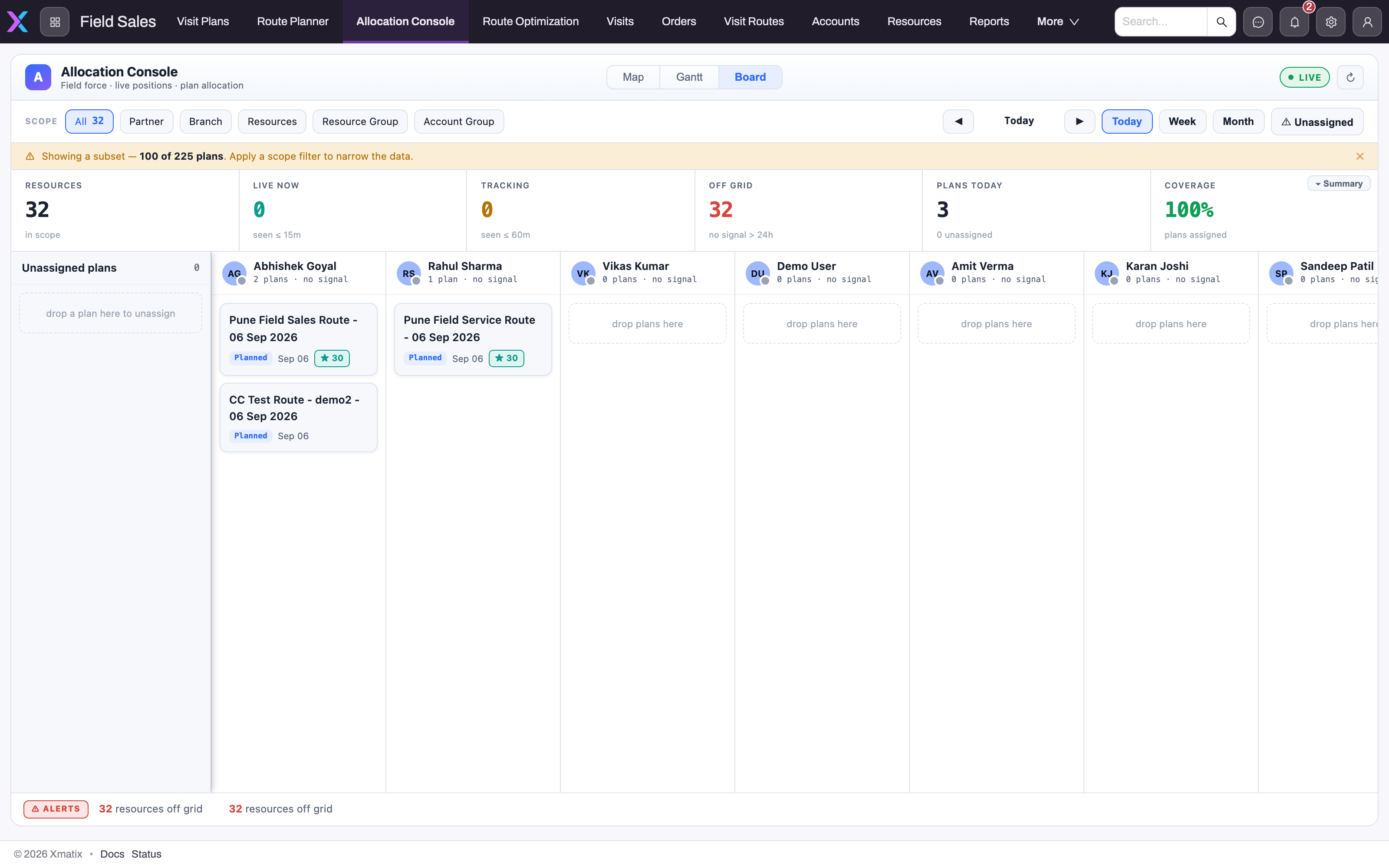
- 1
Map, Gantt and Board are three views of the same scoped work; Board is selected here.
- 2
Scope chips — All, Partner, Branch, Resources, Resource Group, Account Group — decide which resources and plans load; pick your patch before dragging anything.
- 3
Today / Week / Month set the item window; Unassigned jumps straight to the backlog.
- 4
The summary strip: resources in scope, how many were seen in the last 15 or 60 minutes, how many are off grid (no signal for 24 h), today's plans with the unassigned count, and coverage.
- 5
Unassigned plans rail — drag a card here to unassign it; the count is the backlog Optimize day works from.
- 6
A plan card under its resource: status, date and the star badge counting nearby resources within 25 km — a proximity hint, not an instruction. Dragging it writes a real assignment.
Step 1 — Scope the console to your patch
Open the console page, select the correct work date, and pick a scope chip—your branch, a resource group or a hand-picked set of resources. Wait for the summary strip and Board to recalculate, then verify the resource count, backlog and markers match the patch you intend to dispatch. Stop if an unexpected branch or resource appears; every drag writes a real assignment.
Availability markers need careful interpretation. The current resolver treats any leave row whose status is not Rejected or Cancelled as leave; it is not limited to an Approved status. The optimizer's hard exclusions are leave, holiday and week off. Half-day and absent values are not excluded by the same check, and an unrecognised availability value can fall through to present-like handling.
Step 2 — Assign on the Board
Switch to Board, open the unassigned rail and inspect an item's priority, location and required date before moving it. Drag the item onto the intended resource's column and wait until the card settles there; that placement is the visible confirmation that the owner was written. If you moved the wrong item, drag it back to the unassigned rail immediately and confirm its unassigned count increments. A star badge counts resources within 25 km of the item's area based on known location—it is a proximity hint, not an instruction, so availability and skills still require human judgment.
Step 3 — Schedule on the Gantt
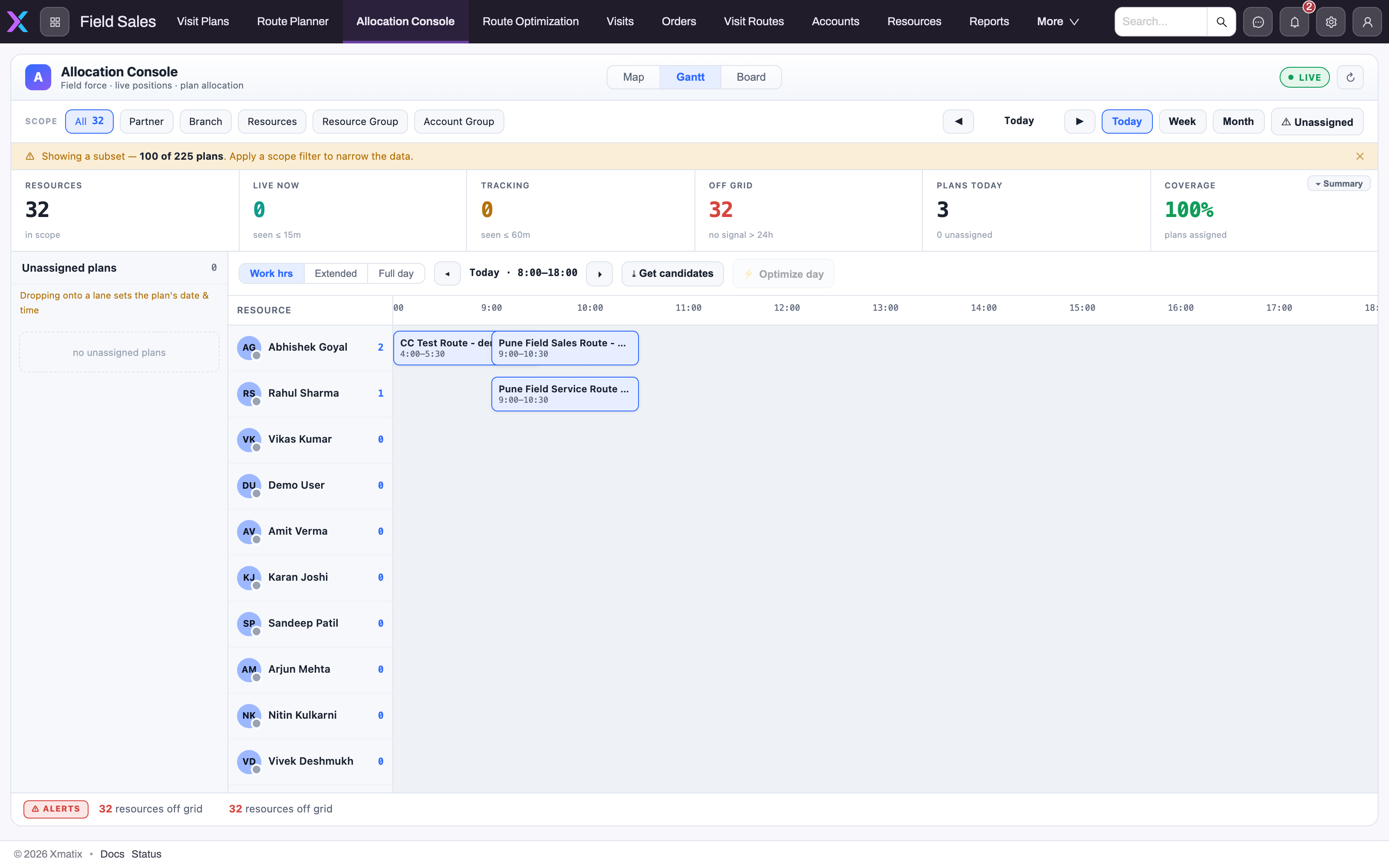
- 1
Gantt is selected; the scope chips, date window and summary strip above are shared with the Board.
- 2
Work hrs, Extended and Full day change the visible window (here 8:00–18:00); the arrows step the day. Optimize day only fills slots inside this window.
- 3
Get candidates suggests the least-loaded available resources; Optimize day places up to 20 backlog items back-to-back into the least-loaded lanes — disabled here because nothing is unassigned.
- 4
Each lane is one resource with its plan count; lanes marked leave, holiday or week off are skipped by Optimize day, Absent and Half Day are not.
- 5
A placed block shows the plan and its time window; its horizontal position is the scheduled start, its width the known duration (a standard block when none is set).
- 6
The rail reminds you that dropping onto a lane sets the plan's date and time — a drop anywhere else only reassigns.
Switch to Gantt, re-check the selected day, and choose the visible window—working hours, an extended day or the full 24 hours. Drop an item onto a resource's lane at the intended start time; the drop position becomes the item's date and time, snapped to 15-minute marks. Verify the card now appears on the correct lane and read its time badge before scheduling the next item. Items whose duration is known stretch across the lane accordingly; items without a duration receive a standard block, so check the underlying record when duration affects travel or capacity.
Step 4 — Fill the backlog with Optimize day
Before using Optimize day, verify the visible time window, scoped resources and unassigned queue; those are the boundaries the operation uses. Get candidates next to it only suggests the least-loaded available resources without assigning. Run Optimize day once and read the result message before clicking again. The fixed rules skip resources classified as leave, holiday or week off, choose a currently least-loaded lane, place work back-to-back after its last block, snap to 15-minute marks, place at most 20 items per run, and stop when the visible window is full. Absent and Half Day are not currently automatic exclusions, so review those lanes before accepting the result. Confirm placed and remaining counts against the Board, then review skill, travel and business constraints manually.
Step 5 — Watch the day on the Map
Switch to Map and first read the freshness state—live, recent, stale or off grid—before treating a marker as current. Select resources in the left pane to draw their travelled paths for the day, or switch the pane to plans/items to plot unassigned work as stops. Use this geographic check to spot travel conflicts and field gaps, then return to Board or Gantt to make changes because Map selection itself does not assign. Open an item drawer and verify its owner and scheduled time agree with the placement you made.
Expected result
The scoped backlog, owner assignments and schedule agree across Board, Gantt and each item's detail drawer. The summary shows the revised coverage and unassigned counts, while Map supplies location context without changing ownership. Every optimized placement has been reviewed and any unsuitable slot has been corrected by drag-and-drop.
Common problems
If the Map view is missing entirely, the work entity has no location configuration — that is an administrator setting, not a data problem. If dropping on the Gantt reassigns but never sets a time, no schedule field is configured for this console. If Optimize day reports no free slots, the visible window is full for every available lane — widen the window to the extended or full day, or reduce the scope. And if positions are absent or stale, location tracking is either not enabled for your organization or the resources are not currently in a tracked working session.
Common questions
Is Optimize day AI-based dispatch?
No. It is rule-based slot-filling: lower current load first, back-to-back after the lane's last placed block, and capped per run. Its current availability exclusion covers leave, holiday and week off rather than every attendance value. Every placement is an ordinary assignment a dispatcher can review and move; xMatix does not treat the result as an autonomous verdict.
Which kinds of work can the console allocate?
Any work entity your administrator configures a console for — visit plans, cases, service orders, leads and product demos are typical. Each console page shows one entity's records; an organization that dispatches both cases and service orders runs a console page for each.
Does the console hide finished work?
Yes. Items in closed statuses — completed, cancelled, closed, expired, rejected by default, and your administrator can adjust the list per console — are filtered out, so the rails and lanes only ever show work that still needs a decision.