
Read a role-ready workspace
Every role starts with a different set of licensed and permitted workspaces. Open the App Launcher to see the apps and entities available to the current account, then choose the guide that matches the work you actually perform. If a guide names an app or entity that is absent from the launcher, resolve licensing and access with an administrator before trying to follow its procedures.
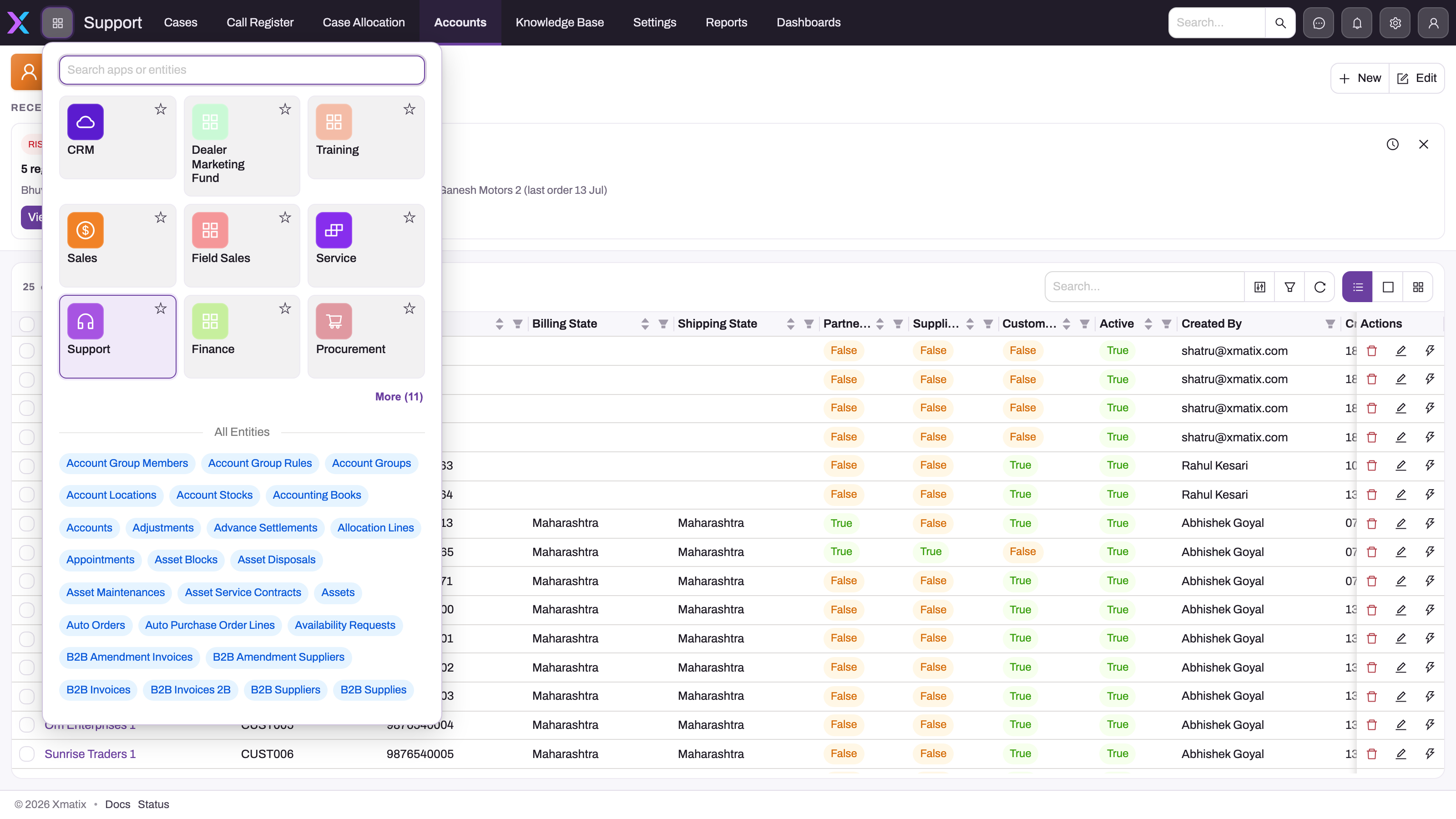
- 1
Open the launcher from the grid button in the global header.
- 2
Search narrows both licensed apps and permitted entities for the current account.
- 3
App cards expose the workspaces available to this role; tenants and users can legitimately see different sets.
- 4
All Entities lists the individual record types the account can open even when they are not pinned in an app.
- 5
The actual Account list behind the launcher shows that choosing an entity leads to its saved-view record register.
The role guides connect those available workspaces to a practical daily sequence and point to the canonical procedure whenever an action requires exact field-level instructions. They do not imply that every tenant or user receives the same apps, records or actions.
Every role sees a different slice of xMatix. These guides are curated learning paths: each one orients a single job role, then links the canonical documentation pages in the order worth reading them. They never repeat what those pages say — they tell you which pages matter for your job, and why.
The guides
- Field sales representative — a mobile-first day of attendance, visits, orders and van sales, on or off the network.
- Sales manager — order oversight, approvals, trade schemes, credit, dashboards and incentives.
- Field service technician — assigned work on mobile, checklists, time sheets and offline recovery.
- Dispatch manager — the dispatch console, routing, availability and supervisor views.
- Warehouse operator — receive, pick, dispatch, count and transfer stock.
- Procurement user — requisition to purchase order to receipt to bill, and the three-way match.
- Finance user — journals, subledgers, banking, statements and period close.
- Support agent — cases, SLAs, macros, knowledge and collaboration.
- Tenant administrator — users, security, licensing, data management and monitoring.
- Developer — the customization deep end: scripts, workflows, expressions and the developer tools.
How to use a guide
Read the opening paragraph to confirm the guide fits your job, then work through Your path in order — each link is a real documentation page, and the one-liner tells you what you'll get from it. The Day to day section shows how those pages fit a normal working day.
Related topics
- Getting started with xMatix — the pre-role basics: signing in, navigation, mobile setup.
- xMatix platform concepts — the ideas underneath every product, worth skimming whatever your role.