
You create a sales order in the Sales app by selecting the customer account, the executive who owns it and the selling company and branch, saving the header, and then adding item lines to the saved order. Matching price-list, discount-group and tax rules fill the commercial defaults on every line; a unit price you type is kept when no rule should apply. Trade schemes marked for automatic application are evaluated as the lines are saved, and the customer's credit position is checked when the header is first saved.
Prerequisites
- Access to the Sales app with create permission on the Order entity, granted through your security profile.
- The customer exists as an account, the executive exists as a resource, and the items you are selling exist as item records.
- A partner account (selling company) with at least one branch; the branch you pick must belong to that partner.
- Price list rules for the items — otherwise you enter unit prices manually (see Pricing, discounts and taxes).
What the create form asks for
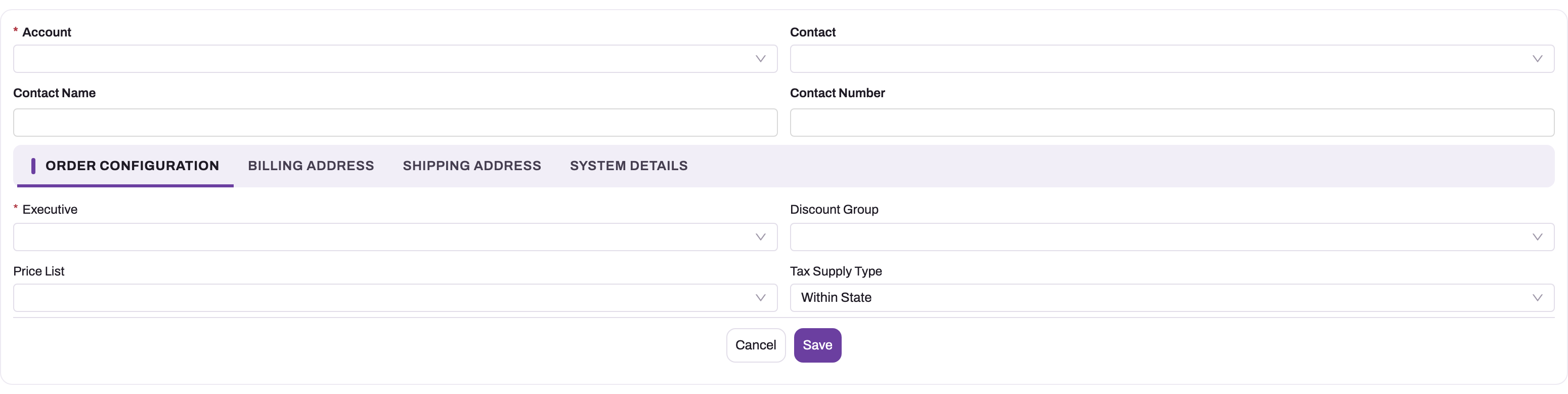
- 1
Account is the customer. It is locked after the first save and pairs with the partner account for the credit-limit check.
- 2
Contact, Contact Name and Contact Number are copied from the account's default contact and can be overridden here.
- 3
Executive is the sales resource who owns the order; the resource service validates it on every save.
- 4
Discount Group and Price List default from the selling company, branch and account groups when active rules exist; blank means no rule matched.
- 5
Tax Supply Type (Within State or Outside State) takes part in matching the tax-group rule for each new line.
- 6
Save creates the Draft header with today's document date; lines are added on the saved order.
The create layout has a short header — Account, Contact, Contact Name, Contact Number — and four tabs. Only Account and Executive are marked mandatory on the form, but the server also rejects a header without a partner account, so treat System Details as required too. There is no document number or document date field: the number is generated on save and the document date is stamped with the current date and time.
| Tab | Fields | What they control |
|---|---|---|
| Order Configuration | Executive, Discount Group, Price List, Tax Supply Type | Ownership, the discount rules and price rules used for every line, and the Within State / Outside State choice that feeds line tax resolution |
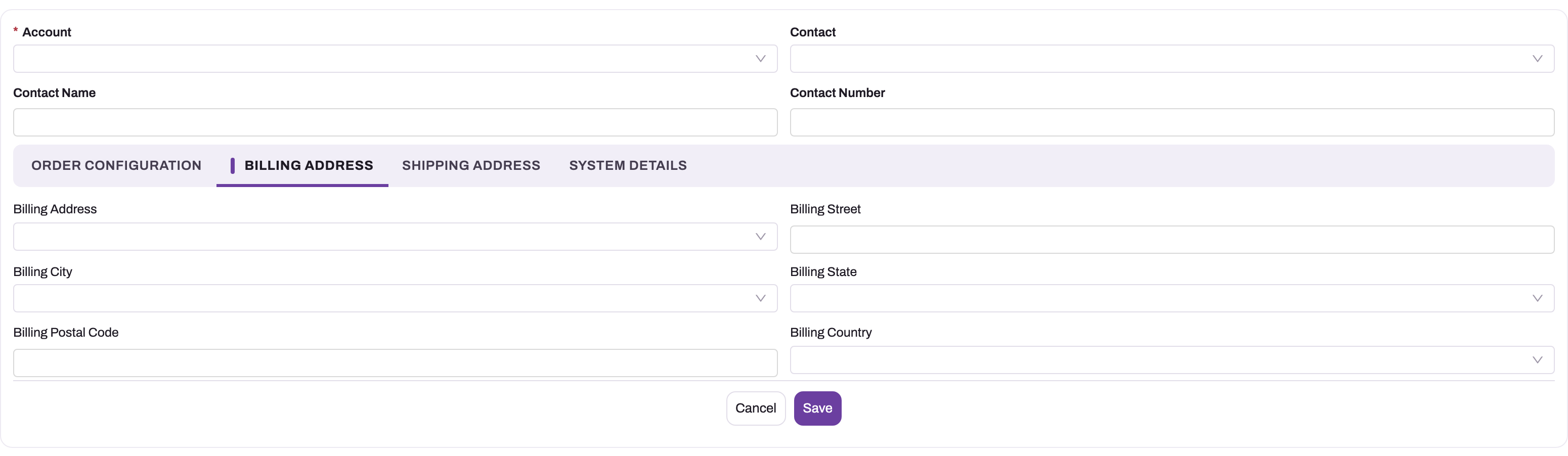
| Billing Address | Billing Address, Street, City, State, Postal Code, Country | The invoicing destination copied to the invoice |
| Shipping Address | Shipping Address, Street, City, State, Postal Code, Country | The delivery destination copied to delivery documents |
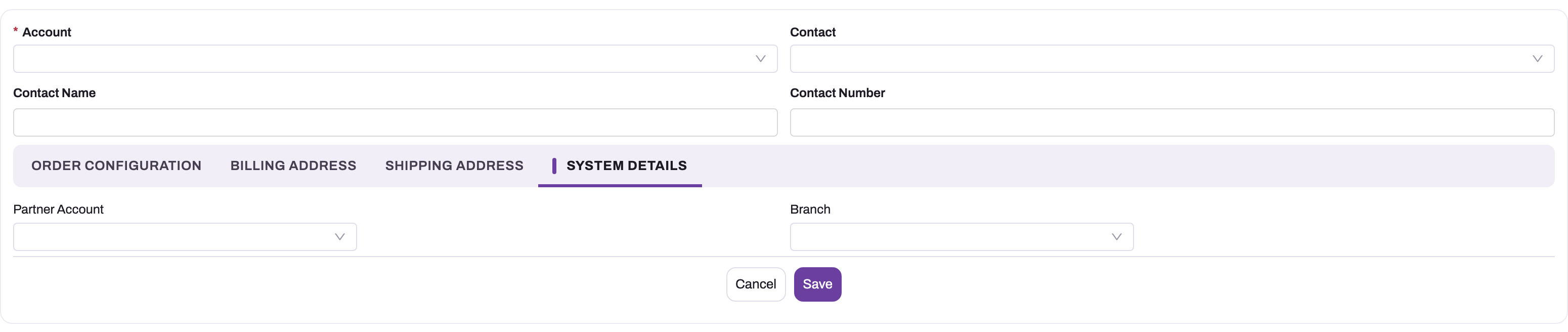
| System Details | Partner Account, Branch | The selling company and the branch it sells from — the pair that scopes stock, credit, numbering and reporting |
Procedure
Step 1 — Start a new order
In the Sales app open Orders and choose New. Select the customer Account first; the contact fields fill from the account's default contact and can be edited. Choose the Executive who owns the order.
Step 2 — Fix the selling scope
Open System Details and set Partner Account (the selling company) and Branch. The branch lookup is filtered to the partner's branches, and saving with a branch that does not belong to the partner, or with no partner at all, fails with an explicit message. Account, branch and document date are locked once the order exists, so a mistake here means cancelling the order and creating a new one.
- 1
System Details is the last tab of the create layout; open it before saving, because the values it holds cannot be changed later.
- 2
Partner Account is the selling company. A blank value is rejected with 'Invalid Partner Account', and it scopes stock, credit and document numbering.
- 3
Branch must belong to the partner account; it fixes inventory, tax, naming and reporting scope for the order.
- 4
Save only when account, commercial context, addresses and selling scope all agree.
Step 3 — Check the commercial context and addresses
On Order Configuration, confirm Price List, Discount Group and Tax Supply Type. When you save, the order resolves an active sale price list and discount group for the selling company, branch and the account's groups if you left them blank; a default that stays empty means no active rule matched, and nothing is invented. The order also copies the account's default billing and shipping addresses and stamps any header-level tax. Review the Billing Address and Shipping Address tabs, particularly for customers with depots or job sites: the shipping address travels onto delivery documents but does not widen stock availability, which stays scoped to the order's partner account and branch.
- 1
Billing Address and Shipping Address are separate tabs; review both, because depots and job sites often differ from the invoicing address.
- 2
Billing Address picks one of the account's saved contact addresses and fills the structured fields from it.
- 3
Billing Street is free text; the remaining fields are structured values that travel onto the invoice.
- 4
Billing City and Billing State are picklists; State matters for the tax supply type chosen on Order Configuration.
- 5
Postal Code and Country complete the destination copied into downstream commercial and regulatory documents.
Step 4 — Save the header
Save. The order is created in Draft with a generated document number and today's document date. At this point the credit-limit check runs: if the customer already has open receivables with this partner account and the order would exceed the configured limit, the save is rejected with a message naming the party, the open amount and the limit. When the Sales module setting credit limit override requires approval is on, the hard block is replaced by whatever approval process your administrator configured.
Step 5 — Add order lines
Open the saved order and add one line per item with its quantity. For each new line the platform resolves, in order: the unit price from the price-list rule in effect for the line's pricing date (a non-zero price you typed is respected instead), the contract discount from a matching discount-group rule, and the tax group from the active tax rules for the tax supply type, company, branch, item, SKU and lot type. Product Catalogue opens a browsable item picker for the order, and packages with configurable components open the Product Configurator. A header Discount percentage entered on the order is pushed down to every line.
Step 6 — Review schemes
Schemes marked Auto Apply are evaluated whenever a line is inserted, changed or deleted and write their discounts or free-item lines automatically; set Skip Scheme on the order to suppress them. For Apply On Selection schemes, use Get Qualified Scheme Slabs to see what the order qualifies for and Apply Scheme to commit one; Get Scheme Recommendations reports near-miss offers and how much more is needed; Reset Scheme removes applied scheme effects. Details in Trade schemes.
Step 7 — Submit or move on
Where your organization has configured an approval process for orders, submit the order for approval. Otherwise the order is ready for Fulfilment, Auto Allocation or direct invoicing — see Allocating stock to orders and the order lifecycle.
Expected result
The saved order carries the intended account, executive, partner account, branch, addresses and a generated document number; Total Amount equals the sum of the lines' gross amounts, Total Discount Amount the ordinary line discounts and Total Scheme Amount the promotion discounts. Each line holds item, quantity, unit price, discounts, tax and the pending fulfilment, invoice and delivery counters that later actions consume. Saving does not create an approval record unless an approval process is configured.
Common problems
- A line's unit price stays empty: no price-list rule is in effect for that item on the order's pricing date. Check the rule's effective dates and the price list the order carries, or type the price.
- Save fails with a credit-limit message: the customer's open receivables with this partner account already exceed the limit. See Credit limits.
- "Invalid Partner Account" or a branch error: System Details is blank or the branch belongs to another company.
- Wrong account, branch or document date after saving: these fields cannot be edited. Cancel the order and create a new one.
- A quantity change is rejected with "Transacted quantity cannot be reduced": part of the line has already been fulfilled, cancelled or returned. Use Cancel on the untransacted remainder instead.
Common questions
Can an order be created from a quote, opportunity or lead?
Yes. The Order action on a quote creates the order and copies the quote's lines (item, quantity, prices, discounts, tax group, SKU and lot type), so do not add them again by hand. The same action on an opportunity or lead creates the header and links the records; a quote or opportunity that already generated an order will not generate a second one. Orders captured on field-sales visits are ordinary sales orders linked back to the visit.
Do I have to enter prices at all?
Only when no price-list rule covers the item. A non-zero price you type while adding a line is respected and not overwritten. Later, the Reprice action or a change to the order's Price As On Date re-applies price-list prices to all lines; Reprice refuses to run on an order with no lines.
Why is the document date not on the form?
It is stamped with the current date and time when the header is saved and then locked. Imports and integrations may supply an earlier date on insert, but a future date is never accepted.