
xMatix Sales is the order-to-cash module of xMatix: it takes a sales order from capture through stock allocation, picking and delivery to invoicing and payment, with pricing driven by price lists and discount groups, ordering gated by customer credit limits, promotions applied by the trade scheme engine, and partner payouts handled as trade claims. This page maps the module and links every topic in this section.
Read the workspace
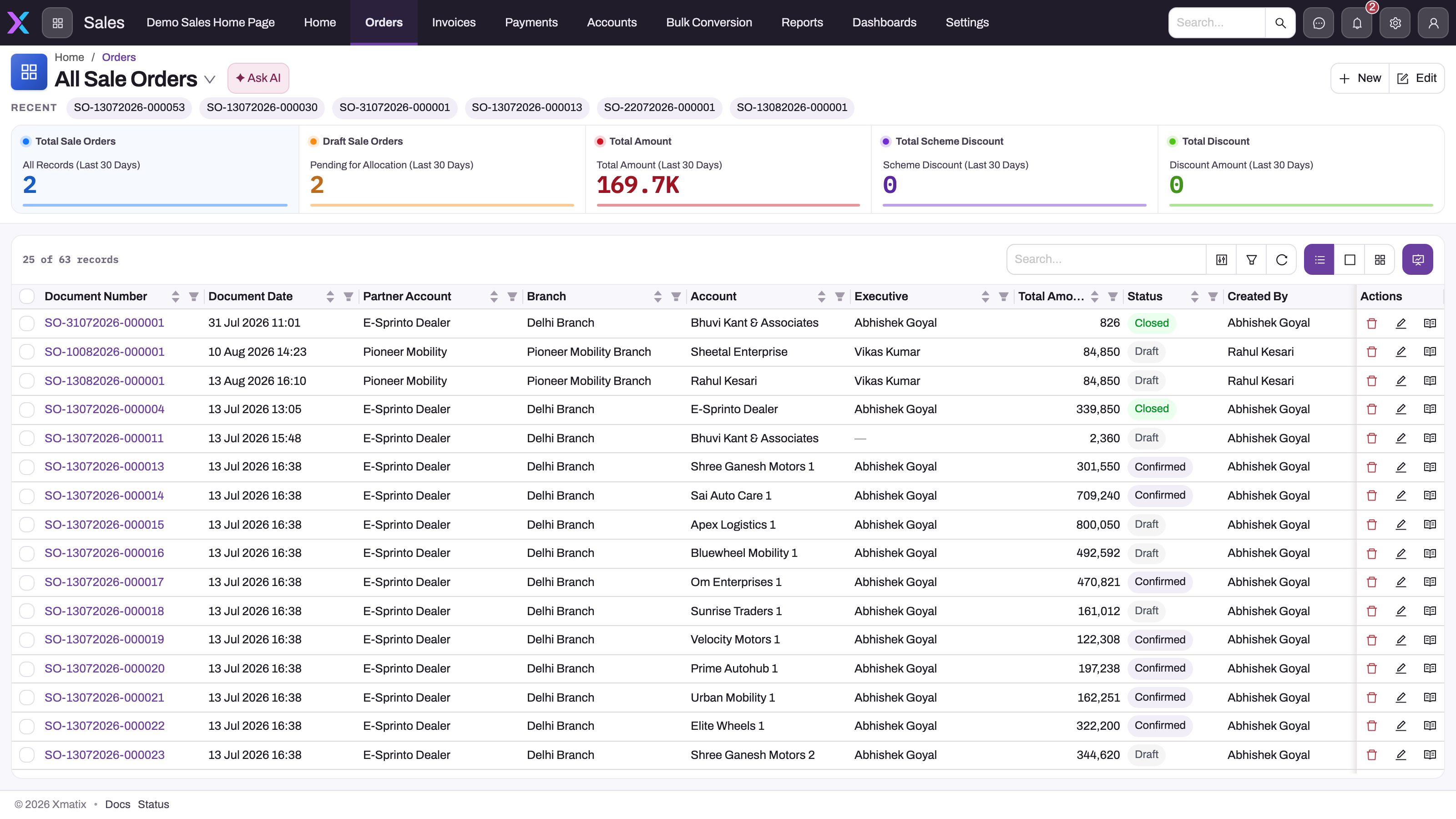
- 1
The view switcher changes which saved list you are looking at; All Sale Orders is the unfiltered register.
- 2
Total and Draft Sale Orders count captured demand against orders not yet allocated or confirmed (last 30 days).
- 3
Total Amount is the commercial control total for the same 30-day window.
- 4
Scheme Discount and Total Discount separate promotion cost from ordinary price concessions.
- 5
Document Date, Partner Account, Branch, Account and Executive establish who sold what, where and to whom.
- 6
Total Amount and Status connect each order's value to its position in the lifecycle.
The Orders entry of the Sales app is the module's working register. Summary cards across the top report the last 30 days: total and draft sales orders show captured versus uncommitted demand, total amount shows value, and scheme discount versus total discount separates promotion cost from all other price concessions. The rows are sample business data, so you can follow the same customer, branch, amount and status from a card into an order.
Use the register to explain those summaries. Document date, partner account (the selling company), branch, customer account and executive establish scope and ownership; total amount and status connect value to lifecycle. Filter a management question down to a concrete population, then open the source order to inspect lines, pricing, credit, tax, allocation and fulfilment evidence before intervening. The view switcher next to the list title changes which saved list you are looking at; All Sale Orders is the unfiltered register.
The Sales app
The Sales app appears in your app launcher when your administrator has granted it. Apps and their entries are metadata, so your tenant may differ, but the first-party Sales app is built around these entries:
| Entry | What it holds |
|---|---|
| Home | Landing page with summary cards |
| Orders | Sales orders and their lifecycle actions |
| Invoices | Sales invoices, printing, e-invoice and e-way bill actions |
| Payments | Payments recorded against orders and invoices |
| Accounts | Customer accounts |
| Bulk Conversion (or Order Processing) | The screen that invoices many orders at once |
| Reports, Dashboards | Sales reporting |
| Settings | The module's masters (below) |
The Settings entry opens the Sales setup list, which holds the masters the module runs on: Account, Account Group, Item, Item Group, Price List, Tax Group, Discount Group and Branch. Orders, invoices and payments reference these, so set them up first. Credit Limit records live under the Field Sales setup list, and trade Scheme records under the Rewards app; both are linked below.
What happens on an order
Nothing downstream is produced by changing an order's status. Every stage is an explicit server action on the order, gated on per-line pending-quantity counters:
- Fulfilment creates an inventory fulfilment document that reserves stock; Auto Allocation and Manual Allocation pick the lots.
- Delivery (or its allocation- and picking-based variants) creates a delivery order.
- Invoice (OTC) creates an invoice straight from the order, drawing stock over the counter; Invoice invoices the allocated lines; Bulk Order does the same for many orders at once.
- Payment opens the payment form against the order so a receipt is recorded.
- Apply Scheme commits a qualifying promotion slab; Cancel cancels all pending quantities.
Line prices come from price-list rule resolution against the order's price list, discount-group rules add contract discounts, the tax-group service stamps header tax, and the credit-limit check runs when the order is first saved. Each of these is documented on its own page below.
Section map
| Page | What it covers |
|---|---|
| The sales order lifecycle | The stages an order moves through and how partial processing works |
| Creating a sales order | Capturing an order: account, lines, pricing, schemes, submit |
| Allocating stock to orders | Automatic and selective allocation, plus cancelling reservations |
| Picking and fulfilment | The fulfilment document: picking, confirmation, delivery release |
| Bulk order processing | Invoicing many orders at once from the bulk conversion screen |
| Invoicing and payments | Invoice release paths, payments, e-invoice and e-way bill (India) |
| Pricing, discounts and taxes | Price lists, discount groups, tax groups, repricing |
| Credit limits | How customer credit limits gate orders and invoices |
| Trade schemes | Scheme conditions, benefits, slabs, budgets and applying them |
| Trade claims | Config-driven claim generation, approval, batching and settlement |
| Troubleshooting | The situations sales users actually hit, and what to check |
Common questions
Do I need every master before I can take an order?
You do not need every optional commercial master, but a valid order needs a customer account, a partner account (the selling company), a branch that belongs to that partner, and at least one item line. Without a matching price-list rule you must enter the unit price; without a discount-group rule no contract discount is added; without a matching tax rule no tax group is derived for the line. Configure pricing, discounts and taxes early so those defaults are predictable.
Where do orders come from besides manual entry?
Orders are created by hand in the Sales app. The Order action on a quote, opportunity or lead creates one from that record (a quote's lines are copied onto the order; a lead skips the opportunity and quote stages). Field-sales flows attach a captured order to its visit, and the dealer flow can pull a purchase order's lines into an order. The order lifecycle page describes what happens after capture, whatever the source.
Is xMatix Sales separate from field sales?
They are separate apps on the same data. Field Sales covers routes, beats and in-store visit execution; the orders a rep captures on a visit are ordinary sales orders that flow through the lifecycle documented in this section. See the Field Sales product page.
Who can see and use the Sales app?
The app, each entity in it and each server action are granted through the user's security profile and the tenant's Sales licence. A user who can open the Orders list but cannot see an action such as Fulfilment or Invoice is missing the action permission, not the data.