
The purchase order is the hub of procurement in xMatix: the commitment to a supplier that every later document — shipment, goods receipt, bill — links back to, line by line. Its lifecycle is driven by per-line quantity counters and release actions: releasing creates the next document in the chain for whatever is still pending, and every release has a selective variant that takes only the lines and quantities you choose.
Open the Procurement app and choose Purchase Orders. The list is titled All Purchase Orders. A saved order has Lines, Related and Details tabs, an Amount Summary and an Approval Request panel, and its release actions in the record header.
Where purchase orders come from
| Source | How |
|---|---|
| Created directly | New in the list — a header with a supplier and branch, then lines. |
| Released from a requisition | Release Order or Selective Release Order on the requisition; the order is linked to the requisition and each line to its requisition line. |
| Pulled in while building an order | Add Requisition takes every open line of the requisitions you pick; Selective Requisition Lines takes chosen lines at a requested quantity. The order needs a supplier and branch first, and only requisitions for the same supplier account and branch qualify. |
| Generated from an auto order | Reviewing a suggestion worksheet and running Purchase Order or Selective Order — see auto-order. The order carries the auto order in Auto Purchase Order and each line points at its suggestion line. |
Read the screen
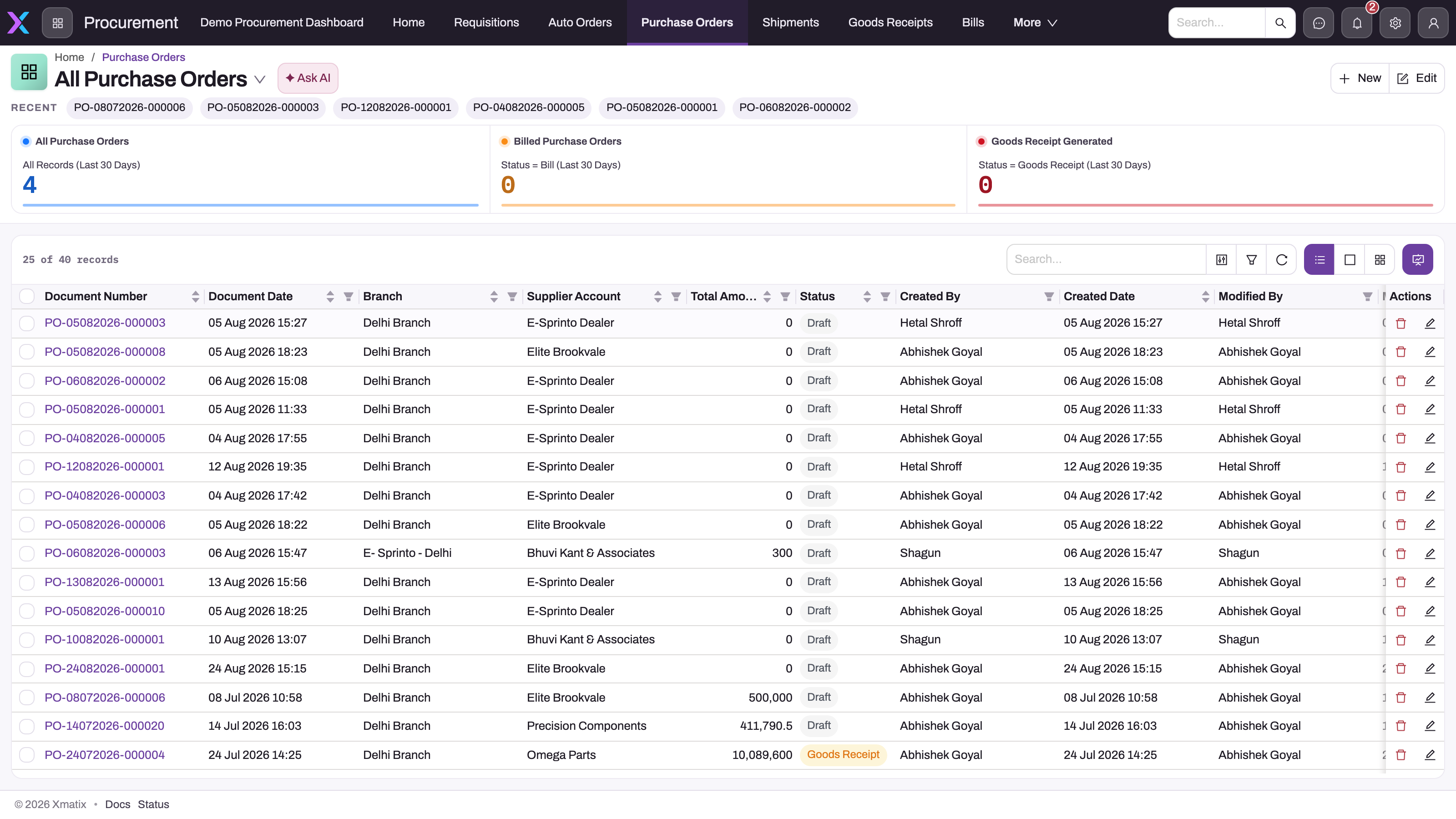
- 1
Open the order by its document number to reach the Lines tab, the release actions and the status stepper.
- 2
Branch and Supplier Account are the scope every goods receipt and bill released from the order inherits.
- 3
Total Amount is rolled up from the lines; an order with a total but no lines has a stale roll-up.
- 4
Status is Draft, Shipment, Goods Receipt or Bill - advanced one step at a time by a person on the saved order, never by Release Receipt or Release Invoice.
- 5
The Billed and Goods Receipt Generated counters count orders whose manual Status was set to those values.
- 6
New opens the create form with Document Date stamped and the purchase price list, discount group and addresses defaulted.
The list identifies orders by branch, supplier, date and total. The three counters at the top and the Status column read the header's Status picklist (Draft, Shipment, Goods Receipt, Bill). That status is set by people, not by the release actions: on the saved order a status stepper under the header lets you advance it one step at a time (moving back is allowed, skipping ahead is not) and saves the choice. Treat it as your team's progress marker; the line counters below are the system's truth.
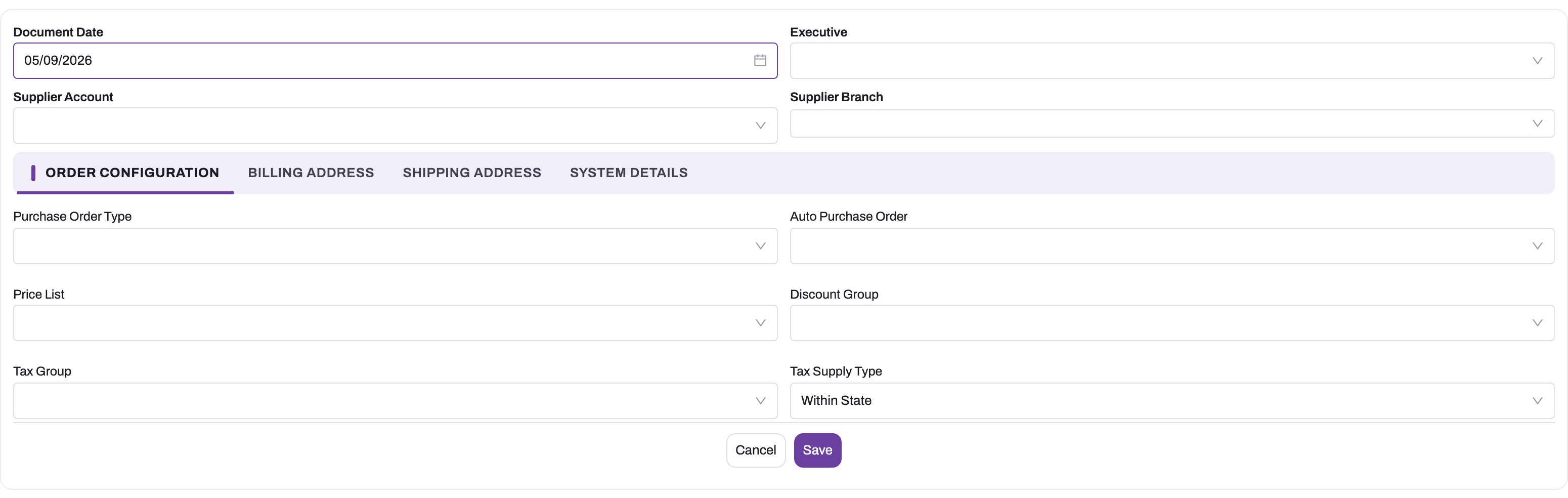
- 1
Document Date is stamped with today and picks the fiscal day; it is locked after save.
- 2
Supplier Account is the vendor; the branch's default supplier is filled in when the branch has one.
- 3
Supplier Branch is only needed for the dealer-order flow (Create Dealer Order) - leave it empty for an ordinary supplier order.
- 4
System Details carries Partner Account and Branch; both must belong together and are locked after save.
- 5
Purchase Order Type is a reporting classification; Auto Purchase Order is filled automatically when the order came from an auto-order worksheet.
- 6
Price List, Discount Group, Tax Group (Document Level) and Tax Supply Type decide how every line is priced, discounted and taxed.
The create form
| Field | Where | What it does |
|---|---|---|
| Document Date | Header | Stamped with today's date; it also picks the fiscal day the order belongs to. Locked after save. |
| Executive | Header | The internal person accountable for the order (a resource). Not validated. |
| Supplier Account | Header | The vendor. The branch's default supplier is filled in when the branch has one. |
| Supplier Branch | Header | The supplier's branch the order is placed against. Required only for the dealer-order flow (below). |
| Purchase Order Type | Order Configuration | A classification picklist (Part PO, Product PO, Local PO, VOR PO in the seeded set). Reporting only. |
| Auto Purchase Order | Order Configuration | Filled automatically when the order was generated from an auto order. |
| Price List, Discount Group | Order Configuration | A purchase-type price list and discount group are defaulted on create; lines price and discount from them. |
| Tax Group, Tax Supply Type | Order Configuration | Header taxes. The header tax group must be a Document Level group; line tax groups must be Line Level. Tax Supply Type (Within State, Outside State, Exempt, Exports, SEZ) picks the tax lane. |
| Billing Address, Shipping Address | Their tabs | Defaulted from the partner account's addresses; pick another address or type the street, city, state, postal code and country. |
| Partner Account, Branch | System Details | The organization and the receiving branch. They must belong together and are locked after save. |
Lines
Add lines on the Lines tab with Quick Add, the Product Catalogue picker or Import. Every line needs an item (or a description for a non-stock charge such as freight) and a quantity greater than zero. On save the line is priced from the order's price list (Unit Cost, with Unit Cost 2 overriding it in the amount when set), discounted from the discount group, and its taxes are snapshotted into the line's tax slots. A package item explodes into component lines.
Two sets of rules guard line quantities:
- Planning rules from the item's inventory attributes. When a planning row matches the item for the order's partner account and branch (or is unscoped), the quantity must be at least its Minimum Order Quantity, at most its Maximum Order Quantity, and a multiple of its Lot Quantity. The messages name the item and the limit — for example Order Quantity 7 needs to be in multiple of the Lot Quantity 5 for Item 'X'. See the configuration reference.
- Downstream integrity. Once receipts or bills exist, the quantity cannot be reduced below what they carry (There are downstream transaction. The minimum Quantity required is : N), a line with receipt quantity cannot be deleted, and the item and SKU of a line released from a requisition cannot be changed.
Lines also carry Exclude In Auto Order, which keeps the line out of the Forecasting engine's pipeline netting, and Cancelled Quantity, which strikes quantity off the line without receiving or billing it.
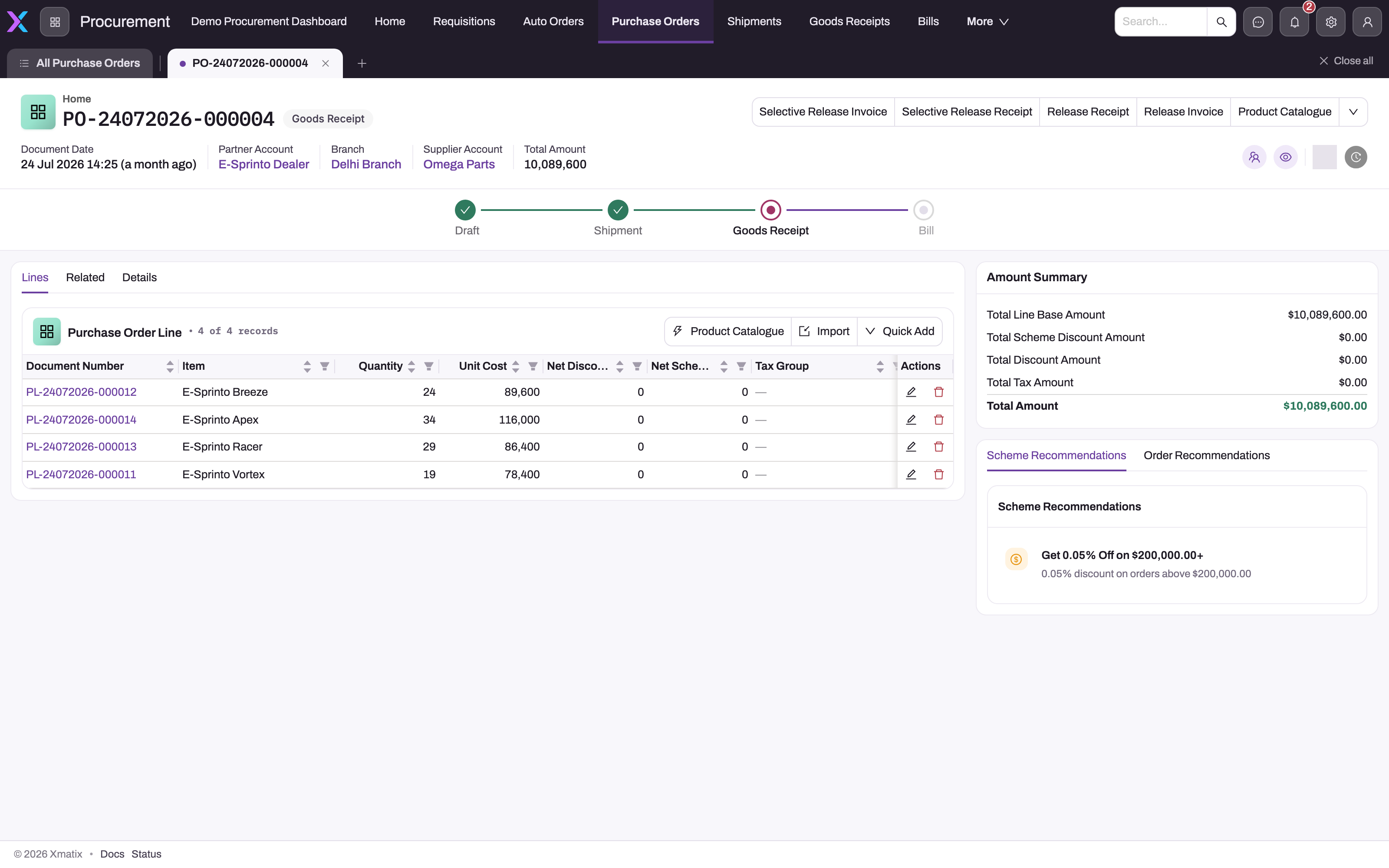
- 1
Release Receipt and Release Invoice take every line with pending quantity; the Selective variants take the lines you tick below with a Requested Quantity each. More actions (Add Requisition, schemes, dealer order) sit behind the chevron.
- 2
The Draft - Shipment - Goods Receipt - Bill stepper is set by clicking the next step; releasing a receipt or bill does not move it.
- 3
Quantity is what was ordered; it cannot drop below what receipts or bills already carry, and it must respect the item's planning row limits.
- 4
Unit Cost comes from the order's price list and is copied onto every receipt line as the stock cost layer; the default grid does not show the pending counters - add those columns or open a line.
- 5
Quick Add, Product Catalogue and Import add lines; Cancelled Quantity on a line strikes quantity off without receiving it.
- 6
Amount Summary rolls the lines up: base, scheme discount, discount, tax and Total Amount.
- 7
Scheme Recommendations lists supplier schemes the order qualifies for; Apply Scheme in the actions applies one.
Line quantities drive the lifecycle
Receiving, billing and dealer-order release are tracked independently, per line, and all three draw on the same ordered quantity:
| Counter | Meaning |
|---|---|
| Quantity | What was ordered. |
| Receipt Quantity | Rolled up from the Ordered Quantity of the goods-receipt lines linked to this line — the quantity staged onto receipts, not proof that it was counted in. |
| Pending Quantity | Quantity − Receipt Quantity − Cancelled Quantity. Release-to-receipt actions draw against it. |
| Invoice Quantity / Pending Invoice Quantity | Rolled up from linked bill lines; the pending part is what release-to-invoice actions draw against. |
| Order Quantity / Pending Order Quantity | Rolled up from dealer sale-order lines created from this line (supplier-branch flow). |
| Returned Quantity | Rolled up from credit-note lines against this line's bills. |
The default Lines grid shows quantity, unit cost, discounts and tax group; add the counter columns to the grid or open a line to read them. The header rolls them up as Total Pending Quantity and Total Pending Invoice Quantity, next to the money totals (Total Line Amount, Total Tax Amount, Total Discount Amount, Total Amount). Partial releases are normal: because the receipt and invoice counters are independent, an order can be fully staged for receipt but only partly billed, or billed before anything is physically received. For proof of arrival and stock posting read the goods-receipt lines' Received Quantity and inventory-ledger reference, not the order.
Releasing to a goods receipt
Release Receipt creates one goods receipt covering every line with pending quantity. Selective Release Receipt takes the lines you tick in the Lines grid, each with a Requested Quantity that must be greater than zero and no more than that line's pending quantity. The receipt copies the order's branch, partner account and supplier, links back to the order, and each receipt line links to its order line with the order's unit cost and an Ordered Quantity equal to the released quantity. Receiving itself — supplier and counted quantities, stock posting, inspection — happens on the receipt: see receive goods against a purchase order. When the supplier ships in consignments, an inbound Shipment sits between order and receipt and the receipt is released from the shipment on arrival.
Both actions refuse with No pending quantities found in order lines to create goods receipt when nothing is left to receive.
Releasing to a bill
Release Invoice creates a supplier bill for the order's lines with pending invoice quantity; Selective Release Invoice takes ticked lines and requested quantities, validated against Pending Invoice Quantity. The bill copies the order's branch, partner account, supplier and document date and links back to the order. How its lines are built depends on what has been received:
- Receipt lines exist for the order line (with quantity still to invoice): one bill line per receipt line, carrying both the purchase-order-line and goods-receipt-line links, the receipt's lot, and the receipt line's pending invoice quantity (a requested quantity caps the total across those receipt lines).
- Nothing received yet: one bill line linked to the order line only, for the requested or pending invoice quantity.
- Description-only lines (no item) bill straight from the order at the cost typed on the order.
Item lines are priced from the bill's price list when the bill line is created — the order's unit cost is not copied — so compare the bill against the supplier's invoice before posting. See supplier bills for posting and for why the receipt-line link matters. The actions refuse with No pending quantities found in order lines to create purchase invoice when everything is billed.
Supplier schemes
Purchase orders take part in the scheme engine — supplier promotions defined as slabs with benefits, evaluated against the order's supplier, date and transaction type:
- Get Scheme Recommendations shows which schemes the order qualifies for; the Scheme Recommendations panel on the saved order shows the same.
- Apply Scheme applies a qualifying scheme's benefits (benefit lines and scheme discount) to the document.
- Reset Scheme removes applied benefits so you can start over.
- Skip Scheme on the header suppresses scheme evaluation for the whole order.
Dealer orders from a purchase order
When the supplier is another organization on the platform, Create Dealer Order and Selective Create Dealer Order turn the order's pending order quantity into a sale order at the supplier's branch, so the supplier fulfils it from their side. Both require Supplier Branch on the header (Supplier Branch is required to create a dealer order) and draw against Pending Order Quantity.
Purchase orders in the stock pipeline
An open order is not just a document — its pending quantities count as inbound supply. The Forecasting auto-order engine nets pending purchase-order lines into its projection (so stock already on order is not suggested again), and the same arithmetic powers a Sense AI nudge that warns when a manually entered order line diverges from what the pipeline needs. A line can opt out of this math with Exclude In Auto Order. While building an order you can also ask for the items this branch buys most often — see frequently ordered item suggestions.
Common questions
Which release path preserves the links used by the current match service?
Use the order-side Release Invoice or Selective Release Invoice after receipt lines exist when you need both links: the order-side service writes the purchase-order-line and goods-receipt-line keys on every line it builds from a receipt. The receipt-side Release Bill writes only the goods-receipt-line key, so its bill lines are not counted by the three-way match service.
Why does a line still show pending quantity after receiving?
The order's Receipt Quantity is reduced by the quantity placed on linked goods-receipt lines (Ordered Quantity), not by the later counted Received Quantity. If the number moved before goods arrived, a receipt has been released; if it stays open after a delivery, compare ordered quantity, receipt quantity and cancelled quantity on the order line and check that the receipt was released from this order rather than created stand-alone.
Can one order produce several receipts and several bills?
Yes. Each downstream line adds to the corresponding receipt or invoice counter and the remainder stays available for another release. Reconcile physical delivery from the receipts and the inventory ledger rather than from the order's receipt counter alone.
Does the status stepper do anything besides record the status?
No. Advancing it saves the Status value and nothing else — no document is created and no counter changes. Equally, releasing a receipt or bill does not advance it.