
The Banking area of the Finance app holds the account masters, imported bank statements, transfers and cheque records that connect external bank activity to the ledger. Its central discipline is simple: a bank account master identifies the external account and links it to the GL account whose posted balance is compared with the bank's statement.
Start from the account list
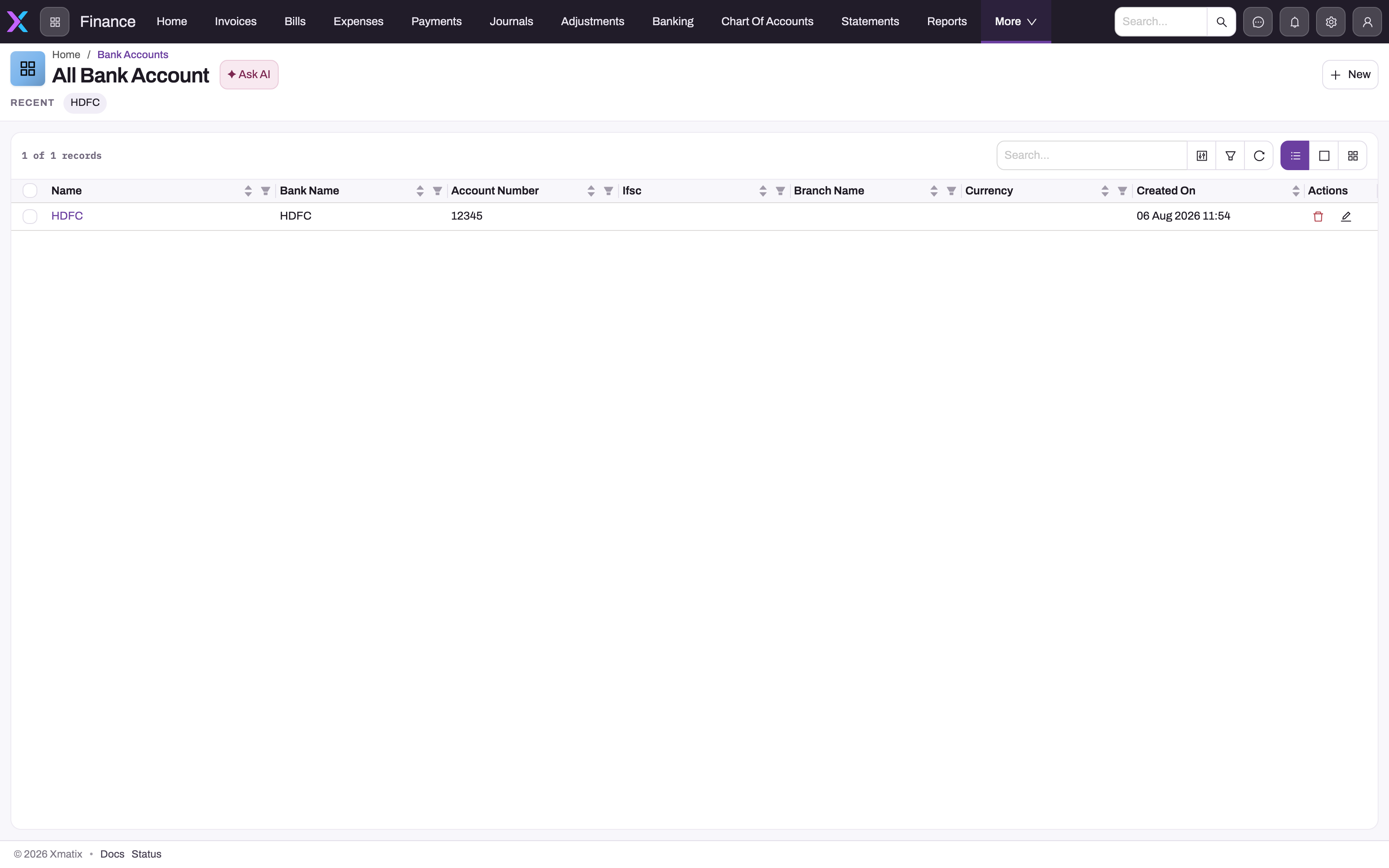
- 1
Name opens the saved bank-account record and its child tabs.
- 2
Bank Name identifies the institution recorded on the master.
- 3
Account Number is visible demonstration data, not a masked placeholder.
- 4
Blank IFSC, branch and currency cells reveal configuration gaps that need review.
- 5
Created On helps distinguish the saved master from an unsaved create form.
The list is the entity-level control point. It shows the saved account name, bank, account number, IFSC, branch, currency and creation date in one place. The demonstration row intentionally remains visible because it is dummy tenant data. Blank IFSC, branch and currency cells are not hidden values; they are evidence that this master is incomplete and should be reviewed before operational use.
Create the master
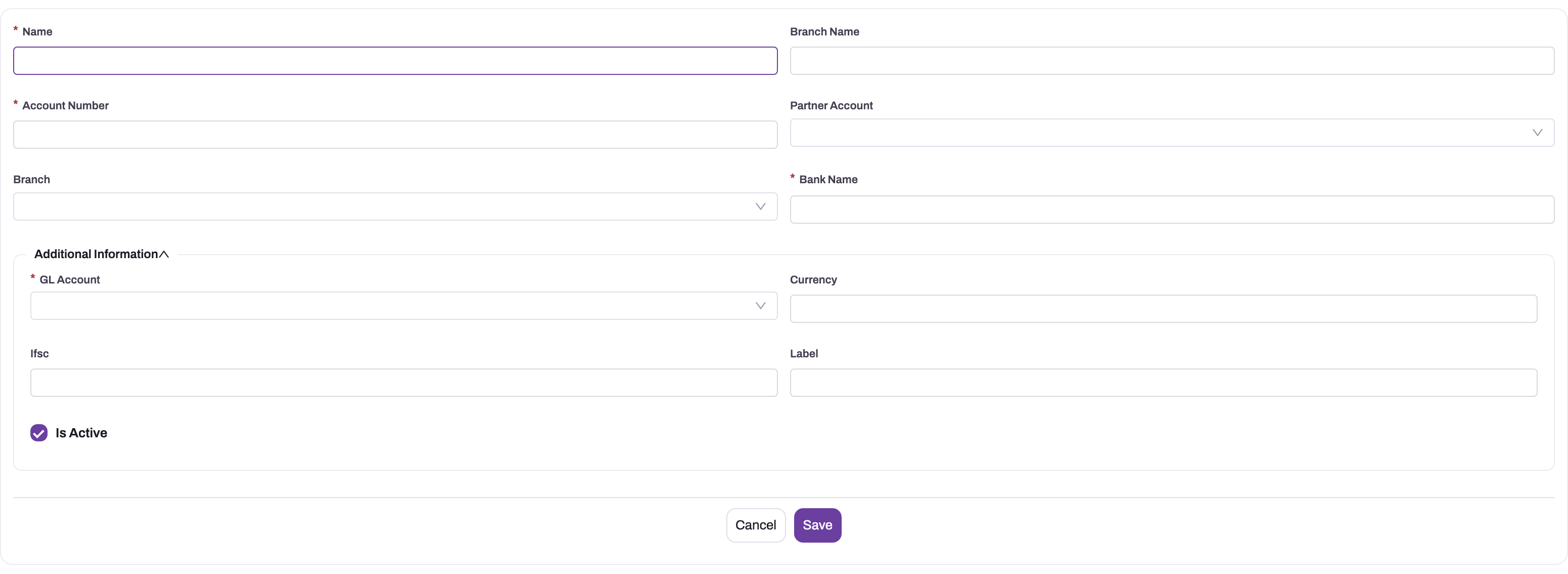
- 1
Name gives operators a recognizable label for this bank-account master.
- 2
Account Number and Bank Name are required by this create layout; this screenshot intentionally shows the unsaved blank state.
- 3
Branch and IFSC identify the banking endpoint used for payment instructions and matching.
- 4
GL Account connects bank activity to the control account whose book balance is reconciled.
- 5
Currency fixes the denomination in which balances, transfers and statement lines are interpreted.
The create form shows the complete input contract rather than a made-up example. Give the record a recognizable Name, then enter the bank name and account number required by this layout. Add branch name, branch master, partner account, IFSC and currency where they apply. Leave Is Active selected only when the master is ready to be used.
The linked GL Account is the most consequential choice. Reconciliation queries posted journal lines on that account and refuses to produce suggestions when no GL account is linked. Reusing one GL account for unrelated real-world accounts obscures reconciliation, while linking the wrong account compares the statement with the wrong book balance. Before operational use, verify the external identity, denomination, partner/branch scope and GL classification independently.
Verify the saved record
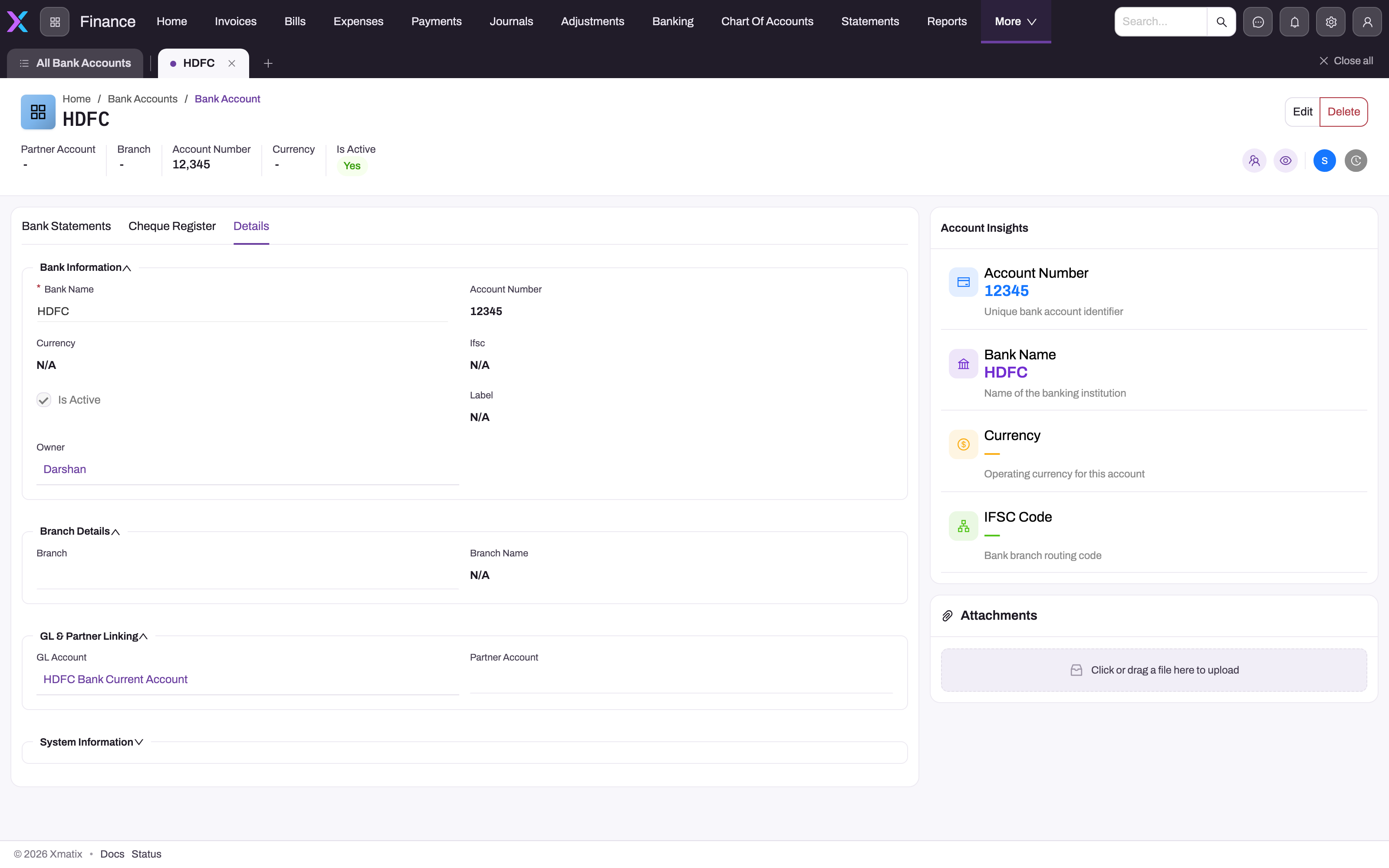
- 1
Bank Information shows the saved bank name and account number.
- 2
Currency and IFSC display N/A because this demonstration record does not contain them.
- 3
Branch Details is separate from the free-text branch name and is also incomplete here.
- 4
GL Account is populated and is the ledger account that reconciliation will query.
- 5
Account Insights repeats key identity fields and makes missing currency or IFSC obvious.
The Details tab separates bank identity, branch details and GL/partner linking. The example is useful precisely because it shows both populated and absent fields: bank name, account number and GL account are present, while currency, IFSC and branch metadata are not. Treat N/A as a configuration gap, not as an anonymization mark.
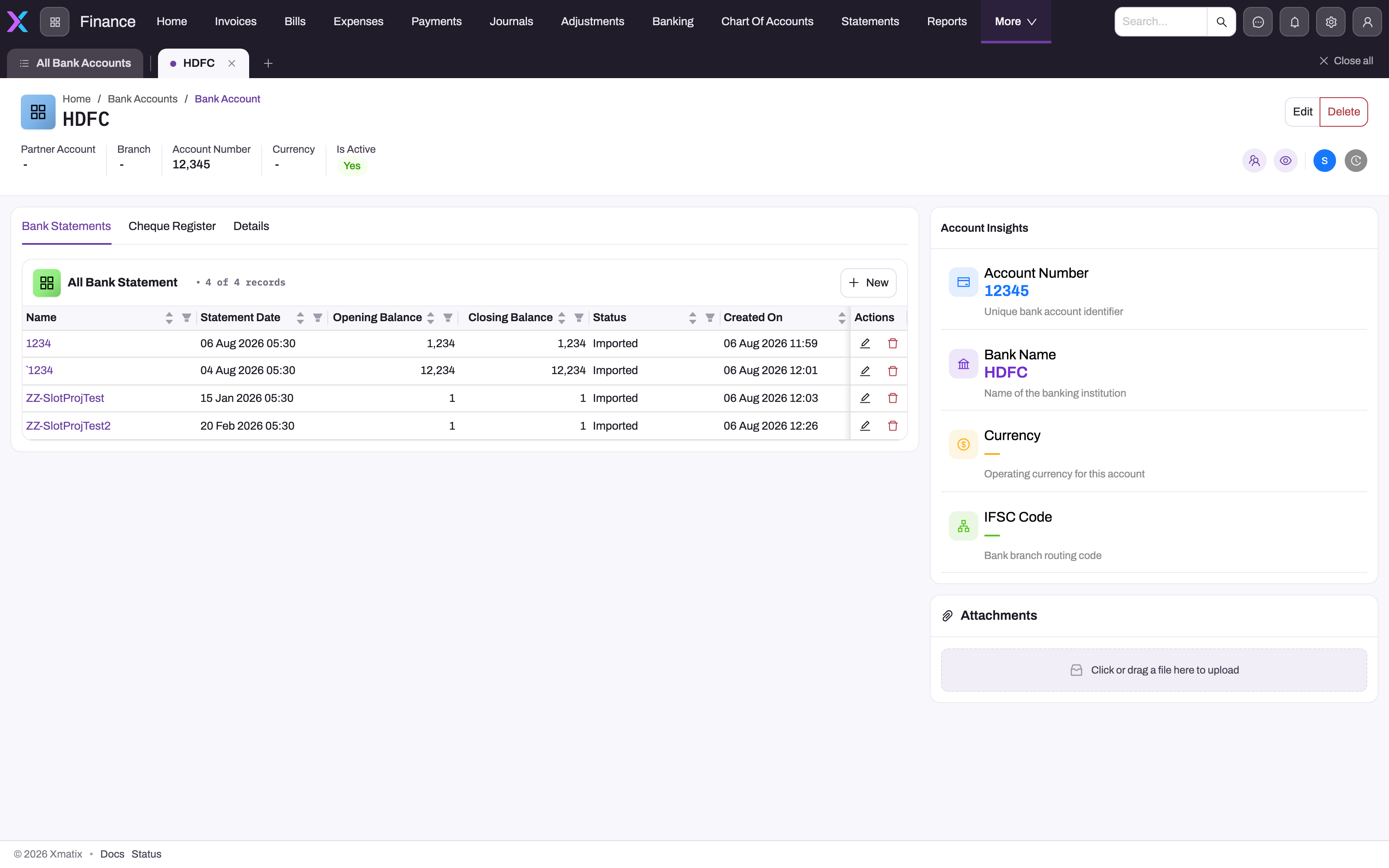
- 1
Bank Statements is the child-record tab for the selected bank account.
- 2
The table contains four imported demonstration statements rather than a blank placeholder.
- 3
Statement Date identifies the bank period represented by each child record.
- 4
Opening and Closing Balance should be checked against the source bank file.
- 5
Imported is the visible statement status on all four records in this example.
The Bank Statements tab is the saved account's child list. Read statement date, opening balance, closing balance and import status before choosing a statement for reconciliation. Four imported dummy records are visible here; the adjacent insights repeat the account identity but also expose the missing currency and IFSC, making the master-data gap easy to spot.
Bank accounts
Create one bank account master per real-world account. Each should link to the GL account that postings debit and credit. The reconciliation service calculates a book balance from posted journal lines on that GL account and a bank-side balance from imported statement closing balances; its difference is the work reconciliation exists to explain.
Bank statements
Import each period's bank statement with its lines—date, narration, reference, deposit or withdrawal per line. Statement lines are the bank side of reconciliation. Match them against posted ledger lines on the linked GL account; where the bank reports a genuine event the books do not yet contain, create and post the appropriate journal or payment before confirming a match.
Transfers and vouchers
- Bank transfer — moves money between two of your accounts, posting a debit to the destination and a credit to the source.
- Expense voucher — posts a direct expense paid from bank or cash, without routing through a bill.
- Employee reimbursement — settles an approved employee claim: the payable to the employee is cleared against the bank, and the claim is marked reimbursed.
The cheque register
The cheque register manages physical cheque books:
- Register a cheque range per book. Issuing a cheque draws the next sequential number from the range, and the register flags itself exhausted when the range runs out.
- Each cheque transaction then walks a lifecycle: Issued → Presented → Cleared, or Bounced or Cancelled. The terminal states are locked — a cleared or cancelled cheque cannot be moved again — so the register stays a trustworthy audit trail.
A bounced cheque is a real event in the books, not just a status: the payment it carried must be unwound so the settled document reopens (see Payments).
Payment and deposit batches
Bulk runs — a supplier payment run, a day's collections banked together — are grouped into payment batches and deposit batches. The batch header rolls up the item count and total, giving the reconciliation one figure to match against the single bank movement the batch produced.
Common questions
Why do the bank balance and book balance differ?
Timing, usually: cheques issued but not yet presented, deposits in transit, and bank charges the books have not recorded yet. The reconciliation session quantifies the difference — matched versus outstanding items on each side — and the account is reconciled when the difference nets to zero. A difference that will not net out points at a missing posting or an unimported statement line.
Can a company have several bank accounts?
Yes. Create a bank account master per real account and normally give each its own GL account. The data model supports many accounts per company/branch, and statements and cheque transactions link to a specific bank-account record.
Do I have to use the cheque register to record a cheque payment?
Recording a payment with mode "cheque" captures the cheque number and date on the payment itself. The register adds sequence control and lifecycle tracking on top — worth it wherever physical cheque books are in active use, optional where cheques are rare.