
xMatix can charge interest on overdue receivables automatically: policies define the rate and terms, an accrual run computes a charge per overdue item, and posting a charge raises a customer debit note — a document the customer can book against — that carries the interest into receivables, where it ages like any other open item. Every charge carries a calculation note you can re-derive by hand, and the accrual arithmetic is cadence-independent: run it monthly, quarterly or once a year and the total charged is the same to the paisa.
Prerequisites
- Overdue open items — interest is levied on posted receivables, so an invoice that never posted can never be charged (see Subledgers).
- An interest income GL account for the company. Set this up before the first posting run: with none configured, resolution falls back to a generic income account and posts there without complaint, and moving history to a dedicated account later is a manual reclassification. Leave the account's branch empty — a branch-pinned account serves only that branch's charges, and charges on other branches fail to post.
Procedure
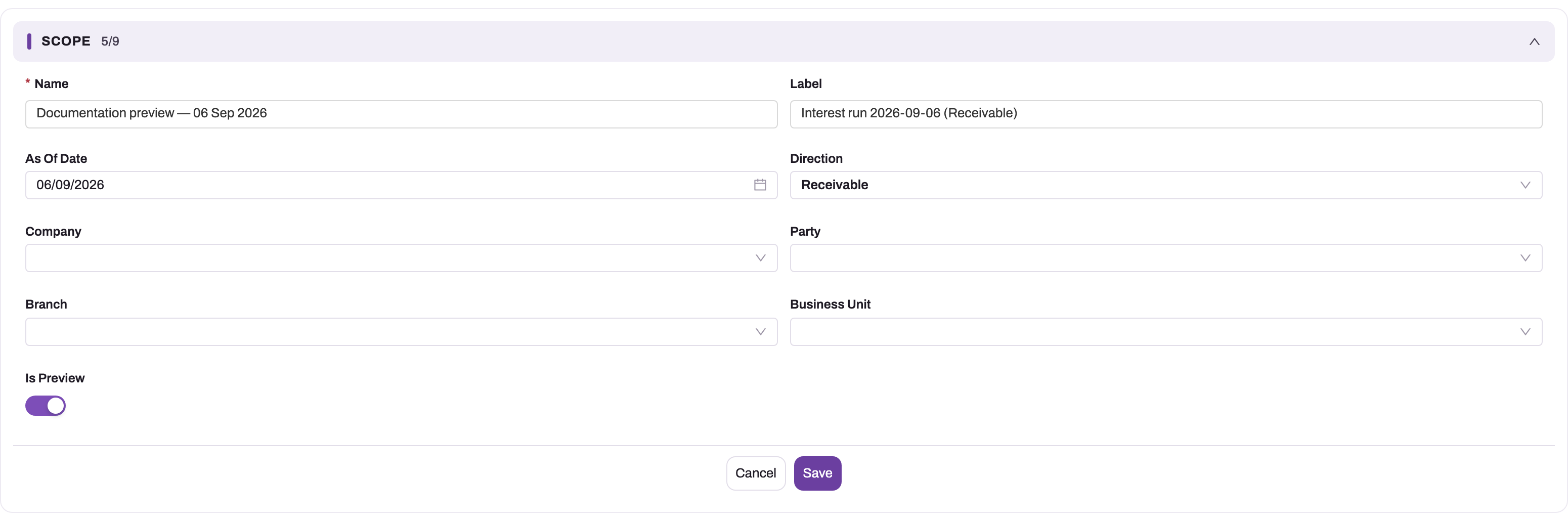
- 1
Name is yours; Label on the right is generated from the as-of date and direction once the form fills.
- 2
As Of Date is the calculation cutoff — overdue days are counted up to it.
- 3
Direction defaults to Receivable (customer interest); Payable runs are permitted by the handler, so change it only deliberately.
- 4
Company, Party, Branch and Business Unit are optional scope — leave them empty for an organization-wide run, or pin a run to one customer.
- 5
Is Preview on: compute and review the charges without posting or consuming the window. Turn it off only for the real run.
Step 1 — Create the policy
In the Finance app open Interest Policies and create one. Give it a clear effective date range and scope, then save and reopen it to confirm the stored rate, period, method and priority. The essentials are:
| Setting | Meaning |
|---|---|
| Direction and scope | Receivable; company-wide, or pinned to one customer for negotiated terms |
| Rate and period | Enter the rate as the contract quotes it — 2% per month and 24% per annum are the same policy |
| Method | Simple, or compound with a compounding frequency |
| Basis | Outstanding balance (default, and the accurate one — a part-payment reduces accrual from its date), original amount, or current open amount |
| Day count | The convention for converting days to interest — 365, 360, actual/actual and others |
| Grace days | Accrual starts the day after grace ends |
| Minimum days overdue | A tolerance on top of grace — below it, nothing is charged |
| Minimum charge | A de-minimis floor; a below-floor charge is skipped and the interest keeps accruing to a later run |
| Maximum charge | A cumulative ceiling as a percentage of the document's face value |
| Charge on settled items | On by default — a late payer still owes for the days it was late |
When several policies could apply, the narrowest wins: customer-and-company beats customer, beats company, beats tenant-wide, with priority as the tie-break. The usual pattern is one company-wide policy plus per-customer overrides.
To change a rate cleanly from a date, end-date the current policy and create a successor effective the day after—accrual windows split at the boundary. Check there is neither an overlap nor a one-day gap before proceeding.
Step 2 — Preview before charging anyone
In the Finance app open Interest Runs and create one. The Scope section holds a Name, an auto-generated Label (as-of date and direction), the As Of Date, the Direction (Receivable) and four optional scope fields — Company, Party, Branch and Business Unit. Turn Is Preview on, save, and run Compute Interest Run. A preview cannot post and does not consume the accrual window. Read the run message, reconcile evaluated/charged/skipped counts, spot-check principal and overdue days against several invoices, and confirm the expected policy won by reading each charge's rate and calculation note.
Each charge's calculation note re-derives the amount in words — window, principal, rate, day count, result — so verifying one by hand takes a minute.
Step 3 — Run the accrual, or schedule it
After the preview is approved, create or compute a real run (Is Preview off) with the exact same as-of date and scope, or let the administrator's scheduled accrual job do so. Compare its summary total and charge count with the approved preview before review. Cadence is a business preference: contiguous windows prevent gaps and overlaps, a missed month is absorbed by the next run, and rerunning through the same date should report items already charged rather than create duplicates.
Step 4 — Review, waive or cancel
Review every material or exceptional charge before posting and record the commercial reason for any intervention. Two tools have opposite effects:
- Waive a charge — the Waive Interest Charge action on the charge, with a reason — when the interest is commercially agreed away. Waiving is permanent — the window stays consumed and those days are never re-charged.
- Cancel the run — Cancel Interest Run, with a reason — when the whole computation is wrong. Cancelling releases the days, so a later run re-charges them correctly.
If you might want the days back, cancel—never waive. After either action, verify the run total and charge status changed as intended before anyone posts it.
Step 5 — Post to the ledger
Run Post Interest Run on the reviewed run once and wait for the per-charge result (a preview run refuses to post). Each successful charge raises and posts a customer debit note: receivables is debited, interest income credited, with tax legs where applicable. Open a sample note and verify customer, source invoice, principal window, tax and amount before accepting the batch. Mixed-tax invoices are flagged for review, and invoices with no captured tax detail are skipped for manual handling rather than charged at a guessed rate.
Posting processes the remaining Draft charges and leaves a failed charge available for correction and retry. Already completed charges are not the retry population. If no Draft charge remains, invoking the posting operation again produces a validation error rather than a no-op success; use the stored run/charge statuses to decide whether a retry is appropriate.
Step 6 — Verify
Read the final run message and reconcile items evaluated, charges computed, skips by reason, failures and total posted. Confirm every posted charge carries a debit-note link, failed charges remain retryable, and the interest appears on the customer's statement and ageing. At month-end, tie the interest-income GL movement to posted charges for the same dates and investigate any difference before period close.
Expected result
The approved real run matches its preview except for documented data changes, waived charges retain their consumed windows, and cancelled runs release theirs. Each successful receivable charge has one posted debit note and open item, failures remain visible for retry, and the interest-income control total reconciles to the run.
Common problems
The run computed zero charges. Read the run message — it names the reason per item. The common ones are all correct behavior: items within grace or tolerance, items already charged to date, and charges below the minimum (which keep accruing and land on a later run). An actual configuration gap shows up as "no active policy applies" — check the policy's active flag, direction, effective dates and scope.
A charge failed to post. Almost always the interest income account (missing, or branch-pinned — see Prerequisites) or a closed fiscal period. Fix the cause and post again; already-posted charges are skipped automatically.
Interest went to the wrong income account. The resolution fallback posted it to a generic income account because no dedicated interest income account existed at the time. Configure the account now for future runs; the posted history can be moved with a manual reclassification journal.
Common questions
Does previewing a period cost us the revenue for it?
No. Preview charges are excluded from the accrual watermark, so the days a preview covered remain chargeable by the next real run. Preview freely — it is the intended rehearsal step.
Why is the interest posted as a debit note rather than a plain journal?
Because the customer needs a document to book against, and because downstream records classify the transaction by its source document. The debit note gives the interest a document number, its own open item that ages normally, and a clean trail from charge to note to journal.
Can interest be charged on interest?
Not by stacking charges — interest open items are excluded from the accrual's scope, so a posted charge never becomes the principal of a later one. Contractual interest-on-interest is expressed properly instead: set the policy's method to compound with the agreed rest.
What about interest we owe suppliers?
The platform permits a Payable-direction run to post; this is not technically limited to disclosure. Whether it should be posted is an accounting-governance decision. Verify the supplier's supporting document and the organization's policy before doing so—the current handler will not enforce that evidence requirement for you.