
An account is xMatix's single master record for a business relationship — a company or an individual you sell to, buy from, or partner with. Every module reads the same account record: the opportunity you work in CRM, the order Sales fulfils against it, the invoice Finance collects, and the visit a field rep logs all point at one account. There is no separate "CRM customer" to keep in sync.
The account form
- 1
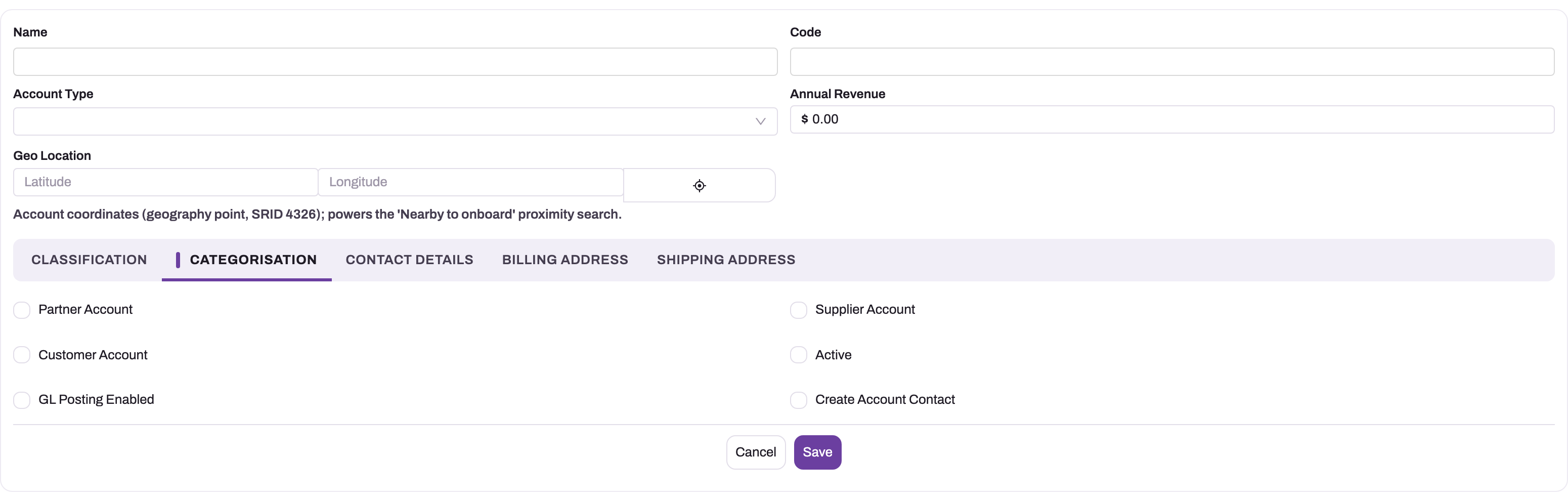
Categorisation sits beside Classification, Contact Details, Billing Address and Shipping Address — the tabs of the standard account form.
- 2
Partner Account marks a dealer or distributor that transacts on your behalf; Customer Account (below it) marks someone you sell to — one record can be both.
- 3
Supplier Account marks someone you buy from, used by procurement documents.
- 4
Active keeps the master available for new documents; it is not implied by any role flag.
- 5
GL Posting Enabled is a finance control for sub-ledger posting; Create Account Contact (right) creates a matching contact on save.
- 6
Geo Location stores the account's coordinates for the 'Nearby to onboard' proximity search.
Open Accounts → New in the CRM app (the same form serves Sales, Procurement and Finance). The header fields are the identity of the master — Name, Code, Account Type, Annual Revenue and an optional Geo Location used by proximity search — and the tabs below hold Classification, Categorisation, Contact Details, Billing Address and Shipping Address. The Categorisation tab is the one that matters most: Customer Account, Partner Account and Supplier Account are independent switches, so one master may participate in several relationships; Active decides whether the master is available for new work; GL Posting Enabled is a separate finance control; and Create Account Contact creates a matching contact when the account is saved.
Treat the account as long-lived master data. Before creating one, search by name, code and phone and inspect likely matches — if the relationship already exists, extend its roles or correct the record instead of creating a parallel customer, supplier or partner. Opportunities, orders, invoices, visits and integrations inherit and report the classification, contact, address and statutory facts entered here.
One record, several roles
An account's roles are flags on the same record, not separate records:
| Role | What it means |
|---|---|
| Customer | You sell to this account — it can carry opportunities, quotes, orders and invoices |
| Partner | A dealer/distributor that transacts on your behalf; CRM documents carry both the customer and the partner account |
| Supplier | You buy from this account — used by procurement documents |
One account can hold any combination, so a distributor you also sell to is still one record. Accounts also carry a parent account, letting you model a head office with branches or a group with subsidiaries as a hierarchy.
What hangs off an account
The account page is the hub for everything the relationship has done: its contacts, its leads, opportunities and quotes, its orders, deliveries and invoices, its credit and debit notes, and its field visits. Opening an account and walking its related lists is the fastest way to answer "what is going on with this customer".
The account also supplies the defaults CRM and Sales documents start from: its billing and shipping addresses, its contact details, its tax context, and — through its price list and discount group — its pricing. That is why an opportunity or order created for the account arrives pre-filled; see Pricing, discounts and taxes for how the pricing side resolves, and Credit limits for how the account's credit position gates ordering.
Account groups
An account group is a named set of accounts used wherever a rule should apply to many customers at once — price lists, discount groups, trade schemes, tax groups and field-sales routes can all target a group instead of individual accounts. Membership works two ways:
- Static — accounts are added to the group explicitly, one row per member.
- Rule-based — the group defines rules (a field, an operator and a value, e.g. billing region equals West), combined by a success criterion (all rules, any rule, or a custom logic expression), and membership follows the data.
Groups are maintained by administrators; see the CRM configuration reference.
Keeping the master clean
Accounts support lifecycle actions directly on the record: set status, clone, and merge — merging folds duplicate accounts into one master record so history consolidates instead of fragmenting. Lead conversion is the other guardrail: converting a lead reuses an existing account when the lead is linked to one (and a lead whose phone number matches an existing account links to it automatically at capture), so new-account creation is the exception, not the default.
Common questions
Can an account be a person rather than a company?
Yes. An account carries first name, last name and salutation alongside the company-style fields, so individual customers are ordinary accounts. The account's contacts remain separate records — even a one-person account typically has a contact created for it (lead conversion does this automatically), because documents and activities reference contacts for who to talk to.
Where do new accounts come from?
Three main paths: created directly in the Account list, created by lead conversion when the lead isn't linked to an existing account, or loaded in bulk with the import wizard. However created, it is the same master record from then on.
Who can see which accounts?
Account visibility follows the platform security model — ownership, sharing and profile grants — not anything CRM-specific. See record-level security and sharing.