The Contracts app is a records module: a structured register of your service agreements — the contract document, its commercial lines, the terms text, the SLA commitments and the planned preventive-maintenance visits — with the platform's full list, view, field and reporting machinery on top. Being a records module is the honest frame: these records describe agreements; they do not run them. Nothing here auto-renews, auto-bills or auto-dispatches — the enforced, self-acting entitlement mechanism in xMatix is the asset service contract, and the two are different tools for different jobs.
Read the register
- 1
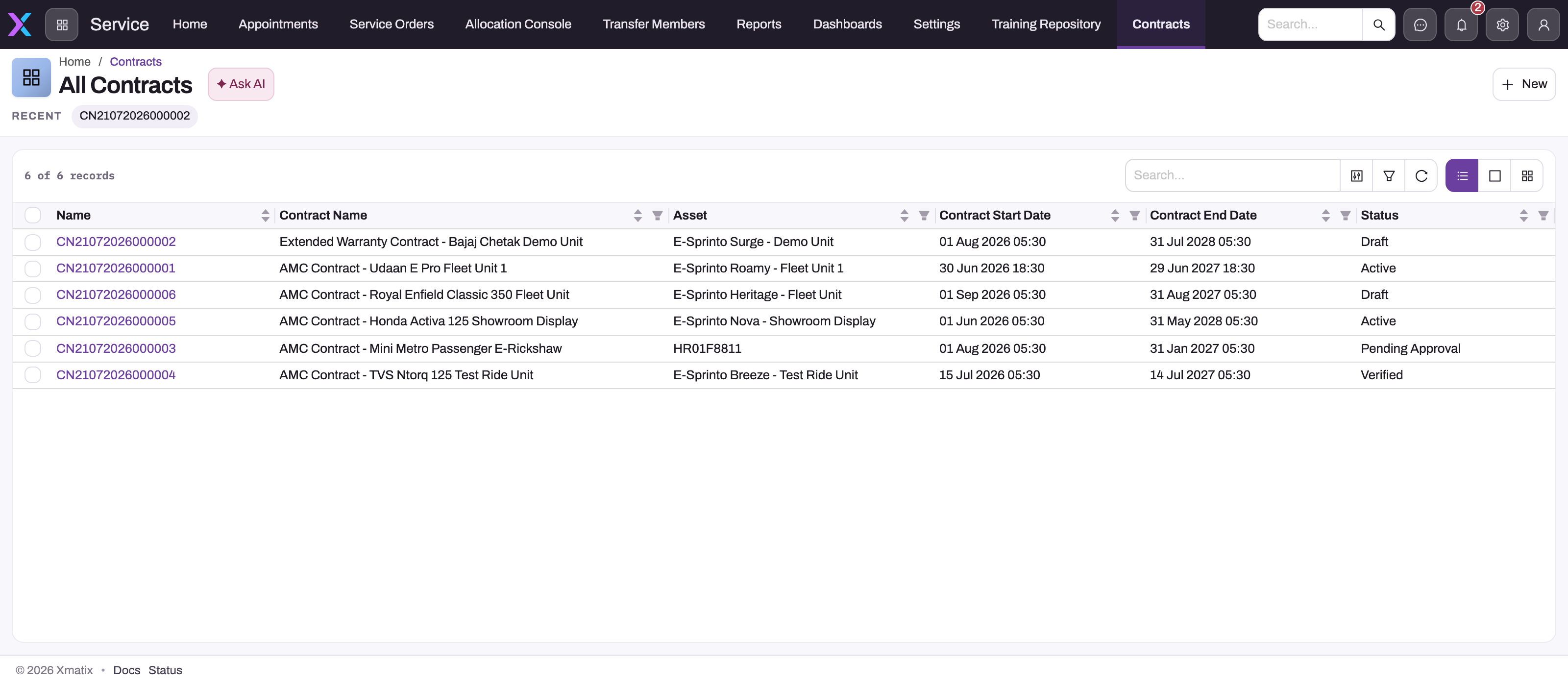
Name is the generated contract number; open it to reach the Scope, Terms & SLAs, PM Tasks, Checklists and Details tabs.
- 2
Contract Name is the human title of the agreement; Asset (right) is the covered unit where there is one.
- 3
Contract Start Date and Contract End Date describe the recorded term; reaching the end date changes nothing by itself.
- 4
Status — Draft, Pending Approval, Verified, Active — is a field you maintain, not a workflow the platform advances.
- 5
New is the only header action: the shipped Contract entity has no Delete, so superseded agreements stay as history.
The All Contracts list is the register's entry point. Contract number and name locate the agreement; asset, start and end dates and status describe its recorded scope and lifecycle; search and filters isolate the agreements that need review. Open the exact row before interpreting obligations: the list tells you which agreement exists, while its Scope, Terms & SLAs, PM Tasks, Checklists and Details tabs hold the supporting records and fields.
The five record types
| Record | What it holds |
|---|---|
| Contract | The agreement: name and number, account, contact and asset, start and end dates and Contract Terms (Months), activation date, the signature facts (Customer Signed Title, Customer Signed Date, Company Signed Date), billing and shipping addresses, special terms, description, line of business (LOB), and a status you maintain — Draft, Pending Approval, Verified, Active |
| Contract Line | One commercial position under the agreement: the item and line description, quantity, unit and cost price, discount, billed amount, billing treatment, contract years and hours, visit frequency, year number, asset count, series, vendor name, the under-warranty and parts-supply flags, remarks, and the bill-to and ship-to accounts |
| Term | Reusable terms text: a terms type, contract duration (a picklist — 6, 12 or 24 months as shipped), line of business, sequence number, display switches (show scope, show summary, show item breakup), and an Is Template flag for the ones you reuse across contracts |
| SLA | A service-level commitment as a reference record: type, priority (Critical, High, Medium, Low), severity level, response time (4, 8, 12 or 24 hours as shipped) and resolution time (12, 24, 36 or 48 hours as shipped), and remarks |
| PM Task | A planned preventive-maintenance visit: task type (as shipped: B Check, C Check, D Check, B and C Check, Coolant Topup, OOS, Preventive Maintenance, Performance Qualification, Operational Checks), a service-request number, due date and the scheduled window, the asset and its site address, the partner account and technician, a status, and the contract line it belongs to |
Contract lines link to their PM tasks, so the register can answer "what visits does this line owe?" through views and reports. Every picklist above is tenant-maintained, so the values in your tenant may differ from the shipped ones.
The Contract entity ships with New, Edit and Clone actions only — there is no Delete action in the shipped configuration, so a superseded agreement stays in the register as history rather than disappearing. Clone is the quick way to start a renewal from the previous term's record.
What this module does — and does not do
Does: everything the platform gives any entity. Lists and views, filters and search, record security, reporting and dashboards over contract data, custom fields and layouts, and — because status changes are ordinary field updates — approval processes and business rules where you configure them.
Does not: act on its own. There is no server logic behind these five entities: the status is a field you set, not a workflow the platform advances; reaching the end date changes nothing by itself; no invoice is generated from a contract line; a PM task does not dispatch a technician or create a service order. When you need the platform to enforce an entitlement — refuse uncovered work, check scope and quantities, route billing to claims — that is the asset service contract, created when a service contract item is invoiced. When you need crews scheduled against planned visits, that is Field Service. And SLA enforcement on support cases — timers, breaches, escalations — runs on the separate SLA policy records documented with cases in Support; the SLA records here are the commitments catalog you quote in agreements.
One shipped-layout caveat matters when you read a contract: the lists on the Scope, Terms & SLAs and PM Tasks tabs are not filtered to the open contract — they show the tenant-wide contract-line, term, SLA and PM-task registers with a New button. Read a row's own contract or contract-line field (or filter the list) before treating it as this agreement's, and expect the same rows on every contract until your administrator binds those lists to the parent record in the layout.
Common questions
Will xMatix bill or renew a contract from this module?
No. Contract records carry the dates and amounts, and reports over them tell you what is due for renewal or billing — but generating the invoice, or the renewal, is a deliberate act elsewhere (invoicing happens on service orders and sales documents). Treat the module as the register you work from, not an engine that works for you.
What is the difference between a Contract record and an asset service contract?
The Contract record is the documented agreement — parties, dates, signatures, terms — maintained for the record. The asset service contract is the operational entitlement the platform checks when service work claims cover: eligibility, lapse, scope and quantity, billing routing. A real-world agreement often exists as both: the signed document here, the enforceable entitlements there.
Can the Pending Approval status trigger an actual approval?
The status itself is just a field — but the platform's approval processes are configured per entity, so an administrator can put Contract under an approval process like any other record. Without one configured, moving the status is a manual bookkeeping step.