
Contract records are maintained by hand — the Contracts module is a register, not an engine — so the value of the register is exactly the discipline of this procedure: capture the agreement when it is signed, keep the lines matching what was sold, and keep the status telling the truth.
Prerequisites
- Access to the Contracts app and its five entities through your security profile.
- The account — and the asset, where the agreement covers one — already on record.
- The items sold under the agreement set up as items, so contract lines can reference them.
Procedure
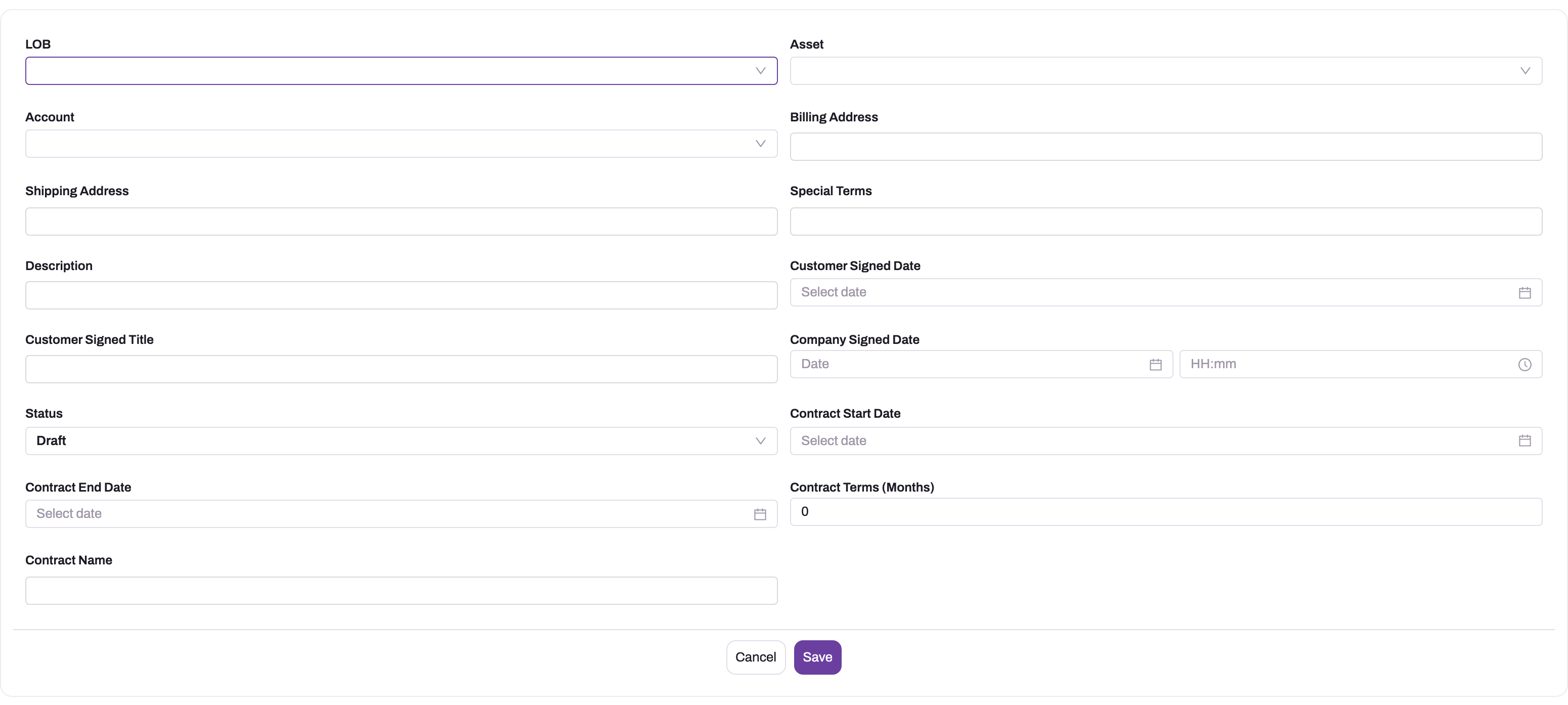
- 1
LOB (line of business) and Asset (right) describe the operating scope and the covered unit.
- 2
Account is the contracting customer; Billing Address and Shipping Address are free-text destinations preserved for the record.
- 3
Special Terms and Description hold negotiated exceptions and narrative that reusable Term records do not capture.
- 4
Customer Signed Date, Customer Signed Title and Company Signed Date are the signature facts — record them when signing actually happens.
- 5
Status starts at Draft; advance it through Pending Approval, Verified and Active only as the real agreement reaches that state.
- 6
Contract Start Date, Contract End Date and Contract Terms (Months) must reconcile with each other; nothing recalculates them.
Use the contract form as an agreement register: LOB, Asset, Account, the billing and shipping addresses, Special Terms, Description, the signature facts, Status, the contract start and end dates, Contract Terms (Months) and Contract Name must describe the signed reality. Operational entitlement and automated billing are separate features, so do not infer those outcomes from setting the status to Active.
Step 1 — Create the contract
In the Contracts app, create the contract with its name, the account, the asset where there is one, the start and end dates and the term in months, the billing and shipping addresses, and the line of business. Leave the status at Draft while the agreement is still being negotiated. The contract number is assigned on save.
Step 2 — Add the contract lines
Add one line per commercial position: the item, line description, quantity, unit and cost price and any discount, the billing treatment and billed amount, and the service-shaped facts the register exists to hold — contract years and hours, visit frequency, year number, asset count, series, vendor name and the under-warranty and parts-supply flags. Where invoicing or delivery goes to a different party, set the line's bill-to and ship-to accounts. A multi-year agreement is naturally captured as one line per year, distinguished by year number.
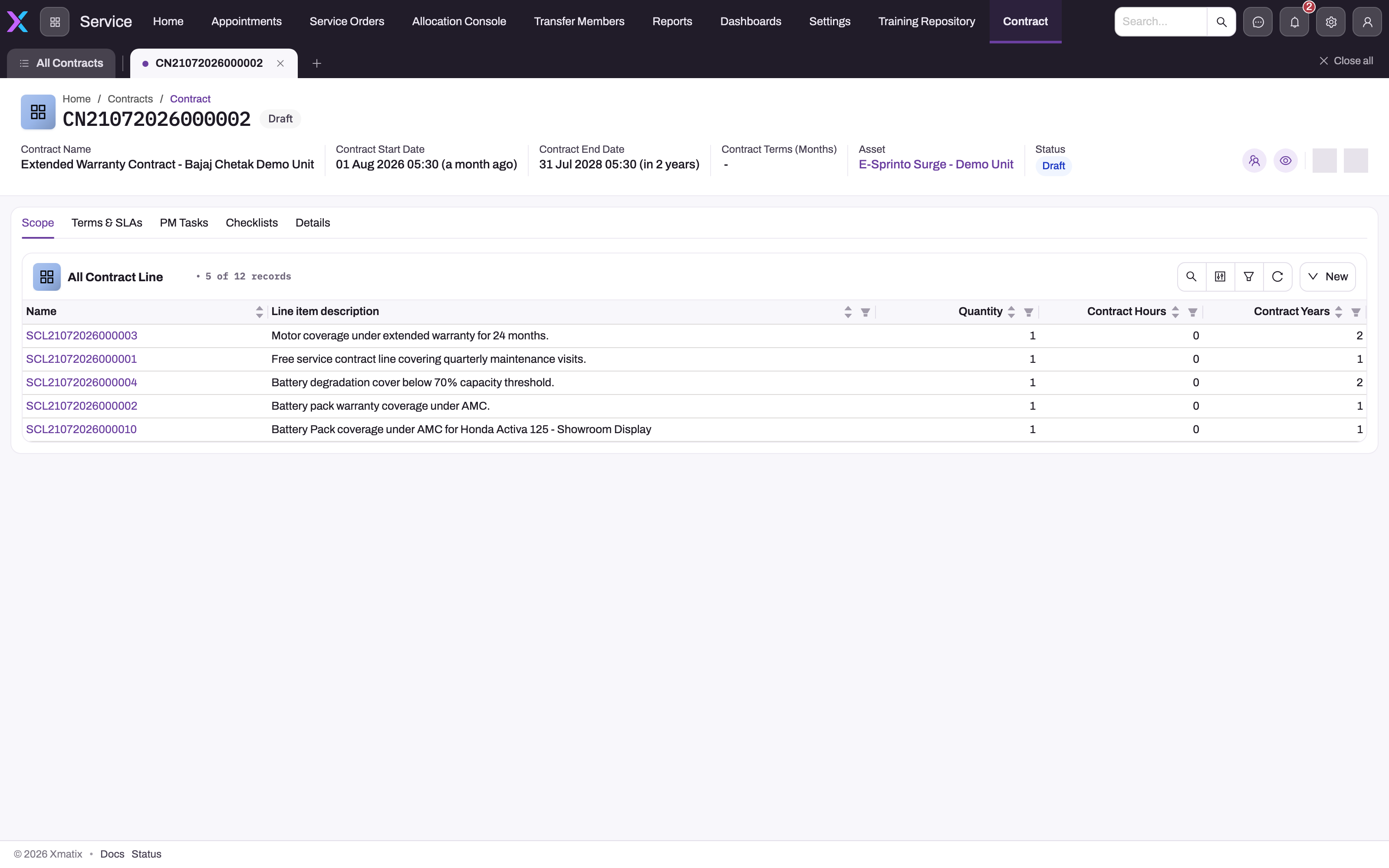
- 1
Header statistics: Contract Name, Start and End Date, Contract Terms (Months), Asset and Status — the fields the register is judged by.
- 2
Scope, Terms & SLAs, PM Tasks, Checklists and Details are the five tabs of the shipped contract layout.
- 3
The record count reveals the caveat: 12 lines exist in the tenant while this contract is one of six agreements.
- 4
Line item description, Quantity, Contract Hours and Contract Years are the compact view; open a row for price, discount, billing and warranty facts.
- 5
New adds a contract line; set its Contract lookup explicitly, because the list does not pre-filter to this agreement.
The Scope tab hosts the contract-line list, with New to add a position and a compact view of description, quantity, contract hours and contract years; open a row for price, discount, billing and warranty details. In the shipped layout this list is not bound to the open contract — it shows every contract line in the tenant — so confirm a row's contract before editing it, and filter or search the list when you review one agreement's positions.
Step 3 — Attach the terms
Record the terms as Term records — terms type, contract duration (6, 12 or 24 months as shipped), line of business, sequence number and the display switches (show scope, show summary, show item breakup). Build the standard ones once with Is Template set, then reuse them contract to contract; sequence numbers keep the printed order deliberate.
Step 4 — Record the SLA commitments
Add the SLA records the agreement commits to: type, priority (Critical, High, Medium, Low), severity level, response time and resolution time — the last two are chosen from hour bands (4–24 and 12–48 hours as shipped) rather than typed, so extend those picklists if the agreement promises a band that is not offered. These are documented commitments; the operational SLA timers on support cases are configured with cases in Support.
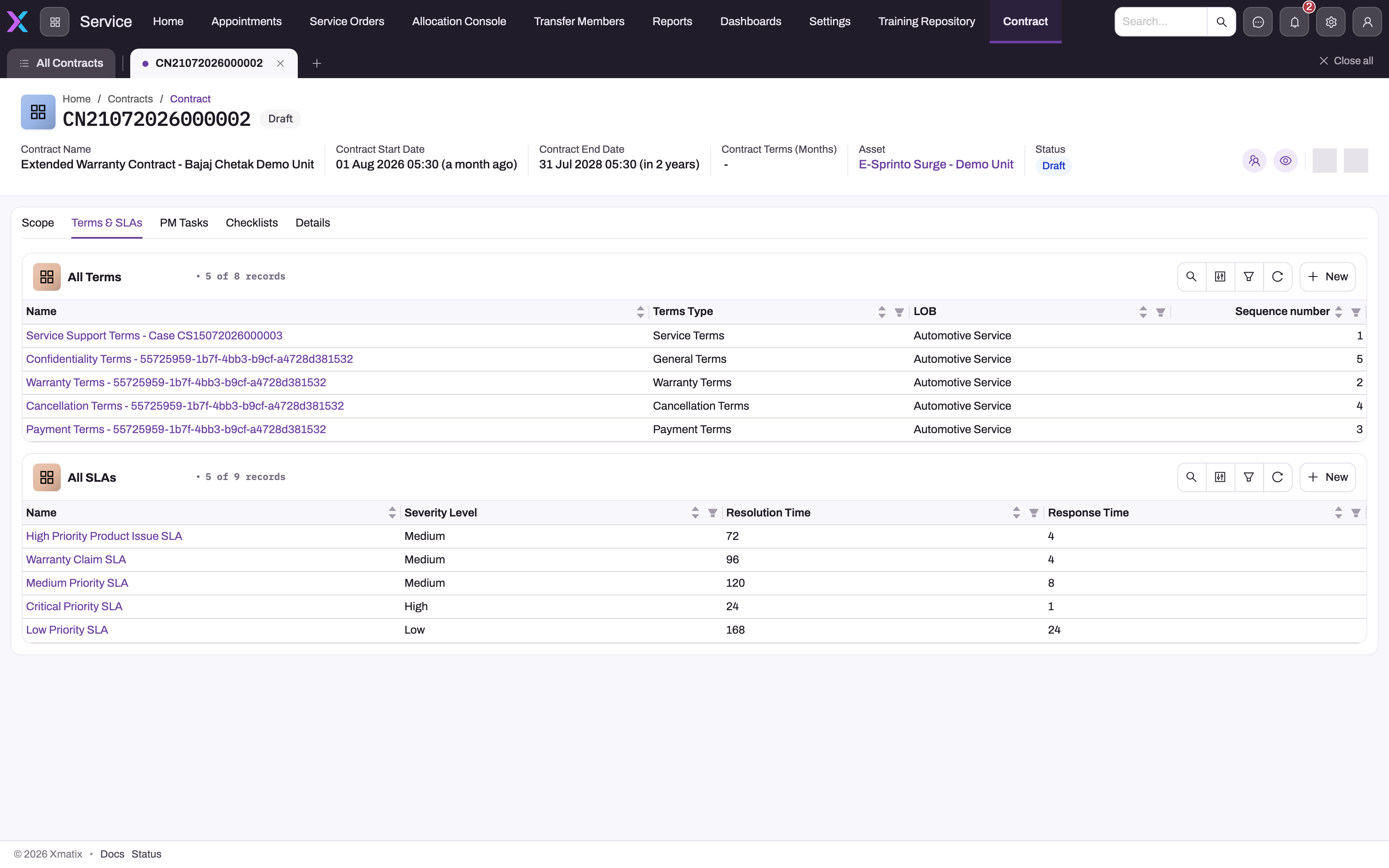
- 1
All Terms: reusable terms text; the count (8 in the tenant) confirms the list is not filtered to this contract.
- 2
Terms Type, LOB and Sequence number classify each term and fix its printed order; a term raised for a support case appears here too.
- 3
New creates a Term; mark the standard ones Is Template so they can be reused contract to contract.
- 4
All SLAs: documented commitments, not the operational SLA policies that time support cases.
- 5
Severity Level, Resolution Time and Response Time (hours) are the commitment you quote in the agreement.
The Terms & SLAs tab presents the two child registers together: term rows with their type, line of business and sequence, and SLA rows with severity, resolution and response targets. Each New button adds a record; neither starts a timer or binds the row to this agreement. Like the Scope list, both lists show the tenant-wide registers in the shipped layout, so a term raised for a support case or another contract appears here too — read before you assume.
Step 5 — Plan the PM tasks
For agreements that owe scheduled visits, create the PM tasks under the contract line: the task type, the service-request number, the due date and scheduled window, the asset and its site address, the partner account and the technician when known, plus a status you maintain. The register then shows what each line owes and when. Executing the visits — dispatching crews, raising the service order for the work — happens in Field Service and the service order flow, not from the task record. The PM Tasks tab hosts the task register with its own New button; like the other lists it is the tenant-wide task register in the shipped layout, so filter by contract line before reading it as this agreement's plan.
Step 6 — Use the layout checklist as a review aid
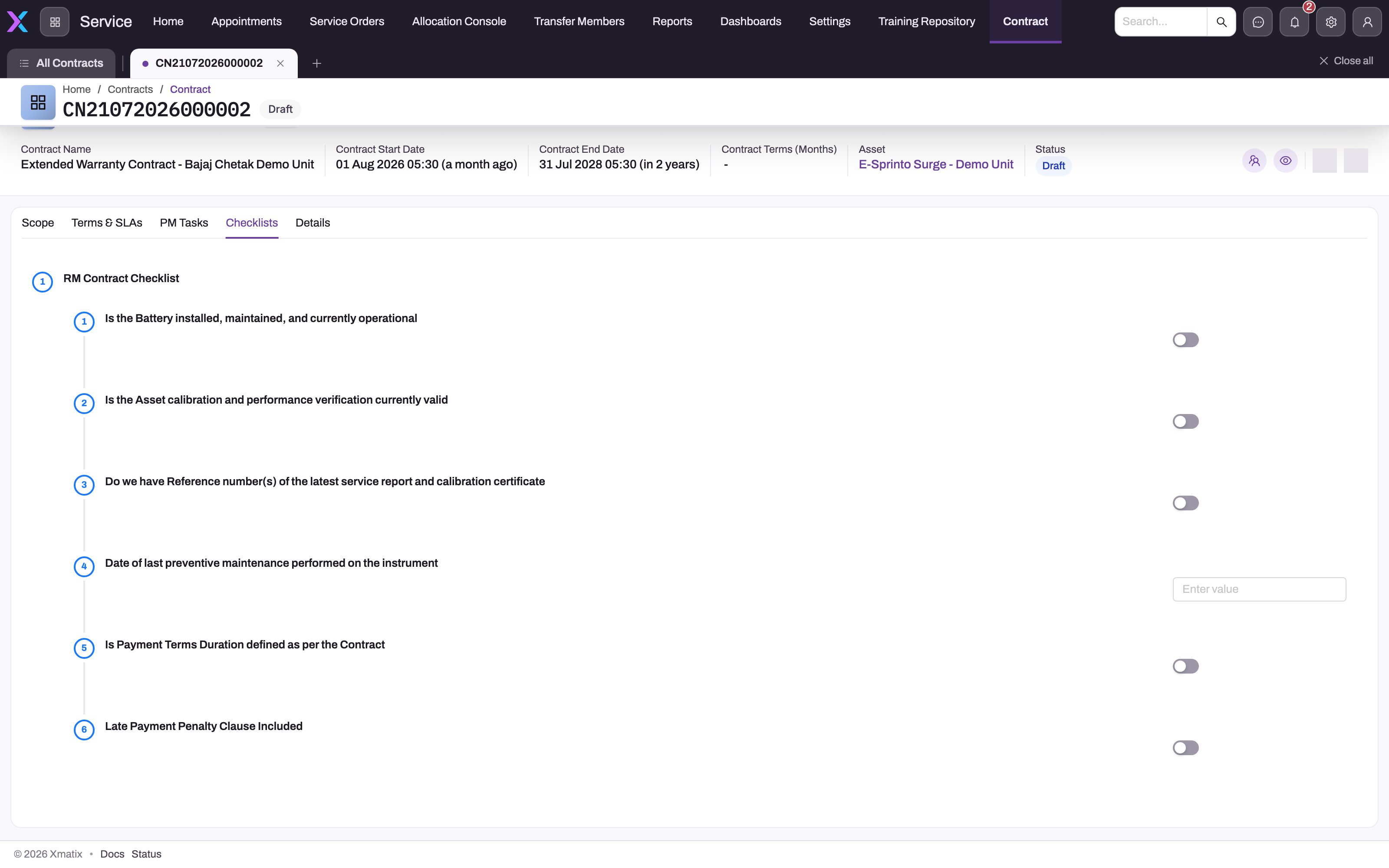
- 1
RM Contract Checklist is the review group; the six numbered steps beneath are its prompts.
- 2
Steps 1 to 3 ask about the asset: battery operational, calibration valid, service-report references on file.
- 3
The step 4 text box takes the last preventive-maintenance date — but it is not persisted; put the date on a PM Task or in Description.
- 4
Toggles record nothing on save; use them while reviewing, then capture the outcome in Status, Special Terms or a Term record.
- 5
Steps 5 and 6 cover commercial terms: payment-terms duration defined and a late-payment penalty clause included.
The Checklists tab shows an RM Contract Checklist: five yes/no toggles (battery operational, calibration valid, service-report references on file, payment-terms duration defined, late-payment clause included) and one text input for the last preventive-maintenance date. These controls are layout-authored timeline actions with no field binding, so nothing you toggle or type here is saved. Use the tab as an on-screen review prompt, and record material answers in governed fields, child records or attachments.
Step 7 — Move the status as reality moves
Advance the status through Draft → Pending Approval → Verified → Active as the agreement progresses, and record the signature facts when signing happens — the customer's signing title and date, and the company-side date. Where your administrator has configured an approval process for contracts, submit through it; otherwise the status is yours to maintain. At the end of the term, the record simply stays as history — closing it out (and opening the renewal, typically with Clone) is a manual act.
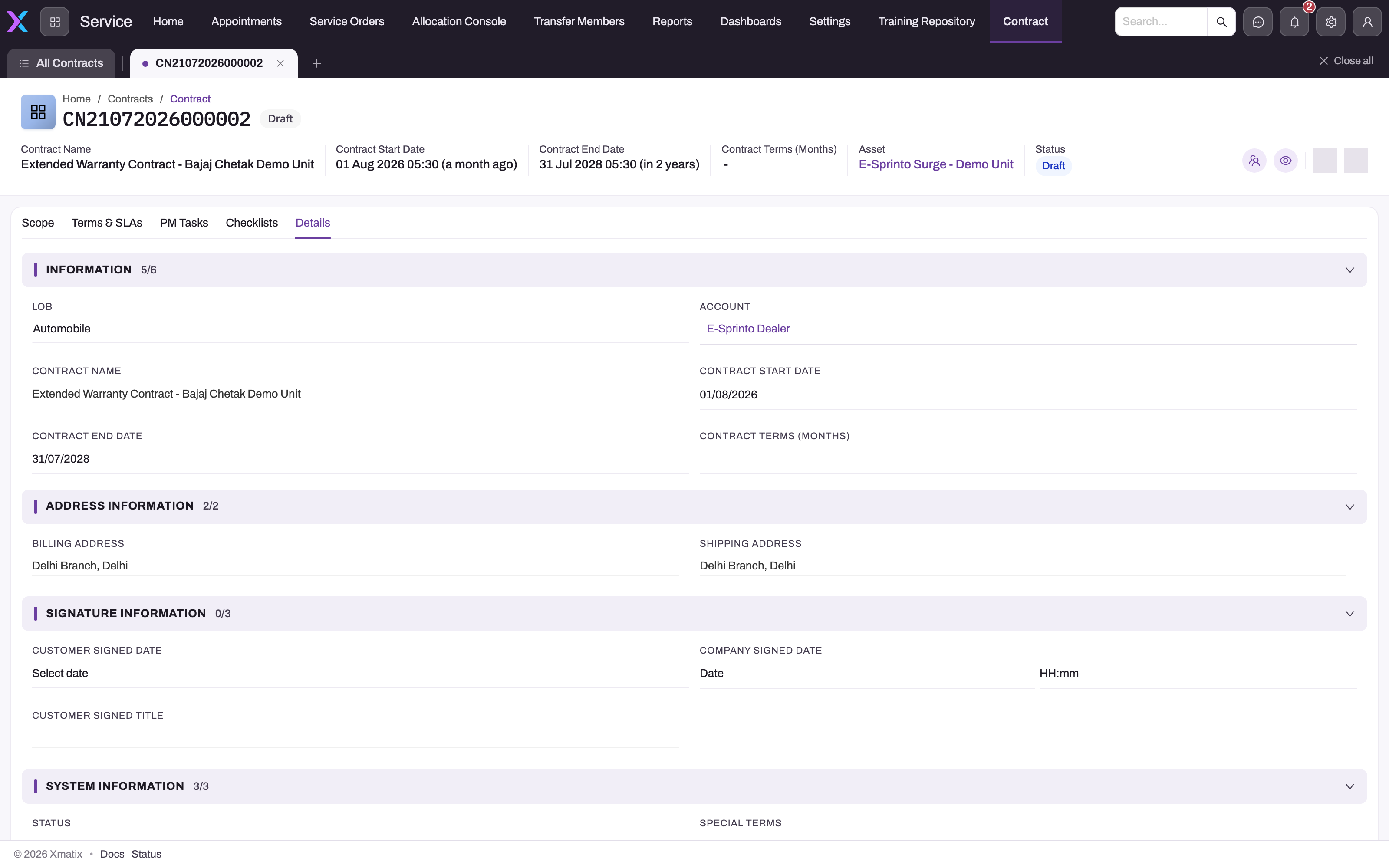
- 1
LOB and Account identify the line of business and contracting customer.
- 2
Contract Start Date, End Date and Contract Terms (Months): here the term is blank while the dates span two years — the kind of inconsistency to fix before activation.
- 3
Address Information preserves the billing and shipping destinations as free text.
- 4
Signature Information is empty on this Draft agreement; fill Customer Signed Date, Company Signed Date and Customer Signed Title when signing happens.
- 5
System Information holds Status and Special Terms; reaching the End Date changes nothing here on its own.
Finish on Details and reconcile the saved header. Information shows LOB, account, contract name, dates and term; Address Information preserves billing and shipping destinations; Signature Information records the customer and company signing facts; System Information shows status, special terms and description. Compare these sections with the lines, terms, SLAs and PM tasks you recorded before advancing the status.
Expected result
The contract header, lines, terms, SLAs and planned-maintenance tasks agree with the signed agreement and can be reported together. Status and signature dates match the real lifecycle, dates and term months reconcile, and upcoming or expired obligations appear in governed views. If an automated operational outcome was expected, verify the separate entitlement, service-order or billing configuration rather than expecting a status transition on the register to do it.
Common problems
The contract reached Active and nothing happened. Correct — nothing is supposed to. Activation is bookkeeping; billing runs through service orders and invoices, and enforced cover runs through asset service contracts. If you expected uncovered work to be refused, the entitlement side is what does that.
The Scope or PM Tasks tab shows rows from other agreements. Expected in the shipped layout: those lists are not bound to the parent contract. Filter by contract, or ask your administrator to set the list's relation to the contract in the layout designer.
A PM task's due date passed silently. PM tasks do not fire anything on their own. Watch them through views and reports filtered on due date and status — or have due-date-driven reminders configured — and raise the visit work deliberately.
The end date passed but the contract still shows Active. Status is manual. Build a view of contracts whose end date has passed with status still Active — that view is the renewal work-list.
Common questions
Should every service agreement get a contract record?
Record what you need to look up later: parties, dates, terms, signatures and per-year commercial positions. Where the agreement's real substance is enforceable service cover, the asset service contract created by invoicing the contract item may be all you need — many operations run entitlements without maintaining the document register.
Can I report across contracts, lines and tasks?
Yes — they are ordinary entities, so reports and dashboards can join contract to lines to PM tasks: contracts expiring this quarter, visits owed next month per technician, lines under warranty. The register's payoff is exactly these views.
Can I delete a contract record?
Not from the shipped configuration: the Contract entity carries New, Edit and Clone actions but no Delete, so agreements entered in error stay visible. Correct the record (or set a status and description that says it is void) rather than expecting to remove it, and restrict who can create contracts if mistaken entries are a recurring problem.
Who should be allowed to edit contracts?
Scope it with security profiles and record security like any entity — typically wide read, narrow write. Because the status is a plain field, restricting who can edit the record is also what protects the status.