
A goods receipt records what actually arrived against a purchase order and posts it into stock. You create it by releasing it from the order (or from an inbound shipment), record the real quantities, and run Receive to post the lines to inventory. Items flagged for inspection take a detour: their received quantity is held under inspection until you complete the inspection. From the finished receipt you can release the supplier's bill and post the goods-received accrual.
Open the Procurement app and choose Goods Receipts. The list is titled All Goods Receipts; a saved receipt has Lines, Related, Details and PDI tabs and a status stepper under the header. Its actions — Receive, Inspection, Inspection Complete, Release Bill and Post General Ledger — are record actions; whether they show as header buttons or in the header's overflow menu depends on your layout.
Prerequisites
- A purchase order (or shipment) with lines that still have pending quantity.
- Permission to run the receipt's actions and, for the last steps, to create bills and post journals.
- For items that should be quality-checked on arrival, Inspection On Receipt enabled on the item record (Details → Inventory Settings) — see the configuration reference. Items without the flag go straight to available stock.
The three quantities on a line
Every receipt line carries three quantities that are deliberately different numbers:
| Quantity | Meaning | Set by |
|---|---|---|
| Ordered Quantity | What the purchase-order line released onto this receipt. It rolls back up into the order line's Receipt Quantity. | Release from the order (the released or requested quantity). |
| Supplier Quantity | What the supplier's papers say was sent. Mandatory before receiving; the over-receipt check compares the cumulative supplier quantity of all receipt lines against the order line's quantity net of cancellation. | Release from a shipment, or you. |
| Received Quantity | What was physically counted in. | You, before running Receive. |
From these the line derives Shortage Quantity (supplier minus received, floored at zero), Excess Quantity (received minus supplier) and, once inspection starts, Pending Inspection Quantity. Damaged Quantity is typed separately and posts to its own damaged-stock bucket. Unit Cost is copied from the order line and becomes the cost of the stock layer the receipt creates — check it before receiving, because the accrual journal and the inventory valuation both use it.
Header fields
| Field | Where | What it does |
|---|---|---|
| Document Date | Header | The receiving date; stamped with today and locked after save. |
| Purchase Order / Shipment | Header | Filled by the release that created the receipt. Which one is set decides which inventory rule posts the line (below). |
| Executive | Header | The person responsible for the receipt. |
| Supplier Account | Supplier Details | Required. Defaults to the branch's default supplier; locked after save. |
| Supplier Invoice Number, Supplier Invoice Date, Supplier Dispatch Date | Supplier Details | The supplier's paperwork references, kept apart from your own document date. |
| Transporter Name, Contact Number, Reference Number | Transportation Details | Carrier details for investigating shortages, delays and damage. |
| Partner Account, Branch | System Details | The organization and receiving branch; locked after save. |
| Status | Stepper under the header | Draft, Receive, Start Inspection, Complete Inspection, Bill. Advanced by clicking the next step (one step at a time), not by the actions. |
Procedure
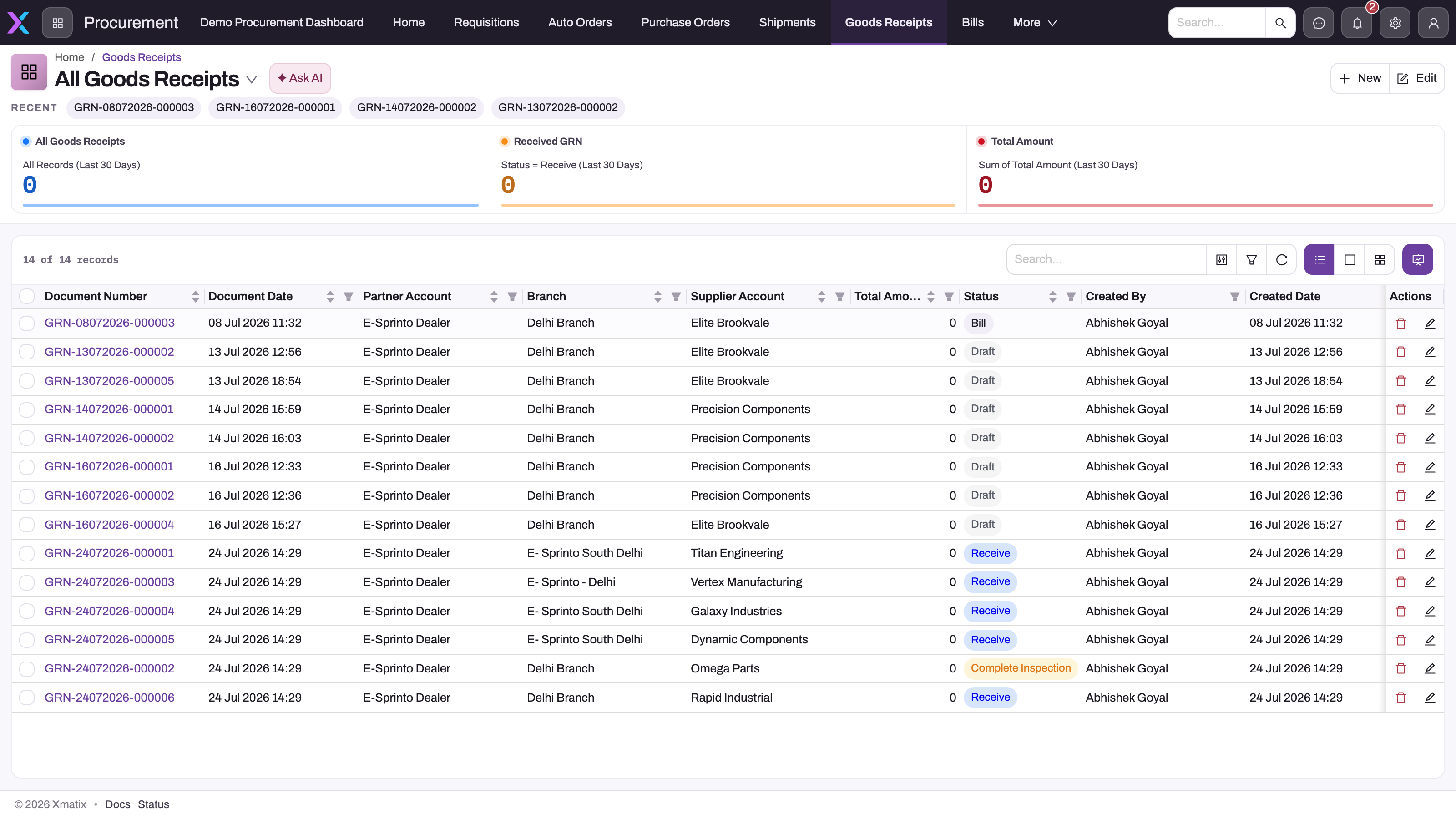
- 1
Open the receipt by its document number to reach the Lines tab and the Receive, Inspection, Release Bill and Post General Ledger actions.
- 2
Partner Account, Branch and Supplier Account are copied from the purchase order or shipment the receipt was released from and are locked after save.
- 3
Total Amount is received quantity x unit cost over the lines - the value the accrual journal posts.
- 4
Status is a manual marker; a line's inventory-ledger reference, pending inspection quantity and pending invoice quantity are the real state.
- 5
Received GRN counts receipts whose Status was set to Receive by a person, not receipts whose lines were posted.
- 6
New creates a stand-alone receipt with no order-line links; prefer releasing from the order or shipment.
Start from All Goods Receipts to find the delivery by supplier, branch and date. Because Status is a manual marker, open the receipt and judge progress from its lines: a line with an inventory-ledger reference has been received, one with a pending inspection quantity is still under inspection, one with pending invoice quantity is still unbilled.
Step 1 — Create the receipt from the order
On the purchase order, run Release Receipt to create a goods receipt for every line with pending quantity, or Selective Release Receipt to tick lines and enter a Requested Quantity per line (greater than zero, at most the line's pending quantity). The receipt copies the order's branch, partner account and supplier; each line gets the order line's item, SKU and unit cost and an Ordered Quantity equal to the released quantity. When the goods travel as a tracked consignment, release the receipt from the inbound Shipment instead (Release Receipt / Selective Release Receipt there); those lines arrive with Supplier Quantity filled from the shipment.
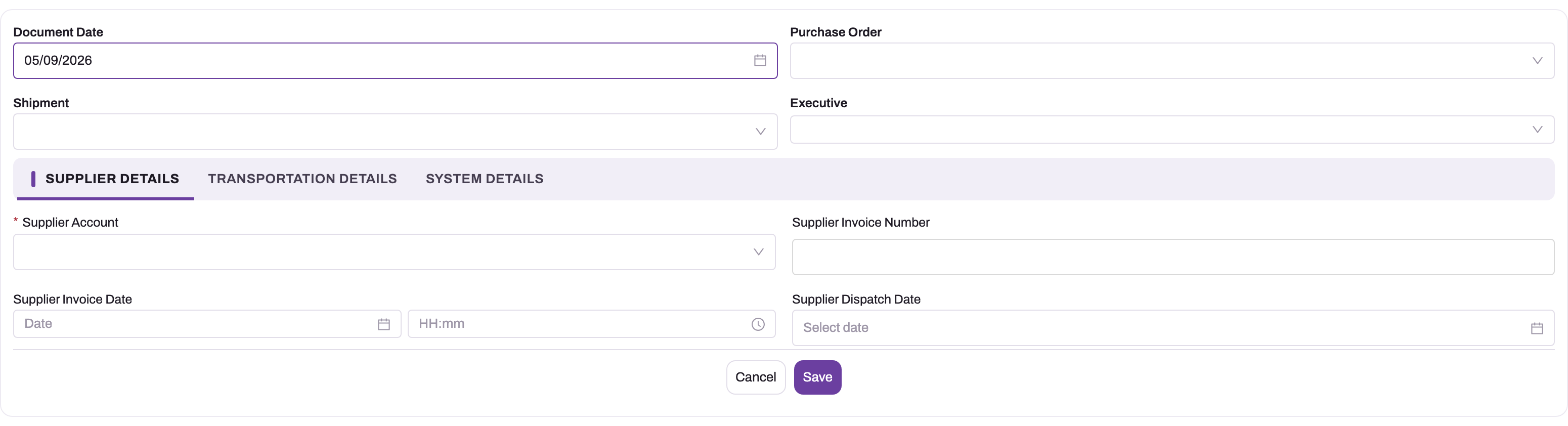
- 1
Document Date is the receiving date - stamped with today and locked after save.
- 2
Purchase Order or Shipment is filled by the release that created the receipt; which one is set decides whether Received Quantity or Supplier Quantity posts to stock.
- 3
Supplier Account is required and locked after save; it defaults to the branch's default supplier.
- 4
Supplier Invoice Number, Supplier Invoice Date and Supplier Dispatch Date are the supplier's references, kept apart from your document date.
- 5
Transportation Details holds carrier name, contact and reference; System Details holds Partner Account and Branch.
When lines are created — by a release or by hand — a line whose quantity exceeds the SKU's or item's Maximum Lot Quantity is split into several lines of at most that quantity, and an asset-tracked item is split to one unit per line, so a release of 63 tracked units produces 63 receipt lines.
You can also create a receipt directly with New — the form asks for the header fields above — but a stand-alone receipt has no order-line links, so nothing rolls back into an order and its bill lines cannot be matched to an order.
Step 2 — Record what actually arrived
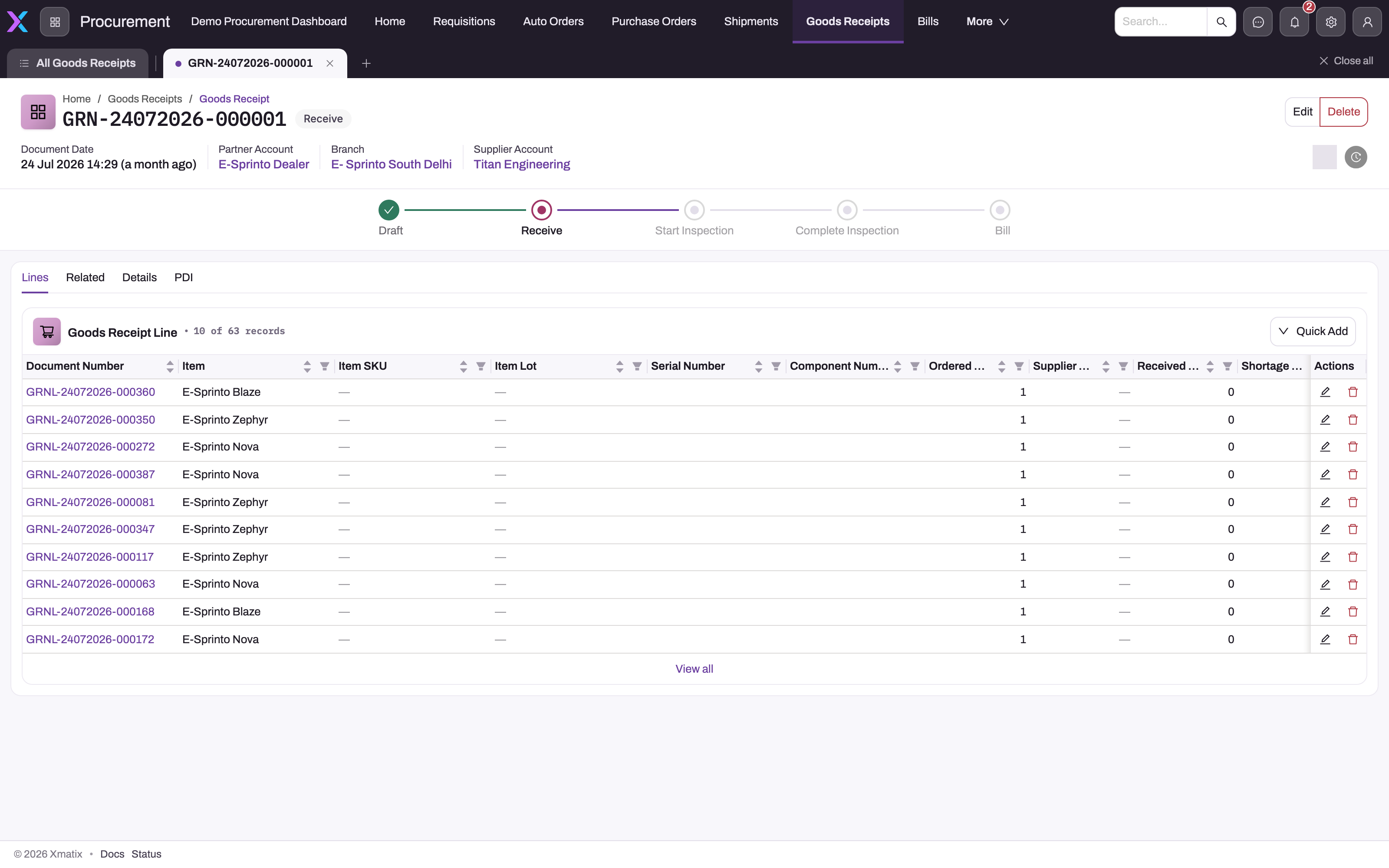
- 1
Draft - Receive - Start Inspection - Complete Inspection - Bill is set by clicking the next step; Receive, Inspection and Release Bill never move it.
- 2
Ordered Quantity is what the purchase-order line released onto this receipt; it rolls back into the order's Receipt Quantity.
- 3
Supplier Quantity is what the supplier's papers say was sent - mandatory before Receive, and capped cumulatively at the order line's quantity net of cancellation.
- 4
Received Quantity is the physical count; on a receipt released from an order this is the quantity that posts to stock.
- 5
Shortage (and Excess) are derived from supplier minus received and post to their own stock buckets.
- 6
Item Lot, Serial Number and Component Number are filled at receiving for items that track lots, serials or assets.
- 7
PDI hosts a manual checklist bound to a template; quality inspection lives on the inspection lines created by the Inspection action, not here.
On the Lines tab enter each line's Supplier Quantity, Received Quantity and any Damaged Quantity, plus lot, serial, MRP and manufacturing/expiry dates where your items track them. The lines' validations refuse a negative ordered quantity, unit cost or MRP, a manufacturing date in the future, an expiry date that fails the seeded manufacturing/expiry rule (its message reads Date Of Expiry should be less than Date Of MFG), and — for lines released from an order — a cumulative supplier quantity above the order line's quantity net of cancellation (Received quantity (N) cannot exceed the ordered quantity (M) for the purchase order line).
Step 3 — Receive into stock
Run Receive. The receive panel lists the lines; tick the ones that arrived and adjust their quantities in place — the values you enter there are applied to the lines before posting. Lines you leave unticked stay pending, so a delivery can be received in several passes. The action:
- refuses when the receipt has no lines, when every selected line already has an inventory-ledger reference (All Goods Receipt Lines have already been posted to Inventory), or when a selected line has no supplier quantity (Supplier Quantity is required for Goods Receipt Lines before receiving);
- creates or matches the item lot for each line and, for items that track assets, creates the asset records;
- approves the selected lines for inventory posting, which fires the inventory-ledger rules and stamps each line with its ledger reference.
Which quantity posts depends on how the receipt was created: a line released from a purchase order posts Received Quantity; a line released from a shipment or on a stand-alone receipt posts Supplier Quantity, and when the shipment line was already posted to the in-transit (pipeline) bucket the receipt moves that stock into inward stock rather than adding to it. Shortage, damage and excess post to their own stock buckets. Verify the resulting ledger entry rather than assuming the same field posts on every receipt.
Step 4 — Start the inspection
Run Inspection. It creates one inspection line for every receipt line whose item has Inspection On Receipt enabled and whose pending inspection quantity is positive, copying the item, lot, SKU, storage location, unit cost and quantities with the damaged quantity already netted out. Saving the inspection lines moves the quantity into the inspection stock bucket and writes the started-inspection and damaged quantities back onto the receipt line. Record your findings on the inspection lines; an inspection line can raise a service order for rework with Create Service Order.
Step 5 — Complete the inspection
Run Inspection Complete. It closes every open inspection line — inspection and adjustment quantities to zero, Inspection Done and Approved set — and approves them for posting, releasing the inspected quantity from the inspection bucket. Until this step the flagged quantities are not available stock.
Step 6 — Release the bill
Release Bill creates a supplier bill for the receipt's lines with pending invoice quantity. The bill copies the receipt's branch, partner account, supplier and document date and links back to the receipt; each bill line links to its receipt line (Goods Receipt Line), with that line's pending invoice quantity, tax group and lot. It does not carry the purchase-order-line link, so a bill released here clears the receipt but is invisible to the three-way match service; when you need both links, release the invoice from the purchase order after the receipt exists instead. The bill's item lines are priced from the bill's price list when they are created — see supplier bills.
Step 7 — Post the accrual
Post General Ledger posts the receipt's journal — inventory debited, the goods-received-not-invoiced account credited — for the header Total Amount (received quantity × unit cost over the lines) and marks the receipt GL-posted. The bill's own posting later clears that accrual for lines linked to a receipt line. Posting is independent of receiving: run it once the received quantities and unit costs are final.
The PDI tab hosts a checklist bound to a configured checklist template. It is delivery evidence you tick through by hand and is separate from the inspection lines created by Inspection; quality-inspection quantities and completion live on the receipt lines and the inspection records.
Expected result
Supplier, received, damaged, shortage and excess quantities stay separately visible; every posted line has an inventory-ledger reference and a cost layer at the line's unit cost; inspection-required items have inspection lines that were closed by Inspection Complete; the receipt has a GL-posted accrual and, if you released one, a bill linked to its lines. The purchase order's receipt counter reflects the ordered quantities you released, not the counted quantities.
Common problems
- "Supplier Quantity is required for Goods Receipt Lines before receiving." Fill in the supplier quantity on every ticked line (or in the receive panel), then run Receive again.
- "All Goods Receipt Lines have already been posted to Inventory." Nothing selected is left to receive — check the order for remaining pending quantity and release a new receipt if more is coming.
- "Received quantity (N) cannot exceed the ordered quantity (M) for the purchase order line." The supplier quantities across this order line's receipts add up to more than was ordered net of cancellation. Correct the supplier quantity, or increase the order quantity first.
- "No Goods Receipt Line requires inspection." None of the receipt's items has Inspection On Receipt enabled, or nothing is pending inspection because it has not been received yet or was already inspected.
- "No Inspection Line found with pending completion." Every inspection line is already done.
- "No Goods Receipt Lines found to Release Bill." Every item line has been fully billed already.
- The line posted a different quantity than I counted. The receipt came from a shipment or was created stand-alone, so Supplier Quantity posted instead of Received Quantity. Correct the supplier quantity on such receipts before receiving.
Common questions
Are all items inspected?
No — only items with Inspection On Receipt enabled. Everything else goes straight to available stock when received. The flag lives on the item record, so mixing flagged and unflagged items on one receipt is fine: only the flagged lines get inspection lines, and Inspection refuses to run on a receipt that has none.
Can I receive a delivery in several passes?
Yes. Tick only the lines that arrived in the receive panel; the rest stay pending on the receipt. At the order level, selective releases let you create separate receipts per delivery as well.
What if the delivered quantity differs from what was ordered?
Record the supplier's papers in Supplier Quantity and the physical count in Received Quantity; the shortage or excess is derived and posted to its own bucket. The over-receipt check compares cumulative Supplier Quantity with the order quantity, while the backend match compares cumulative Received Quantity with the ordered quantity — review both when a delivery differs from the order.
Does the status stepper change when I run Receive or Inspection?
No. The stepper only records the value you click; the actions never write it. Use the line-level ledger reference, pending inspection quantity and pending invoice quantity to see where a receipt stands.