
Dealer orders reach xMatix two main ways: built up cart-style from the Product Catalogue, or handed off from the dealer's own purchase order. Both produce an ordinary sales order, so everything downstream — pricing, schemes, credit, allocation, fulfilment, invoicing — is the standard pipeline. This page covers the two capture paths and the handoff mechanics.
Cart-style capture with the Product Catalogue
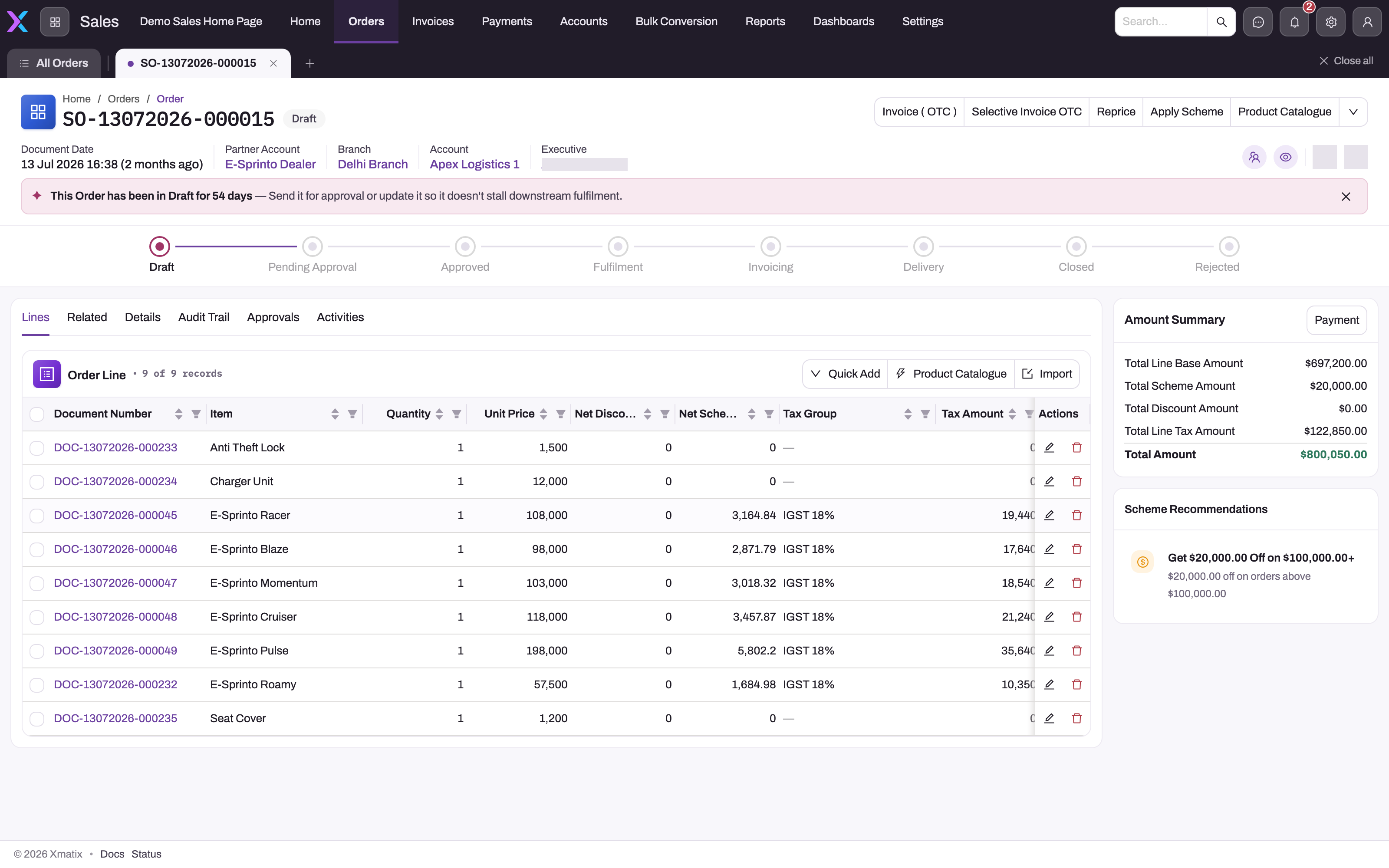
- 1
Partner Account (the selling dealer), Branch and Account (the customer) are the commercial context every line inherits — the same fields a purchase-order handoff fills in.
- 2
Product Catalogue opens the store's merchandised catalogue for this document; Apply Scheme and Reprice re-run the scheme and pricing engines on demand.
- 3
Lines can also be added with Quick Add or Import — whichever path is used, the same line handlers price and discount them.
- 4
Amount Summary shows base, scheme, discount and tax totals; Payment records money against the order.
- 5
Scheme Recommendations show trade schemes the order qualifies for or is close to.
- 6
The status ladder is the standard sales-order lifecycle — nothing about a dealer order changes it.
A dealer order is an ordinary sales order in the Sales app, and everything on its page is the standard order machinery: Partner Account, Branch and Account in the header, the status ladder from Draft through Approval, Fulfilment, Invoicing and Delivery, the Lines grid, and an Amount Summary with Scheme Recommendations beside it. What Commerce adds is the Product Catalogue action — in the header actions and again on the Order Line toolbar next to Quick Add and Import.
From an open order (or purchase order, on the buying side), Product Catalogue opens the store's merchandised catalogue described in Catalogue and pricing: tabs for Focused, Frequently Ordered, New Items, Schemes and All, a barcode scanner, search by name or code and a sort control. The user browses, filters and sets quantities per unit of measure where the item defines a unit ladder. In this host-document surface, Add to document writes the selected line to the open document immediately; it is not the persisted public-storefront Cart record.
Each created or updated line then runs the document line handlers that resolve price, discounts and other derived values. The catalogue's offer text remains a prompt; the document engines are the authority. Public storefront carts and checkout sessions are a separate direct-to-consumer flow described in Direct-to-consumer selling.
The dealer handoff: requirement to supplying order
When the dealer's requirement is itself an xMatix document — a purchase order naming the supplier and the supplier's branch — the dealer-order handoff creates the supplying sales order from it, so nobody re-keys the requirement:
| On the purchase order | Becomes, on the sales order |
|---|---|
| Supplier branch | The order's branch, and its partner account the selling company |
| The party raising the requirement | The order's customer account |
| Lines with outstanding quantity | Order lines (item, SKU, quantity), each referencing its requirement line |
Three behaviours make the handoff safe to repeat:
- Only outstanding quantity moves. Each requirement line tracks how much has already been ordered against it; the handoff takes what remains, so running it twice cannot double-supply.
- Quantities roll up. The created order lines count back against their requirement lines, so the outstanding figure falls as supply is arranged — visible from the purchase order at any time.
- It can be selective. The selective variant takes chosen lines and chosen quantities, capped at what is outstanding — for supplying part of a requirement now and the rest later.
The handoff refuses to run without a supplier branch on the purchase order, and refuses when no line has outstanding quantity — both with explicit messages. On the sales-order side, the same Create Dealer Order action does the reverse convenience: an order linked to a dealer's purchase order pulls that document's outstanding lines in. Reprice and Apply Scheme on the order re-run pricing and scheme evaluation after lines arrive by either path.
The standard pipeline takes over
However captured, the order is now a sales order:
| Stage | Documented at |
|---|---|
| Pricing, contract discounts, taxes fill in | Pricing, discounts and taxes |
| Trade schemes evaluate on save | Schemes and credit |
| Credit limit gates creation | Credit limits |
| Stock is allocated | Allocating stock to orders |
| Picking and fulfilment | Picking and fulfilment |
| Delivery and invoicing | The sales order lifecycle |
| Payment and receivables | Invoicing and payments |
Other capture channels
The same order document is also created by hand in the Sales app, captured on field visits (including van sales, where the vehicle sells from its own stock), and invoiced in bulk from the order-processing screen — see creating a sales order, van sales and bulk order processing.
Common questions
The dealer sent a second requirement for the same items — what happens?
A second purchase order is a new requirement and hands off independently. Re-running the handoff on the same purchase order, though, only ever takes what is still outstanding — quantity already turned into an order has rolled up against the requirement lines, so the repeat covers the remainder and a fully ordered document has nothing left to hand off.
Can the supplier accept only part of what the dealer asked for?
Yes — the selective handoff takes named lines and quantities, capped at each line's outstanding figure. The rest stays outstanding on the purchase order for a later run.
Does an order from the catalogue cart skip pricing, schemes or credit?
No. Product Catalogue adds lines to the same document used by manual entry. The line and document handlers apply pricing, discounts, scheme evaluation and the available credit checks through the normal lifecycle; using the catalogue does not create an alternate pricing pipeline.