
Read the Sense Agent surface
- 1
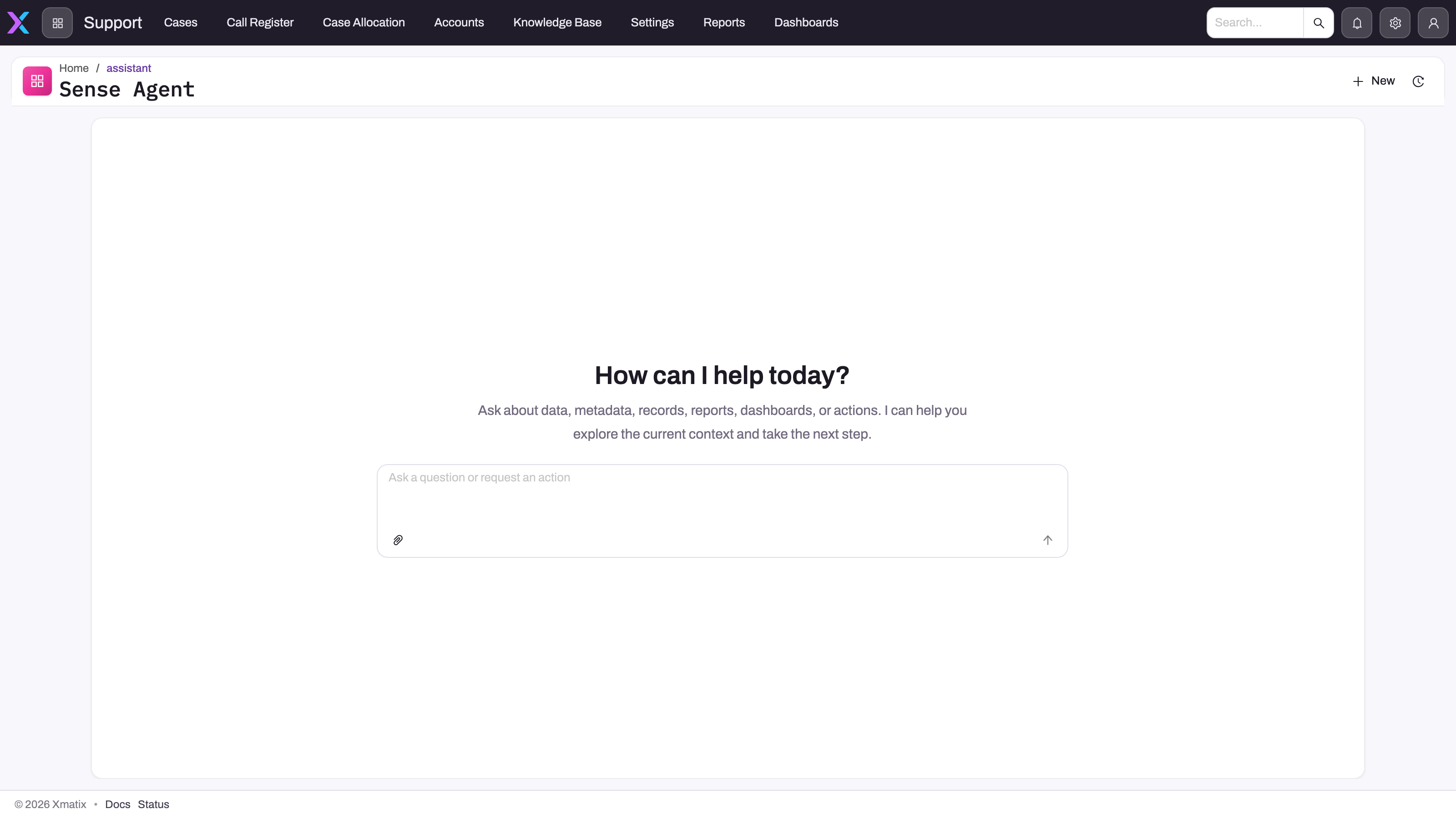
The active app and its navigation remain visible around the assistant; the label is tenant-dependent.
- 2
Sense Agent and its breadcrumb identify the full-page assistant rather than a record list or Setup Copilot.
- 3
New starts a clean conversation and refresh reloads the current session; neither control changes the configured execution identity.
- 4
The welcome text names supported subjects—data, metadata, records, reports, dashboards and actions.
- 5
The visible composer accepts a prompt or attachment; this empty screen does not imply a particular tool or approval policy.
The full-page Sense Agent keeps the current xMatix app visible while providing a dedicated investigation canvas. The breadcrumb identifies the assistant route, New starts a clean conversation, refresh reloads the current session, and the prompt composer accepts a question or attachment. Ask about data, records, reports, dashboards or actions in ordinary language, but remember that the answer is assembled only from records the signed-in user can access.
The screenshot is an intentionally empty conversation state: it documents the real assistant controls without exposing prior prompts, responses or attachments. A new chat does not change licensing or the execution identity chosen for the agent. Approval behavior for tool calls is deployment-configured, so administrators must verify the effective identity, enabled tools and approval policy rather than inferring them from this neutral screen.
Sense is the AI layer of xMatix. It answers questions, surfaces proactive suggestions called nudges, reads configured shelf-photo attachments and helps administrators configure the platform. Its data scope comes from the effective agent execution identity and its write/tool controls come from runtime configuration, so both require explicit administrative review.
One principle, three words
Sense is easiest to govern as three separately verifiable layers: deterministic signals, AI delivery, and configured action controls.
- Deterministic signals. The triggers are fixed arithmetic over your data — an invoice past due, an order near a scheme threshold, a purchase quantity off its expected value. The same data always produces the same signals, and the thresholds are visible and tunable.
- AI delivery. What the model adds is language and retrieval: a plain-language explanation of why something fired, an answer assembled from records you could open yourself, a drafted report or dashboard.
- Configured action controls. Nudge mutations show a confirmation dialog. Agent tool approval is controlled by the deployment's human-approval switch and its approval-required tool list; it is not safe to assume every tool call pauses in every environment.
Interactive turns run under the routed agent's resolved execution identity. When an agent has an explicit execution account, that account becomes the effective user for the turn; otherwise the resolver uses its configured fallback behavior. Scope dedicated execution accounts narrowly, test them against representative prompts and do not describe the asking user's list access as an automatic ceiling unless your deployment independently enforces that intersection. The full governance checklist is in How Sense AI is governed.
What's in this section
| Page | What it covers |
|---|---|
| Asking Sense about your data | The chat assistant — what it can and cannot do, the drawer vs the full page, mobile chat |
| Sense Home | The home surface: morning brief, KPI strip, attention queue, industry pulse |
| The nudge library | Reference for the nine built-in nudges — what each computes and where it appears |
| Nudge administration | Enabling nudges and tuning each source's thresholds, cooldowns and caps |
| AI Studio | The admin surface governing models, agents, knowledge, tools and credits |
| Create an agent | Building a Sense agent: model, instructions, knowledge, routing, testing |
| Shelf Vision | Shelf photos scored for planogram compliance and share of shelf |
| Setup Copilot | Configuring xMatix by asking — task by task, with confirmation |
| Extending Sense | Bringing your own tools to Sense agents as tenant capabilities |
| Using Sense from Claude, ChatGPT or Claude Code | Connecting an external assistant to your organization, what it can do as you, and the administrator controls |
Who sees Sense
Availability is an administrative decision, made in layers. A user sees Sense surfaces only when they hold a Sense AI seat — see Licensing — and the module's master switch is on. A separate switch controls nudges independently, so an organization can run the assistant without suggestions, or neither. Per-source controls then shape exactly what the licensed group receives. If you expected a Sense surface and don't see it, start with your administrator, not with support.
Related topics
- How Sense AI is governed
- Sense AI on the xMatix site — the product overview
- Sense in Claude and ChatGPT — the external-assistant overview
- Agentic AI use cases — the use cases, stated as jobs
- How xMatix approaches AI trust
- See Sense in a demo