
A posted claim is a liability: the amount sits in employee payable until finance pays it. Reimbursement clears that liability one claim at a time, through a batch, or through the payroll handoff. A successful finance reimbursement moves the claim's business status from Posted to Settled and its payment status to Paid; keep those two fields distinct during reconciliation.
Prerequisites
- Posted claims — final approval posts a claim automatically; a claim that is not posted cannot be reimbursed.
- The bank GL account the payments go out of.
- Finance access to Expense Claims and Reimbursement Batches through your security profile.
Procedure
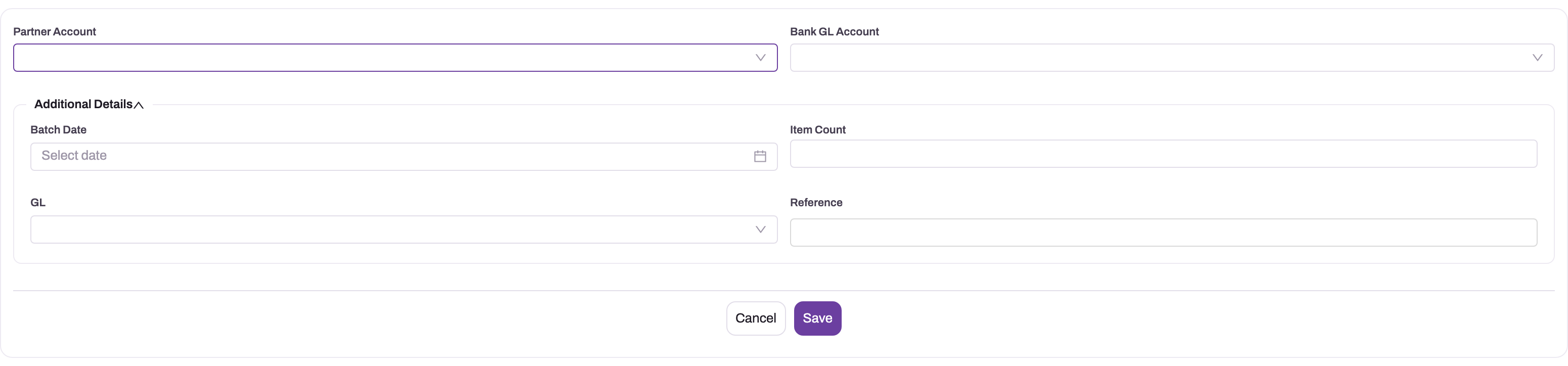
- 1
Partner Account scopes the operating company for the batch.
- 2
Bank GL Account is the cash account used by eligible reimbursements.
- 3
Batch Date fixes the run's accounting date.
- 4
Item Count and GL are header controls; reconcile them after lines are processed.
- 5
Reference identifies the run; Save creates only the unpaid batch shell.
Step 1 — Find what is payable
Filter Expense Claims to Posted and Unpaid, then reconcile that set with employee-payable ageing. For each candidate, confirm employee, currency, approval, posting journal, open balance, advance settlements and reimbursement mode. Separate finance-payment claims from payroll-mode claims before building a run; do not copy the gross claim amount when the open item has already been reduced. Record the selected count and total as the control figure for later verification.
Step 2 — Pay a single claim
Open the finance-mode claim, choose Reimburse, and verify the bank account, employee beneficiary, currency and displayed open balance; a claim-specific payment account takes precedence when present. Submit once and open the journal: employee payable is debited and bank credited for the full remaining balance after advance settlements. Confirm the open item is closed, status is Paid, and a second reimbursement is refused.
Step 3 — Pay many claims as a batch
Create a Reimbursement Batch, enter payment date and bank account, then add one line per reviewed claim. Compare its line count and calculated total with the Step 1 control before selecting Pay Batch. The action settles each eligible employee payable at its actual open balance. Unposted or already-settled claims are silently skipped: their batch lines remain Pending, and the handler does not store a per-line skip reason. Reconcile every Pending line back to its source claim instead of treating batch completion as proof that all lines were processed.
Step 4 — Hand payroll-mode claims to payroll
For a payroll-mode claim, confirm the payroll period and employee mapping, then choose Settle via Payroll and link the payroll run where available. This does not pay cash: it moves the liability from employee payable to payroll payable and marks the expense-side claim Paid. Open the transfer journal, verify amount and accounts, and confirm the payroll run contains the reimbursement for that employee. Reconcile final cash delivery on the payslip; see xMatix Payroll for that side.
Step 5 — Verify the run
After each run, verify every processed claim shows payment Paid and business status Settled. Investigate every batch line still Pending against the source claim because no skip reason is stored. Rerun employee-payable ageing: processed items must disappear and the remaining total must equal the employee-payable control account. Reconcile batch totals to journals and payment evidence, and payroll settlements to payroll payable.
Expected result
Every processed finance-mode claim is paid for its actual open balance, payroll-mode claims move to payroll payable instead, and settled claims disappear from employee-payable ageing. Any Pending batch line is resolved from its source claim before the batch is signed off.
Common problems
"Expense claim must be posted before it can be reimbursed." The claim's approval finished but posting did not happen — usually a missing control account at posting time. Fix the cause and run Post on the claim, then reimburse. See Troubleshooting.
"Claim is set to reimburse via payroll." A finance reimbursement is not applicable to a payroll-mode claim by design — use Settle via Payroll, or change the claim's reimbursement mode first if it was set wrongly.
"Batch has no payable claims to reimburse." Every line in the batch was skipped: the claims are unposted, already paid, or fully covered by advances. Rebuild the batch from the posted-and-unpaid filter.
A claim was paid for less than the employee expected. The payment is the open balance — the claimed total minus policy disallowances and advance settlements. Both deductions are recorded on the claim; nothing was lost in the payment run.
Common questions
Can I partially pay a claim?
A finance reimbursement pays the claim's full open balance in one go — partial states arise from advance settlements reducing the balance before you pay, not from partial payment runs. If you need to stagger payouts, stagger the claims.
Can one batch mix branches and employees freely?
Yes. The batch settles each claim's own payable and merges the accounting per control account and branch, so a company-wide payment run is one batch and one bank payment regardless of how the claims are spread.
What tells the employee they have been paid?
The claim itself: its payment status flips to Paid and the claim shows as settled. Employees track their own claims in the Expenses app — no separate notification step is required for the state to be visible.