
Read the company-card master
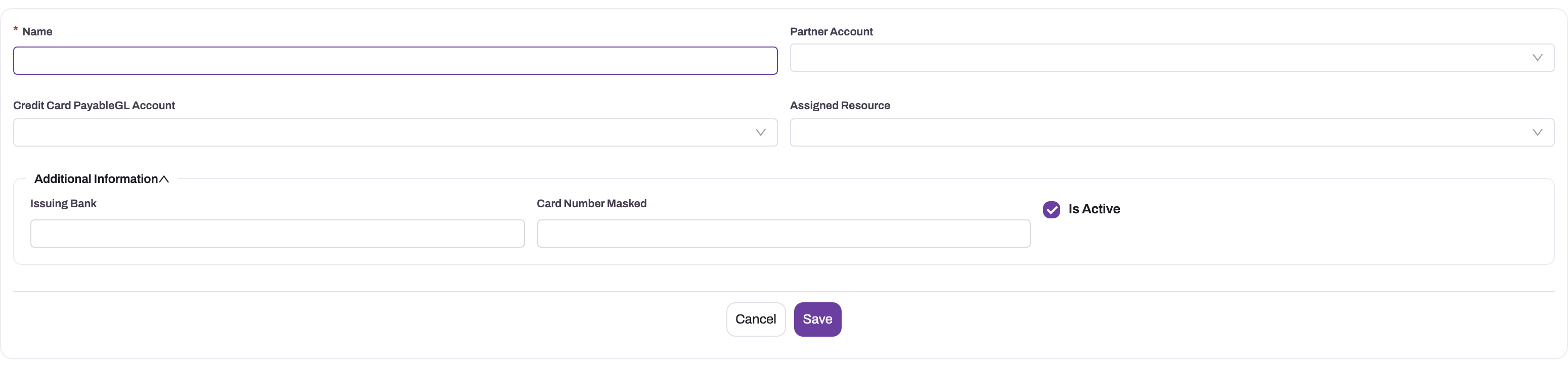
- 1
Name gives finance a recognizable card master without relying on the card number.
- 2
Partner Account identifies the operating company responsible for the issuer liability.
- 3
Assigned Resource links the card to the employee accountable for receipts and coding.
- 4
Credit Card Payable GL Account is where posted statement transactions accumulate.
- 5
Issuing Bank and Card Number Masked support matching; Is Active controls participation.
The company-card master separates accountability from settlement. Name gives users a safe label, Partner Account establishes the operating company, and Assigned Resource identifies the employee responsible for receipts and coding. Issuing Bank and a masked card reference support statement matching. The liability GL account is the accounting hinge: posted transactions credit that account until a bank payment clears the issuer balance.
Create one active master per physical card and avoid placing a full card number in the name or any narrative field. Confirm the cardholder is current, the issuing bank is correct and the liability account belongs to the right company before importing or entering transactions. When a card changes hands, deactivate or close the old assignment according to your control policy so historical transactions retain their original accountable employee. The screenshot uses visible synthetic demo2 data so readers can follow realistic rows, values and controls together; production exports and screenshots must still remain inside authorized channels.
Company-card spend is not a reimbursement problem — the company owes the card issuer, not the employee. xMatix therefore keeps card spend on its own track: each card is a master mapped to its cardholder, each statement line is a transaction, posting a transaction books the expense against a card liability, and paying the statement clears that liability from the bank. No employee payable is ever raised, which is precisely the point.
The three records
- Company card — one per physical card: the masked card number, the issuing bank, the cardholder (an employee record), and optionally a dedicated card-liability GL account for this card. Cards can be deactivated when returned.
- Card transaction — one per statement line: date, merchant, amount, the expense category and expense GL account it belongs to, and optionally a receipt and a link to the expense claim line it corresponds to. A new transaction starts as
Unmatched— meaning nobody has yet posted or tied it to anything. - Card reconciliation — a record that ties a statement to its posted transactions, so a period's card activity can be signed off as complete.
Transactions are created from the card statement — entered directly or brought in through the banking statement-import tooling — and coded with their category and expense account before posting.
Posting card spend
Running Post on a card transaction books it: the expense account is debited and the card's liability account is credited (the card's own account if one is set, otherwise the tenant's card-payable control account). The transaction is stamped Posted and carries its journal reference. A transaction needs an expense account and a positive amount before it will post, and it will not post twice.
Because the credit goes to the card liability, the cardholder is never owed anything for card spend — contrast this with a claim, where posting credits the employee payable. A company-card purchase therefore belongs on the card transaction, not as a reimbursable line on a claim; the claim is for money the employee spent out of pocket. When a card purchase also appears in a claim's story (a hotel bill inside a trip claim, say), link the card transaction to the claim line — the link records the correspondence for reconciliation without paying anyone twice.
Paying the statement
When the card bill falls due, run Pay Card Statement on the card with the bank account and the amount you are paying. The payment debits the card liability and credits the bank. Do not rely on the card master's Amount Due field as a live roll-forward: the current posting/payment services do not update it. Reconcile the liability account and statement transactions directly.
Reconciling a period
Reconciliation is the discipline that makes card accounting trustworthy: every line on the issuer's statement should exist as a transaction, every transaction should be posted, and the liability account's balance should equal what the issuer says you owe. The reconciliation record ties a statement to its posted transactions; unposted or unmatched transactions are the gap list to work through. Receipts and claim-line links attached along the way are what make the sign-off defensible.
Common questions
Does card spend show up in the employee's expense balance?
No. Card spend credits the card liability, so the employee-payable subledger never sees it. The cardholder's name is on the card master for accountability and reconciliation, not for payment.
What happens if someone claims a card purchase as an out-of-pocket expense?
The claim would reimburse them for money they never spent while the card side books the same cost against the issuer. Catch it during review: current duplicate detection compares expense-claim lines with other claim lines, not claim lines against company-card transactions. Reconcile statement rows, payment mode, merchant, invoice and amount explicitly. Card purchases belong on the card transaction.
Can one card have its own liability account?
Yes — set a card-specific liability account on the card master and its postings use it; cards without one share the tenant's card-payable control account. Per-card accounts make issuer-by-issuer reconciliation trivial at the cost of a longer chart of accounts.