
A lead is interest that hasn't been qualified yet — a name, a way to reach them, and what they seem to want. You work it with calls and tasks until it is real, then convert it: conversion creates (or reuses) the account, gives it a contact, and opens an opportunity linked back to the lead. Leads that warrant no opportunity can release straight to a sales order instead.
Prerequisites
- Access to the CRM app with create permission on the Lead entity.
- A partner account and branch are required when the lead is created or updated, unless both resolve from a mapped postal code. They are also required for direct release flows.
Procedure
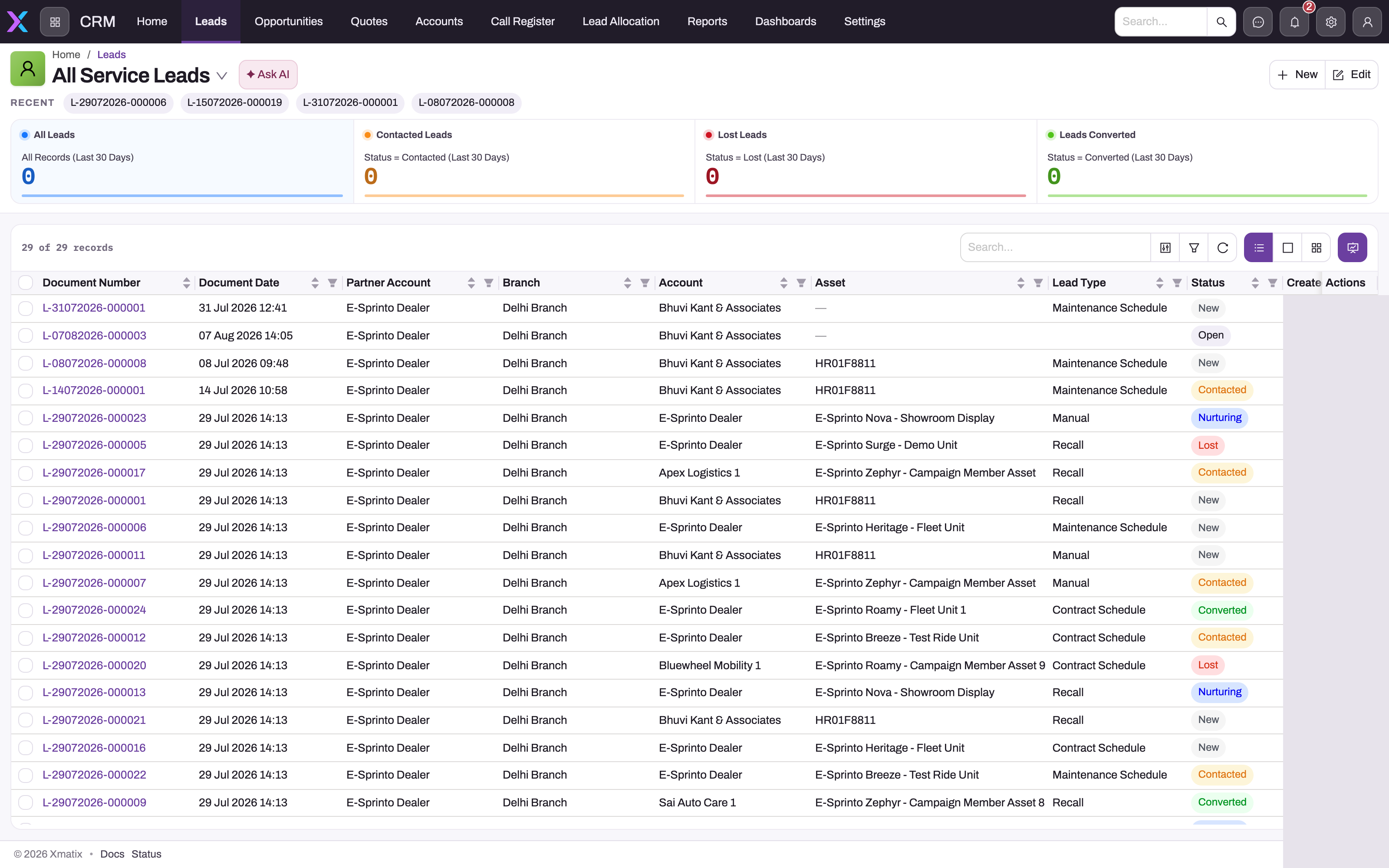
- 1
Saved views split leads by record type (All Sales Lead, All Service Leads, All Partner Leads…) and state (All Open Leads, All Lost Leads); New opens the form for the current view's record type.
- 2
Summary cards count the last 30 days by Status — Contacted, Lost and Converted — so the pipeline's health is visible before opening a record.
- 3
Partner Account and Branch are the required routing context (resolved from the postal code or entered by hand); Account fills automatically when the phone number matches an existing account.
- 4
Asset links a lead to the equipment it concerns; Lead Type records how it was created (Manual, Recall, Maintenance Schedule, Contract Schedule).
- 5
Status: New and Open leads await qualification, Contacted and Nurturing are being worked, Converted has produced an opportunity, Lost carries a reason.
- 6
New creates a lead; Edit changes the current view's columns and filters.
The Leads list is the working surface: saved views split leads by record type and state, the summary cards count the last 30 days by status, and each row shows the routing context — Partner Account, Branch, Account — beside the lead's Status. The create form's tabs and fields depend on the lead record type your organization has configured (the standard Lead entity carries Partner Account, Branch, Executive, Postal Code, Interested Item, Source and Rating; a partner-onboarding record type asks for business details instead), and New opens the form for the record type of the view you are on — so switch to the right view first when your organization uses more than one lead type.
Step 1 — Capture the lead
In the CRM app open Leads, pick the view for the kind of lead you are capturing, and choose New. Record who the lead is (name, account name, phone, address), where it came from (source, rating) and what they are interested in (the interested item). Several fields fill themselves on save:
- The document date defaults to today.
- If you enter a postal code that your organization has mapped, the lead's branch and partner account resolve from it automatically.
- If the phone number matches an existing account, the lead links to that account and takes its name details — so repeat customers don't spawn duplicates.
- If you pick an asset, the lead links to the asset's owning account.
Before saving, search by phone and account name, confirm any automatically resolved account, partner account and branch, and correct the postal code rather than overriding a surprising result blindly. Reopen the saved lead and verify the document date, source, rating, interested item and ownership are populated as intended.
Step 2 — Qualify
Work the lead from its timeline: log calls and emails, create tasks and schedule meetings — see Activities. Record an outcome and next action for every touch so another seller can continue without reconstructing the conversation. The lead keeps two counters current from its activities — whether it has been called or emailed at all, and how many tasks and events it carries — which business rules can read to advance status automatically. After each meaningful interaction, verify the timeline entry, counters, rating, owner and status agree; mark genuine dead ends Lost with a reason so pipeline reporting stays honest.
Step 3 — Convert
Run Convert Lead from the lead record. Conversion creates, in one step:
- An account — only when the lead isn't already linked to one. The new account is named from the lead's account name and marked as an active customer.
- A contact on the account — only when the account has none yet.
- An opportunity — carrying the lead's account, partner account, branch, asset and service contract, dated today and linked back to the lead. Where the lead named an interested item, the opportunity starts with a line for it.
Your organization may present conversion as a guided dialog instead: there you choose explicitly whether to create a new account or use an existing one, whether to create the contact, whether to create the opportunity or link an existing one, what status the lead should take once converted, and you can adjust field values on each record before they are created. Records you create or pick in the dialog win over the lead's old links — converting with a brand-new account points the opportunity at the new account, not the old one.
Which conversion actions a lead offers depends on its record type and your organization's configuration. Review the conversion summary before confirming, especially every “create new” versus “use existing” choice. After conversion, follow the links from the lead and verify the account was not duplicated, the contact belongs to that account, the opportunity carries the correct branch and partner, and the lead's terminal status and conversion audit are visible.
Step 4 — Or release straight to an order
For leads that skip the deal stage entirely, Release Order creates a sales order from the lead directly. Before running it, confirm the partner account, branch, customer, interested item and quantity because those values seed a financial document. The action refuses missing organizational context and should be run only once. Open the resulting order from the lead, reconcile its header and lines, and verify a second Release Order attempt is blocked before continuing through the normal sales order lifecycle.
Expected result
The lead has verified contact and routing context, its activity timeline supports the current qualification status, and conversion creates or links only the intended account, contact and opportunity. The original lead remains traceable as converted or released and cannot generate duplicate downstream documents.
Common problems
A lead that was already converted refuses to convert again with "An opportunity has already been created for this lead." — open the linked opportunity instead of re-converting. Release actions fail with "Partner Account is mandatory for this transaction." or "Branch is mandatory for this transaction." when neither the fields nor the postal code supply them — fill them in and retry. If a new lead unexpectedly shows another customer's name, its phone number matched an existing account at capture; correct the number or the account link before converting.
Common questions
What exactly does conversion create?
At most three records: an account (only if the lead has none), a contact (only if the account has none), and an opportunity linked to the lead. Nothing is duplicated when the lead already points at an existing account — conversion reuses it.
What happens to the lead afterwards?
It stays, linked to the opportunity it produced, so the source of the deal remains traceable. In the guided dialog you also choose the status the lead takes on conversion (for example a "Converted" value your organization defines).
Can I convert a lead to an existing account and opportunity?
Yes — in the guided conversion dialog, pick the existing account (and contact or opportunity) instead of creating new ones. The lead links to whatever you picked.