
Every record in xMatix that has activities enabled carries a timeline — the running history of engagement with it. One activity model covers all of it: tasks, calls, meetings and events, emails, notes and documents, each logged against the record it concerns and, where relevant, the account and contact involved. Learn it once on a lead and it works the same on an opportunity, an account, a case or an order.
The call register at a glance
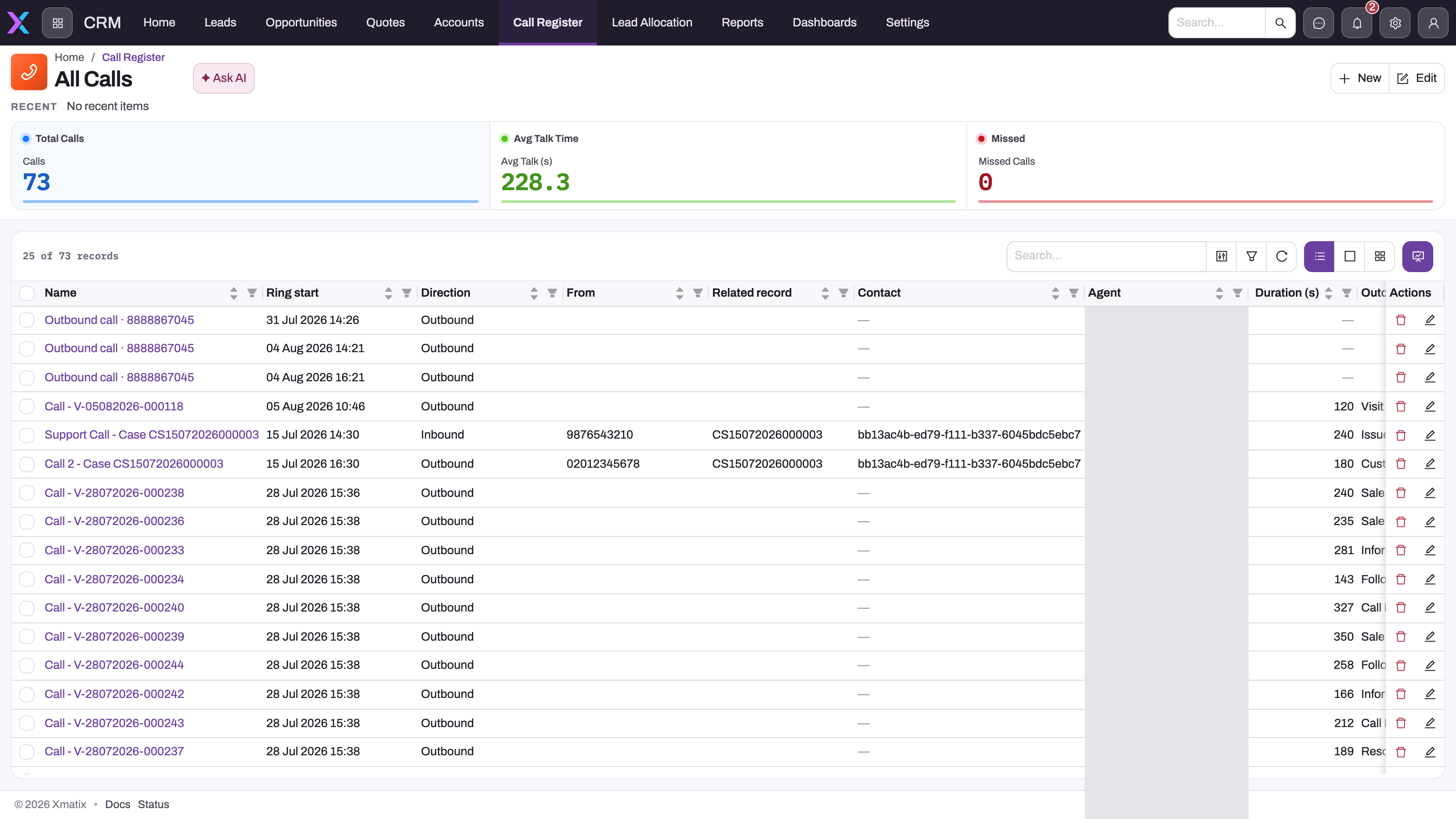
- 1
All Calls is the saved view; New logs a call by hand (calls from an integrated telephony provider arrive automatically).
- 2
Total Calls, Avg Talk Time and Missed give the workload and responsiveness signals for the current view.
- 3
Direction, From and Related record say who called and which case, order, visit or deal the call belongs to; calls linked to a record also write a call activity onto that record's timeline.
- 4
Agent (masked here), Duration and Outcome record who handled the call, how long it took and how it ended.
- 5
Open a call to Link to record or Create record (case, lead, opportunity, order, service order or task) from it.
The Call Register (CRM app → Call Register) is the organisation-wide view of phone calls, while a record's timeline is its own engagement history. Read each call across the row: ring time and direction give the chronology, From and Contact identify the participant, Related record names the case, order, visit or deal the call was about, Agent says who handled it, and duration and outcome capture the result. The cards above the list — total calls, average talk time, missed calls — summarise the current view.
When a call belongs to a case, order, lead or opportunity, link it to that record so the completed call writes into the same timeline as tasks, notes and emails. That keeps both views without duplication: supervisors analyse the register, and a record owner reads the complete customer history in context.
Activity types
| Type | What it carries |
|---|---|
| Task | Due date, status, priority — work to be done against the record |
| Call | Direction (inbound/outbound), disposition (connected, no answer, …), duration |
| Meeting / Event | Start and end, all-day flag, location, availability shown to others |
| The message logged against the record | |
| Note | Free-form text with a visibility setting |
| Document | A file attached to the timeline |
Activities can carry reminders, and notes have visibility: internal notes (the default) stay inside your organization, public ones are visible to external audiences such as portal users — so a customer-facing note is an explicit choice, never an accident.
Activities do work, not just record it
Timelines aren't passive. A lead, for example, keeps counters current from its activities — whether it has been called or emailed, and how many tasks and events it carries — and your organization's business rules can read those to advance the lead automatically (working leads). Activity reporting works across records too, because every activity is one row in the same model regardless of what it hangs on.
The call register
Alongside call activities, CRM keeps a Call register: one record per actual phone call, with numbers, direction, ring/answer/end times, duration and wait time, outcome and notes. A call links to the record it was about — and from a call you can link to record (attach it to an existing case, order or deal) or create record (spin up a case, lead, opportunity, order, service order or task from the call, pre-filled with the caller and notes). A completed call writes a call activity onto the linked record's timeline, so the record's history stays in one place.
Common questions
Who can see a note I write?
Internal notes: your colleagues, subject to normal record access. Public notes: also external viewers of the record, such as portal users. Visibility is set on the note itself; when in doubt, leave it internal — that is the default.
Do activities change the record they are on?
They append to its timeline always, and on some records they also drive fields — lead contact and task counters are recomputed from activities so edits and deletions keep them accurate. Whether a status changes as a result depends on the business rules your organization has configured.
Related topics
- Leads
- xMatix CRM overview
- Documentation home — a dedicated engagement section is planned; this page stays the CRM-side summary
- Task — entity reference