
While you are out on a beat, the plan agenda can show a "Nearby to onboard" feed: outlets around your position that are not on today's plan or route — existing customers you are walking past, and prospect places sourced from external lookups — ranked by distance. From the same cards you can propose an existing customer as a new route stop or onboard a brand-new outlet on the spot, so a gap in coverage becomes a stop instead of a missed observation.
Prerequisites
- The nearby feed enabled on your organization's visit-plan agenda (it is a configuration choice).
- Device location permission — the feed is anchored on where you are standing.
- Permission to create customer accounts, if you will onboard new outlets.
Procedure
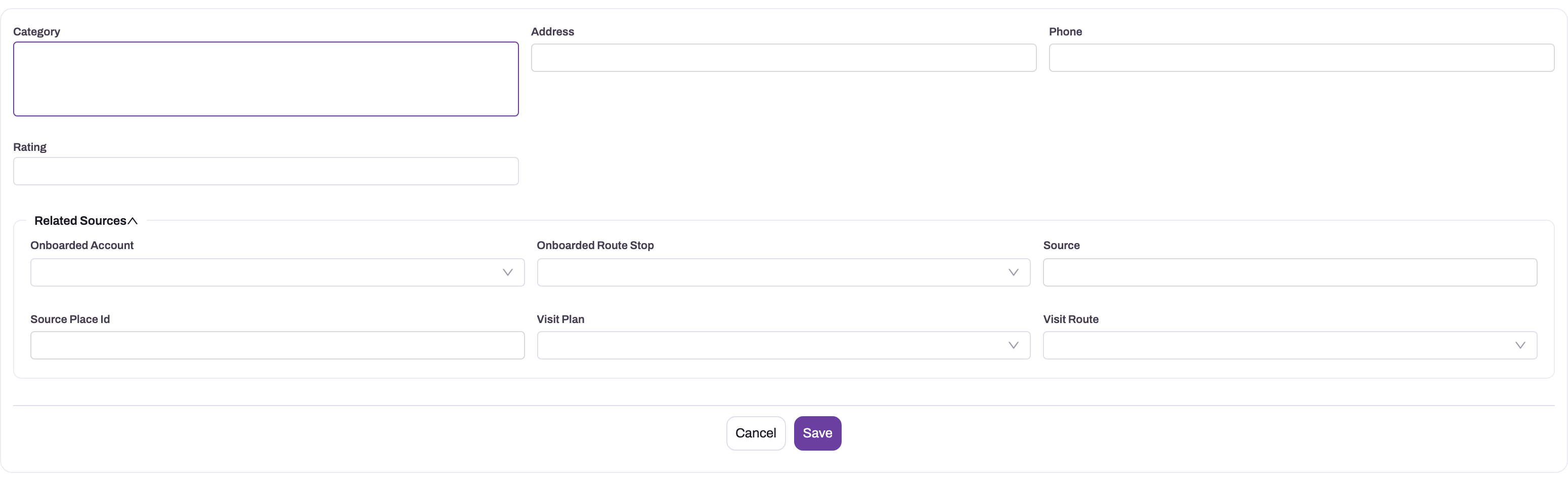
- 1
Category describes the kind of outlet discovered in the field.
- 2
Address is reviewed before onboarding and later geocoded for route planning.
- 3
Phone provides a contact path but should be verified before conversion.
- 4
Rating helps prioritize which discovered outlets deserve follow-up.
- 5
Source links retain the plan, route and external-place origin used for deduplication.
Step 1 — Open the nearby feed on your plan
Open today's Visit Plan, start or select the correct active stop, and grant precise device location when prompted. The nearby scroller lists existing customers not already on the plan or route and prospects that are not customers, nearest first. Before acting, confirm the location indicator is current and inspect distance, address and phone on the card; a stale GPS fix can make the ranking misleading even when the records are correct.
Step 2 — Discover more outlets around you
With connectivity available, select Find Nearby Outlets once and wait for the server-side places search to finish. Review new cards against visible storefront names and addresses before assuming they are distinct. The platform saves prospect records and deduplicates previous discoveries; run the same search again during testing and verify the count does not increase for unchanged places. If nothing appears, confirm both connectivity and the displayed search origin before widening the radius.
Step 3 — Add an existing customer to the route
On an existing-customer card, open enough context to verify the account and address, then tap Add to Route once. The card should change to Proposed and the route should gain one pending stop without changing today's visit order. Tell the planner why the stop belongs on the beat; after approval, verify it becomes an approved route stop and appears only in newly generated plans, not retroactively in completed work.
Step 4 — Onboard a new outlet
On a prospect card, tap Onboard and review every prefilled name, address, phone and coordinate against the storefront or contact—external place data is a starting point, not verified customer master data. Search for an existing account before saving, complete required commercial fields, and save once. Open the resulting account and verify the prospect links to it, is marked onboarded and no longer appears as available. Use + Add outlet only when discovery has no matching place and validate the hand-entered location before route use.
Expected result
The nearby feed is distance-ranked without duplicating existing route stops, an existing customer becomes one proposed stop for planner review, and an onboarded prospect creates one linked customer account with verified contact and location data. Repeating discovery does not recreate the same place.
Common problems
If the feed is empty, you may genuinely be covered — outlets already on the plan or route are excluded by design — or the surrounding accounts may be missing coordinates, which keeps them out of any distance-ranked list. If Find Nearby Outlets returns nothing, check connectivity: discovery is one of the few visit-flow actions that cannot run offline.
Common questions
What is the difference between "Add to Route" and "Onboard"?
Add to Route is for a store that is already your customer but not on this beat — it becomes a proposed stop. Onboard is for a store that is not a customer at all — it creates the account first. Both start from the same feed; the card type decides which you see.
Do onboarded prospects show up again?
No. Onboarding flips the prospect's status and links it to the created account, and the feed only offers prospects still waiting. The linkage also means the source place is kept for audit — you can always see which lookup a customer came from.
Where do prospect places come from?
Two sources: on-demand discovery runs from the field, and bulk-loaded lists your organization imports. Both land in the same pool, keyed by their source identity so repeats collapse into one record.