
A storage location is the "where" of every stock figure in xMatix: on-hand quantities, lots, receipt lines, allocation and picking lines, transfer lines, adjustment lines and count lines all name one. A location belongs to exactly one branch, can sit inside another location to form a hierarchy (a warehouse containing racks, for example), and one flag — Mobile — turns it into a vehicle: a van that holds stock like any bin and additionally declares what it can carry.
Where to find it
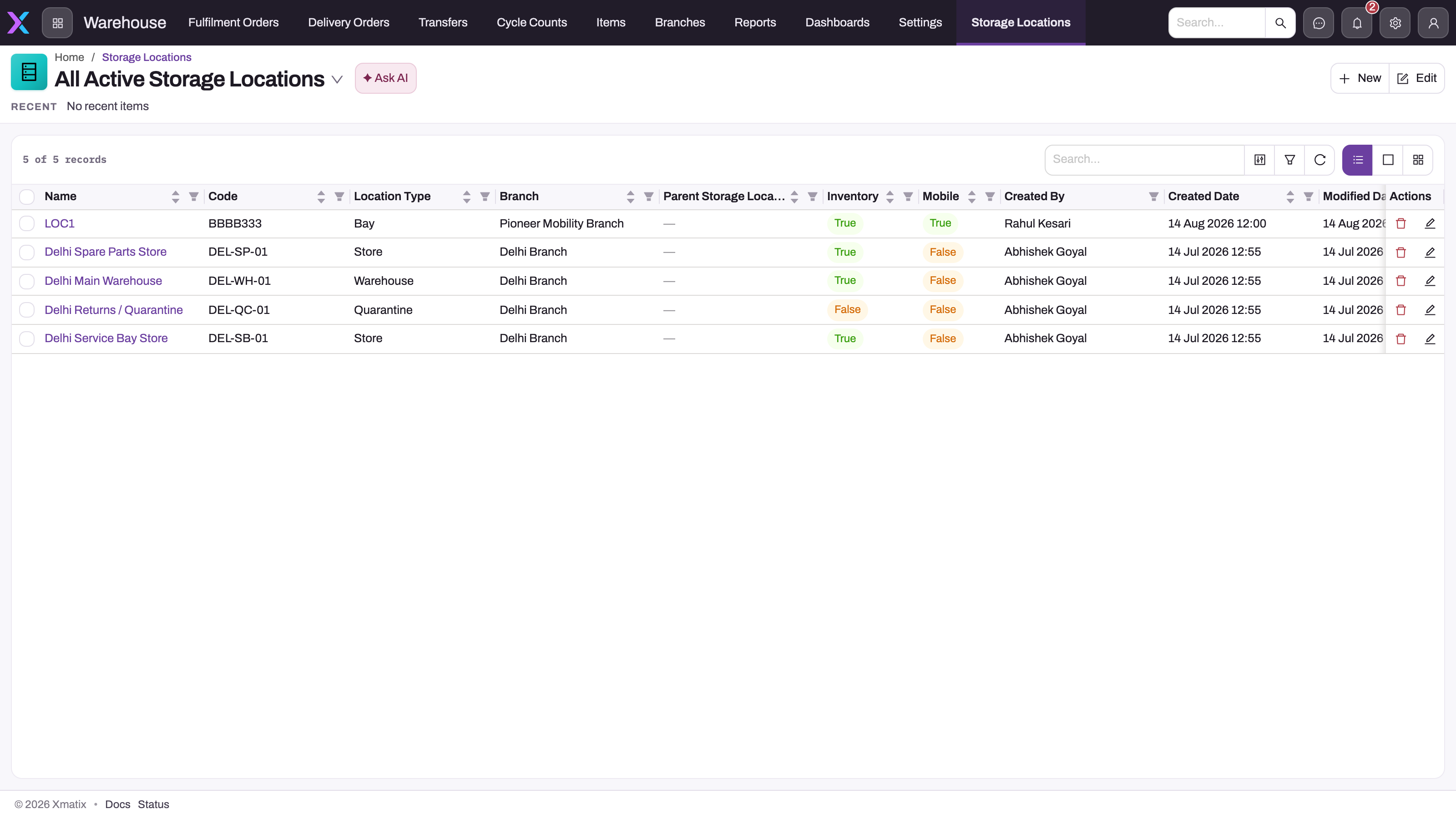
Storage locations belong to the Warehouse Settings app, which has no tab of its own on the web. Open the App Launcher, type Storage Locations into the search box and choose the entity, or open /StorageLocation directly; the list then appears as an extra tab on whatever app bar is current (the screenshots below show it under Warehouse). The default view is All Active Storage Locations; switch views to see retired locations. New opens the create form; a row's name opens the saved record.
Creating and editing locations needs create/edit access to the Storage Location entity in your security profile. Because every stock movement names a location, treat the list as master data: add a row only when a real place (or vehicle) exists.
Read the location screens
- 1
Storage Locations is not a fixed Warehouse app tab — it is appended to the bar when you open the list from the App Launcher's entity search.
- 2
The default view is All Active Storage Locations; switch views to see retired (inactive) locations.
- 3
Name and Code — the code is the short scan-friendly identifier; both appear on receipt, picking, transfer and count lines.
- 4
Location Type comes from a picklist (Warehouse, Store, Rack …); tenants can add their own values such as Quarantine or Bay.
- 5
Parent Storage Location shows where the location sits in a hierarchy; a dash means it is a top-level location.
- 6
Inventory = stock may be held here; Mobile = the location is a vehicle (van) with its own stock and capacity fields.
Check the list before adding anything. Code, type, branch, parent and the Inventory/Mobile flags tell you whether the physical or virtual place already exists and where it sits; a duplicate location splits one physical bin's stock across two records that nothing reconciles.
- 1
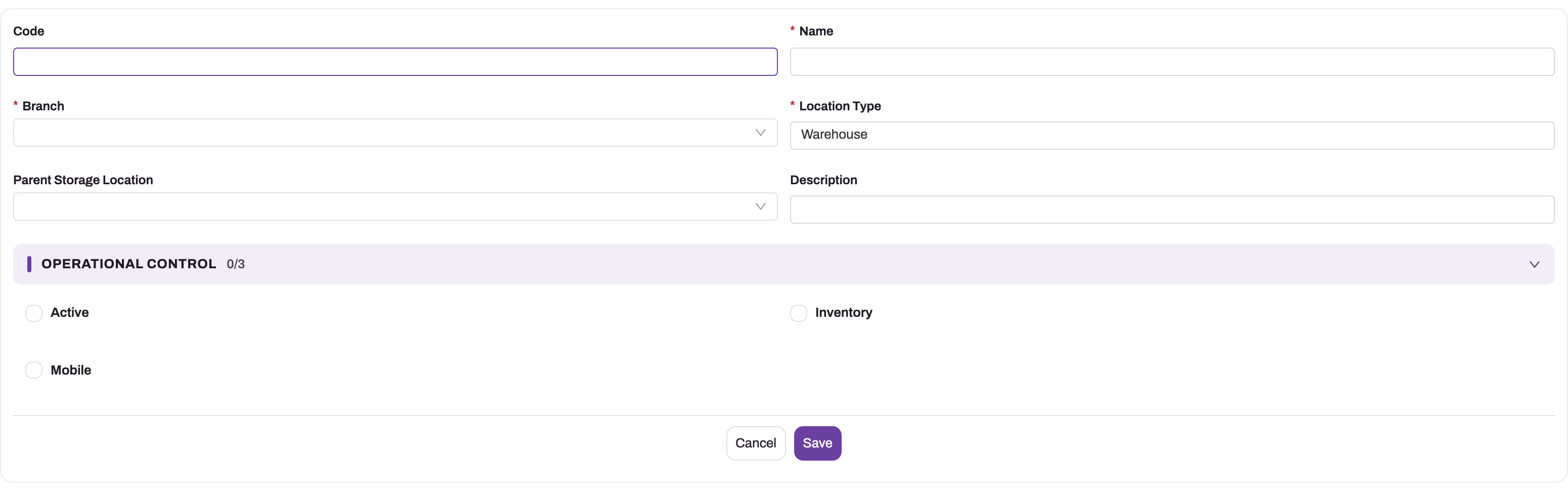
Code is the short, scan-friendly identifier that appears next to the name on receipt, picking, transfer and count lines.
- 2
Name is mandatory and is what pickers see in every location lookup.
- 3
Branch (mandatory) fixes which branch's stock this location holds — one branch per location, never shared.
- 4
Location Type is a descriptive picklist (Warehouse by default); no stock rule depends on it.
- 5
Parent Storage Location nests this location under another to build a site → warehouse → rack tree.
- 6
Active retires a location later; Inventory marks it as stock-holding; Mobile makes it a van with its own stock and capacity fields.
The create form asks for identity and placement — Code, Name, Branch, Location Type, Parent Storage Location, Description — and the three Operational Control flags. Location Type defaults to Warehouse. Name, Branch and Location Type are mandatory.
- 1
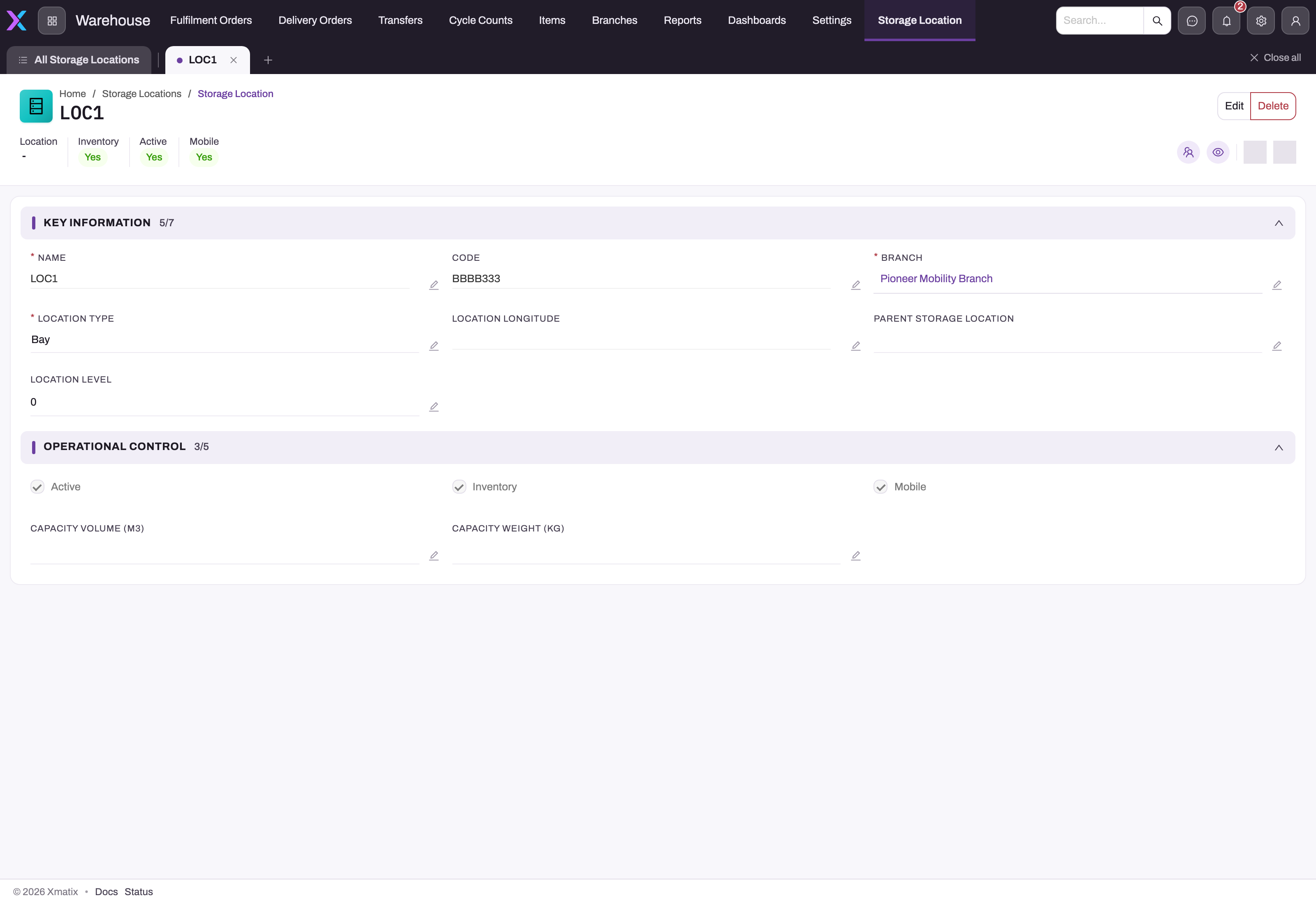
Header badges summarise Inventory, Active and Mobile — Mobile = Yes means this location is a van.
- 2
Branch is fixed per location; every stock figure here is keyed by this branch.
- 3
Location Type is a picklist tenants can extend (Bay here); it is descriptive only.
- 4
Location Level and Parent Storage Location describe the hierarchy; level and root are typed by you — nothing computes them.
- 5
Active, Inventory and Mobile — Inventory is read when the platform picks a landing location automatically, not enforced on document lines.
- 6
Capacity Volume (m3) and Capacity Weight (kg): a van needs at least one for load building and the capacity check to consider it.
The saved record adds the fields the create form leaves out: Location Longitude and Location Level under Key Information, and the vehicle capacity fields under Operational Control. Header badges summarise Inventory, Active and Mobile at a glance. Fields are edited in place (pencil icons) or through Edit.
The location record
| Field | Meaning |
|---|---|
| Name / Code | The display name (mandatory) and a short code for scanning and quick reference. Both appear on the lines that reference the location. |
| Branch | The branch this location belongs to — mandatory, and exactly one per location. |
| Location Type | Mandatory picklist. The default values are Site, Warehouse, Store, Showroom, Rack, Engine Bay and Virtual; administrators can add their own values such as Quarantine or Bay. The type is descriptive — no stock rule depends on it. |
| Parent Storage Location / Location Level / Root Location | The location this one sits inside, its depth in the tree and the top of the tree. Level and root are stored exactly as typed: nothing computes them from the parent, and no stock process reads the hierarchy. Fill them consistently if you report on them. |
| Inventory | Whether stock is meant to be held here. Structure-only locations (a site containing warehouses) leave it off. See the honest note below on what the flag does and does not enforce. |
| Mobile | Marks the location as a vehicle — see the next section. |
| Active | Retires a location without deleting its history. Inactive locations drop out of the default view and are skipped when the platform picks a landing location automatically. |
| Location Longitude / Latitude | Geographic coordinates as text, for tenants that map their locations. |
| Fulfillment Sequence Number | Sort order used when the platform has to pick a branch's depot automatically (order-driven van load building takes the lowest-numbered non-mobile, stock-holding location). |
| External ID / Description | An identifier for integrations, and free-text notes. |
What the Inventory flag enforces
The Inventory flag is read when the platform chooses a location for you — the landing location for an incoming partner transfer is the branch's first active location with Inventory on, and the default depot for van load building is its first non-mobile location with Inventory on, in Fulfillment Sequence Number order. It is not validated on document lines: a receipt, transfer or adjustment line can name a location with Inventory off and the ledger will post there. Keep structure-only locations out of your pickers by naming convention and training, not by relying on the flag.
Vehicle locations (vans)
A location with Mobile on represents a vehicle. Because it is a real storage location, a van has its own stock: loading it posts a transfer from the depot onto the van, selling from it draws that stock down, and the evening check-in transfers the remainder back — the full run is documented in Van sales. The vehicle fields on the record:
| Field | Meaning |
|---|---|
| Vehicle Number | The registration number. |
| Capacity Volume (m³) / Capacity Weight (kg) | Declared load limits. A van needs at least one of them to be usable by order-driven van load building and by the capacity check. |
| Cargo Length / Width / Height (cm) | Cargo-bay dimensions, stored for reference. |
| Default Resource | The usual driver or sales executive for this van. |
| Default Position | The route seat the van is anchored to; load building and territory planning prefer a van whose seat matches the route over any other van of the branch. |
On the shipped default layout the vehicle fields sit in a Van section of the create form; tenants whose layout predates it see only the two capacity fields on the saved record, as in the screenshot above, and can add the rest with the form layout designer.
The van capacity check
When a dispatcher releases a van load, the platform sums the planned lines' quantity × unit weight and quantity × unit volume from the item master and compares the totals with the van's Capacity Weight and Capacity Volume. The behaviour is governed by a Sales module setting with three modes, described in the configuration reference:
- Off — no check.
- Warn — the load is released, and the overload is written into the load transfer's label (
OVER CAPACITY — … kg against … kg) so the loader sees it on the document. - Block — the release is refused with the same message and nothing is posted.
A van with neither capacity declared is never checked, and items without unit weight or volume contribute zero on that axis, so the check is only as strict as the item and location master data behind it.
Common questions
Can one location serve two branches?
No — a location belongs to exactly one branch, and every stock figure is keyed by partner account, branch, item, SKU and location together. Physically shared space is modelled as one location per branch. This is also why branch is fixed on documents such as cycle counts: the stock being counted is branch-scoped by construction.
How deep can the hierarchy go?
As deep as you like — Parent Storage Location is an ordinary lookup to another location. Level and root are informational fields you maintain yourself. Keep stock-holding (Inventory on) at the level you actually pick and count from, and name structure-only levels so that nobody selects them on a document line.
Is a van's stock counted like warehouse stock?
Yes. A van is a storage location, so its stock appears in the same on-hand figures, can be scoped in a cycle count by picking the van as the count's storage location, and moves on and off exclusively through posted transfers — there is no separate van-stock bookkeeping to reconcile.
Why is my van not offered when a load is built?
Order-driven load building only uses locations that are Mobile, Active and have Capacity Weight or Capacity Volume declared, anchored either to the selected route seats (Default Position) or to the branch, and it skips vans that already have a run on that delivery date. Fill in a capacity, or pass the van explicitly.