
Read the Integration Apps registry
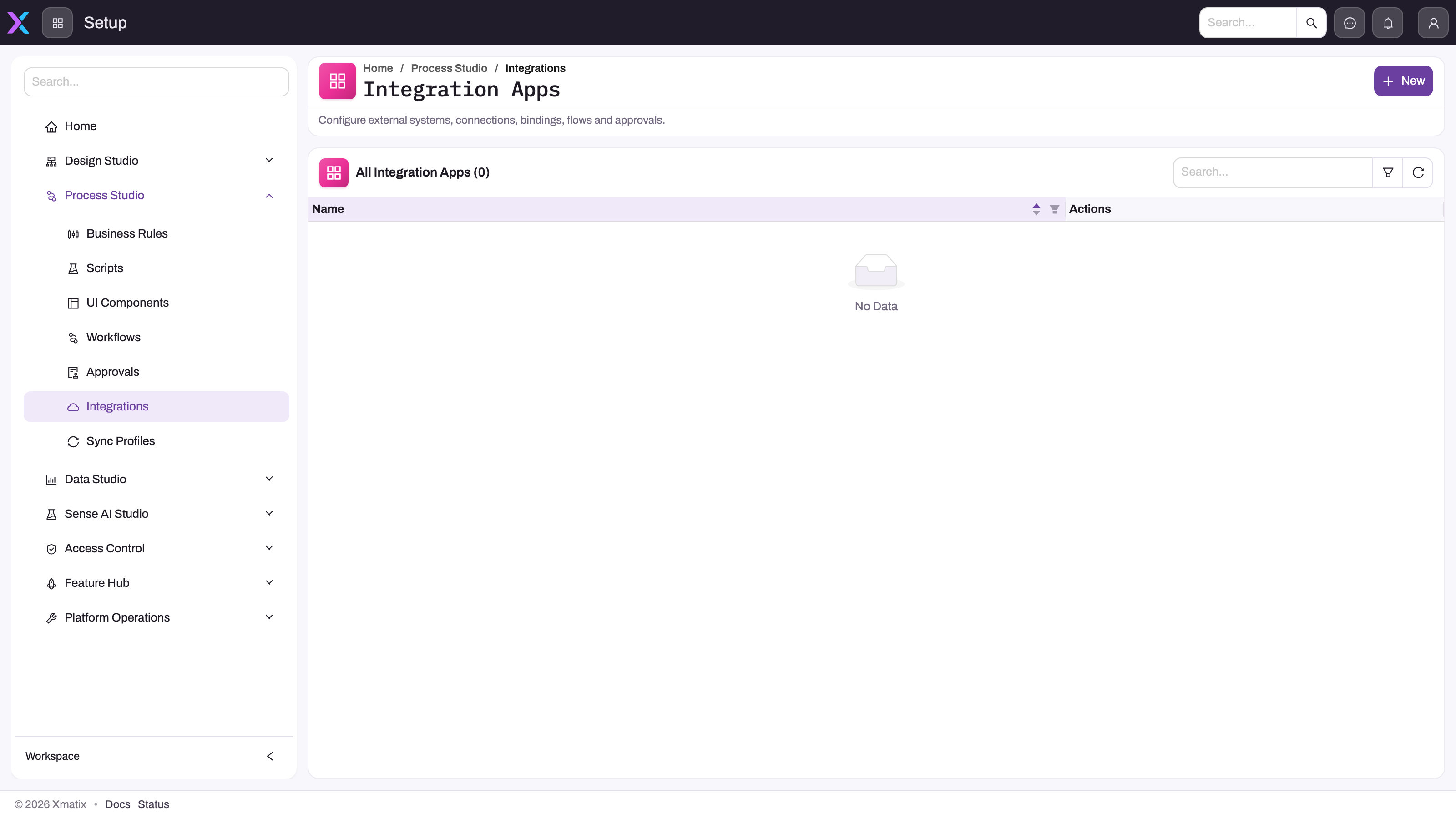
- 1
Integration Apps is the governed inventory for external-system integration products.
- 2
The description names connections, bindings, flows and approvals owned by each app.
- 3
Integrations and Sync Profiles are separate Process Studio levels: authored flows and declarative contracts.
- 4
The empty demo2 registry means no Integration Hub app is configured.
- 5
Search, filters and refresh support inventory review as apps are added.
Integration Apps are the ownership boundary for external-system work. An app contains its connections, secrets, bindings, flows, triggers, approvals, staging queues, errors and members, and its active state acts as a kill switch for dispatch. The registry is therefore an inventory of governed integration products, not merely a list of connector credentials.
Create one only after naming the external system, data owner, operational owner, security profiles, retry expectations and deactivation plan. Keep secrets out of names and descriptions, test connections separately from business flows, and verify monitoring before enabling schedules or entity events. The screenshot is demo2's genuine empty Integration Apps registry: useful here because this page explains the registry itself, but it is not reused as evidence for connection, flow or sync-profile procedures.
xMatix talks to other systems through one integration surface with two levels of control. The Integration Hub is the low-level machinery: apps, connections, flows and triggers that move records in and out through connectors. Sync Profiles sit on top: a declarative way to say "keep these entities in step with that system" that compiles into Hub flows, adding change detection, conflict handling and a per-record ledger. Both are administered from Setup, and both report into the same monitoring screens.
The two connector tiers
Every connection to an external system uses a connector — the component that speaks the other side's protocol. Connectors come in two tiers, and both appear in the same picker when you create a connection:
| Tier | What it is | Examples |
|---|---|---|
| Built-in connectors | Engineered per system, for transports and auth flows that need real logic — OAuth token exchange, bulk APIs, schema discovery, file transfer | Generic HTTP/REST, Salesforce, the Zoho family, SFTP, message queues |
| Catalog (manifest) connectors | Declared as reviewed configuration for REST partners with standard auth — same secrets, retry and typed config form, no custom code | ClearTax GSP, HubSpot, Shopify, Zendesk |
The tier is invisible in day-to-day use: you pick a connector type, fill in its form, test it, and use it in flows. The difference matters only for what a given connector can do — built-in connectors can offer extras like bulk writes and live schema discovery, which the catalog tier does not.
Integration apps: the unit of ownership
Everything in Integration Hub belongs to an integration app: connections, secrets, flows, triggers, run history and profile-role assignments. App-scoped endpoints use Viewer, Operator, ConnectionManager and Admin roles. A separate implementation caveat applies to Sync Profiles: their controller currently checks the tenant integration capability but does not enforce the referenced app's membership roles. Treat that as a boundary to remediate and test, not as inherited authorization. Deactivating an app refuses new flow dispatches without deleting configuration.
Sync flows
For ongoing synchronization — rather than a one-off import or a single push — create a sync profile (Setup → Process Studio → Sync Profiles). A profile declares the external system, the connection, the entities in scope with per-entity direction (inbound, outbound or bidirectional), and the field mappings. It then compiles into the Hub flows that execute it. The engine tracks a watermark cursor per entity and direction, pairs records in a ledger, drops unchanged re-reads as echoes, and opens a conflict instead of guessing when both sides changed the same field. See Scheduled sync.
Monitoring
Two places, one habit:
- Per app: the app's Overview shows recent runs; the Errors tab pre-filters to failures; Staging and Approvals hold anything parked for review.
- Across all sync profiles: Sync Monitor has Health and Conflicts views. In the profiles-list summary, the value labeled Parked records aggregates record states Conflict, Error and Deferred; the detailed monitor separates those conditions. Do not read that summary number as "explicitly excluded" records. Sync health and conflicts explains the detailed states.
Section map
| Page | What it covers |
|---|---|
| Connect an external system | App → secret → connection → flow → trigger, end to end |
| Scheduled sync | Sync profiles, entity declarations, mappings and schedules |
| Sync health and conflicts | The monitor screens and how to read a failed run |
| Zoho | Zoho Books, Payroll and People sync |
| Tally | Push-based Tally master-data sync |
| Salesforce | The Salesforce connector in flows and sync profiles |
| Catalog connectors | ClearTax GSP, HubSpot, Shopify, Zendesk |
| Outbound integration | How data leaves xMatix, including push-style needs |
| Credentials and rotation | Write-only secrets and safe key rotation |
| Troubleshooting | Symptom-first fixes |
Common questions
Do I need a developer to set up an integration?
Not for the common paths. Connecting a system, storing credentials, testing a connection, declaring a sync profile and mapping fields are all administration screens — a flow is authored as a small step graph, and sync profiles generate those graphs for you. Custom transformation logic inside a flow is where technical comfort helps; the developer documentation covers the programmatic surface.
Which external systems are supported out of the box?
Named connectors ship for Salesforce, Zoho Books, Zoho Payroll, Zoho People, Tally, ClearTax GSP, HubSpot, Shopify and Zendesk. Beyond the named list, the generic HTTP/REST connector reaches any JSON-over-HTTPS API, and SFTP and message-queue connectors cover file and queue transports. The catalog grows by configuration review rather than product releases, so a missing REST partner is a request, not a roadmap item — see what a catalog connector provides.
What is the difference between an import and a sync?
An import is a one-time, file-based load you run and review. A sync profile is standing configuration: it runs on a schedule, detects what changed on each side since the last pass, writes only the differences, and keeps a per-record ledger so the same record is updated rather than duplicated on every cycle.
Who can see and operate integrations?
Two gates stack: the integration administration capability shows the screens, and per-app role membership (granted to security profiles on each app's Members tab) controls what a user can do inside an app — from read-only Viewer up to Admin. A user with the capability but no membership can list apps yet not open them, which is by design. See security profiles.