
What an incentive plan is
An incentive plan answers four questions: who is being incentivised (its members), over what timeframe (its periods), measured on what (its targets) and earning what (its incentive lines and their compensation slabs). Once the plan's status is Approved, the incentive engine evaluates each member's KPI performance against that member's own quota and writes the earned reward to the member's compensation line.
Where to find it
Open the Rewards app and choose Incentive Plans. The list opens as All Incentive Plans; New opens the create form with four sections — Details (Member Resource Type, Member Type, Status), Compensation Eligibility, Period Definition (Period Start Date, Period End Date and Period Type, all required) and Resource Member Filters. Click a plan's name to open the saved record, which adds a status stage bar and four tabs: Related, Targets by Resources, Targets by KPI and Compensations.
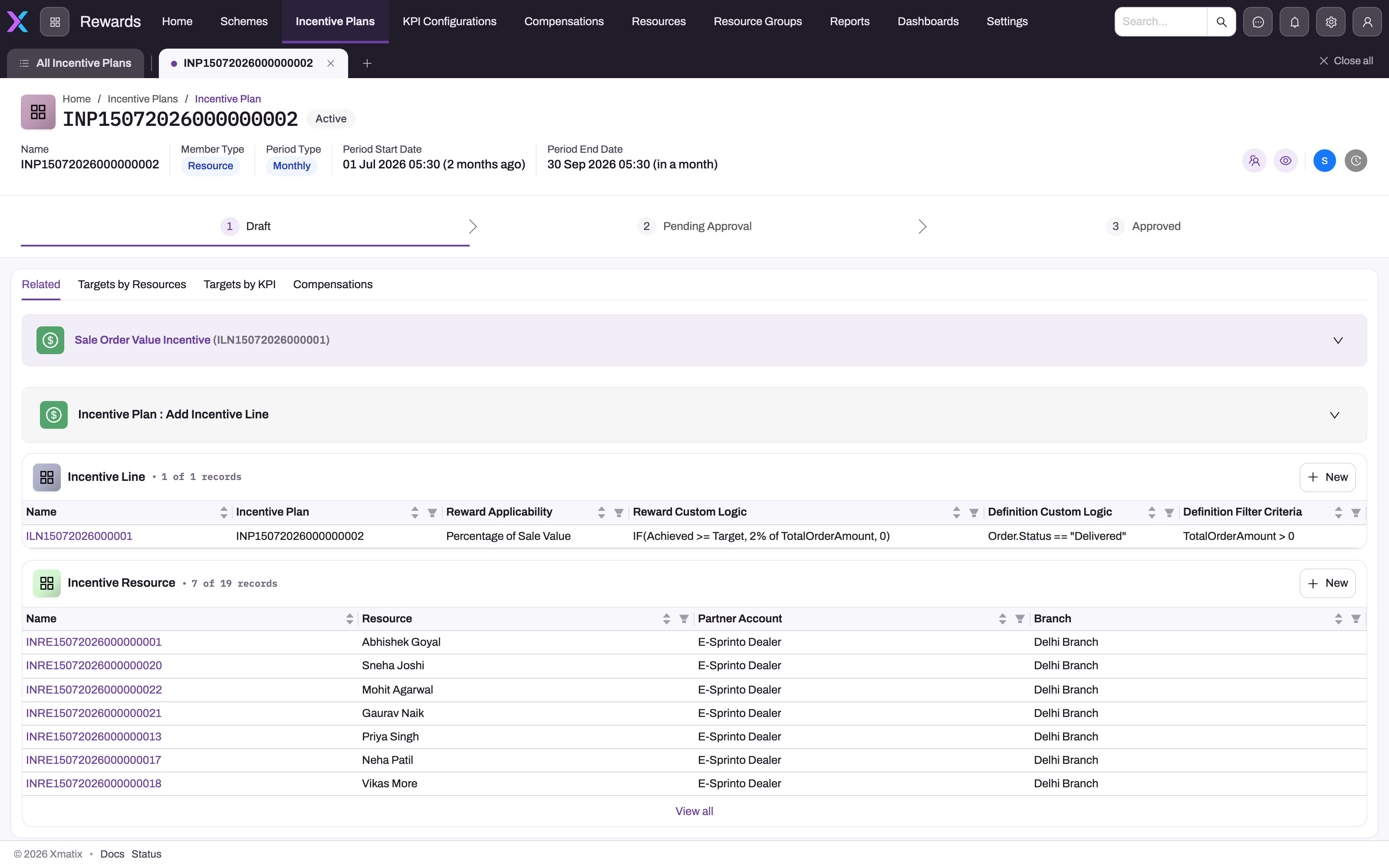
The plan header
| Field | What it does |
|---|---|
| Name | The plan number, generated on save |
| Member Type | Who the members are. The engine matches KPI records for Resource (by resource), Partner (by partner account), Branch (by branch) and Customer (by account). Any other value in the picklist has no matching rule, so members of such a plan never accrue achievement |
| Member Resource Type | Narrows a Resource plan to one resource type. Saving fails if it is set on a plan whose Member Type is not Resource. It is recorded for enrolment; the engine matches on the enrolled resource itself |
| Resource Group | Optional member resource group, recorded on the plan for enrolment; not read by the engine |
| Status | Draft → Pending Approval → Approved, shown as the stage bar on the saved record. Only Approved plans are evaluated |
| Period Start Date / Period End Date / Period Type | The plan's window and how it is sliced into periods. Required. The engine's generator supports Yearly, Quarterly, Monthly, Weekly, Bi Weekly and Daily; the default picklist ships with Weekly, Monthly and Yearly, so an administrator adds the other values under Setup before they can be chosen |
| Account, Account Group, Branch | Scope the plan to one partner account, one partner account group or one branch. An account group cannot be combined with an account or a branch — saving fails with Either Partner Account Group or Partner Account can be selected |
| Compensation Eligibility / Compensation Eligibility Formula | Stored on the plan and shown on the form, but no evaluation step reads them in the current release. Do not rely on them as a payout gate |
| Copy Source Targets / Incentive Plan (source) | Intended to copy target assignments from another plan. In the current release saving with the box ticked only clears the box — no targets are copied. Enter or import resource targets directly |
| Business Hours | Intended to skip non-working days when generating Daily periods; the generator currently creates a period for every calendar day |
What happens when you save
- On create, the plan's incentive periods are generated from the period type across the date range: one period for a Yearly plan; one per quarter, month, week (aligned to Monday), fortnight or day otherwise. Periods are named after their dates (for example July - 2026). They are generated once — changing the dates later does not regenerate them, so add or delete Incentive Period rows by hand if the window changes.
- Validation rejects an end date before the start date, and limits Daily, Weekly and Bi Weekly plans to at most one year.
- Once the plan has members or targets, six fields lock: Branch, Member Type, Account, Account Group, Period Type and Member Resource Type. Changing any of them is rejected. Set these right before you enrol anyone.
- Partner-member plans also refresh the partner portal's target cards on every save: the plan is the single source of the goal a partner sees and the number the engine pays on. Only ordered/invoiced quantity and value targets are mirrored; count, purchase and custom-KPI targets are skipped, and hand-authored portal targets are never overwritten. See Partner portals.
Periods
Targets, KPI records and compensation lines all attach to a specific Incentive Period, so one month's achievement never mixes with the next. Each period carries Date From, Date To and a Status (Draft / Calculated) that is informational — the engine does not set or check it. Periods are listed on the plan's Compensations tab.
Members and their targets
Each member is enrolled as an Incentive Resource row on the plan, pointing at the person (Resource), Partner Account, Branch or Contact that matches the member type. Targets then come in two layers:
- An Incentive Target defines what is measured: an Incentive Target Type (see below), optional filters — a specific Item, an Item Group (SKU-aware) or an Account — a Sequence Number that gives it a position in the line's logic, and for Custom KPI targets the Custom KPI Field Name to read. The target's own Value, Value Percentage, Operation and Target Value Type fields are stored but not read by the engine; the quota always comes from the member's assignment.
- An Incentive Resource Target assigns a target to one member for one period with the Value that member must reach, and names the KPI Configuration it belongs to. Achievement is always computed against the member's own value — a member with no assignment, or a value of zero, never qualifies.
The target types the engine evaluates, and what each one sums from the member's matching Performance KPI records:
| Target type | Measures |
|---|---|
| No Of Sale Orders / Sale Order Amount / Sale Order Quantity | Count, value or quantity of sale orders |
| No Of Invoices / Sale Amount / Invoice Quantity | Count, value or quantity of sale invoices |
| Purchase Order Amount / Purchase Order Quantity | Value or quantity of purchase orders |
| No Of Unique Invoices | Distinct accounts across the matching KPI records |
| No Of Unique Items | Distinct items across the matching KPI records |
| Custom KPI | The field named in Custom KPI Field Name, read from each KPI record |
The Incentive Target Type picklist offers many more values (bills, finance, insurance, repair orders, hours and so on). A target of any type not listed above sums nothing and stamps nothing. Note also that the picklist value Sale Invoice Quantity is not the engine's Invoice Quantity — a target saved with the picklist spelling scores zero until an administrator adds the engine's spelling to the picklist.
Incentive lines: combining targets into a qualification
An Incentive Line groups targets under a qualification rule and carries the compensation slabs that state the reward. Its Definition Filter Criteria decides how the targets combine:
- All Conditions Are Met — every target must qualify.
- Any Condition Is Met — one qualifying target is enough.
- Custom Logic Is Met — Definition Custom Logic holds an expression such as
{1} AND {2} OR {3}, where{N}is the target at sequence position N.ORsplits first,ANDbinds within each branch. A malformed expression qualifies nothing. - Always (No Criteria) — the line qualifies without evaluating targets. Because rewards attach to slabs that qualify through targets, a line set to Always writes no reward.
The default picklist ships with the first two values; add the other two under Setup if you need them. Lines are evaluated in Sequence order, and a plan can carry several lines with different rules and slabs. The line's Reward Applicability, Reward Custom Logic and Use Slab Absolute Value fields are not read by the incentive engine (they mirror trade-scheme line settings); every qualified slab on a line is applied.
The saved plan's tabs
Related shows the configuration behind the header: an Incentive Line grid (with each line's Definition Filter Criteria, Definition Custom Logic and reward settings), an Incentive Resource grid of enrolled members with their Resource, Partner Account and Branch, one collapsible panel per incentive line above the grids, and an Add Incentive Line panel. New on either grid opens the child form. An approved plan whose Related tab shows no lines or no members cannot produce compensation.
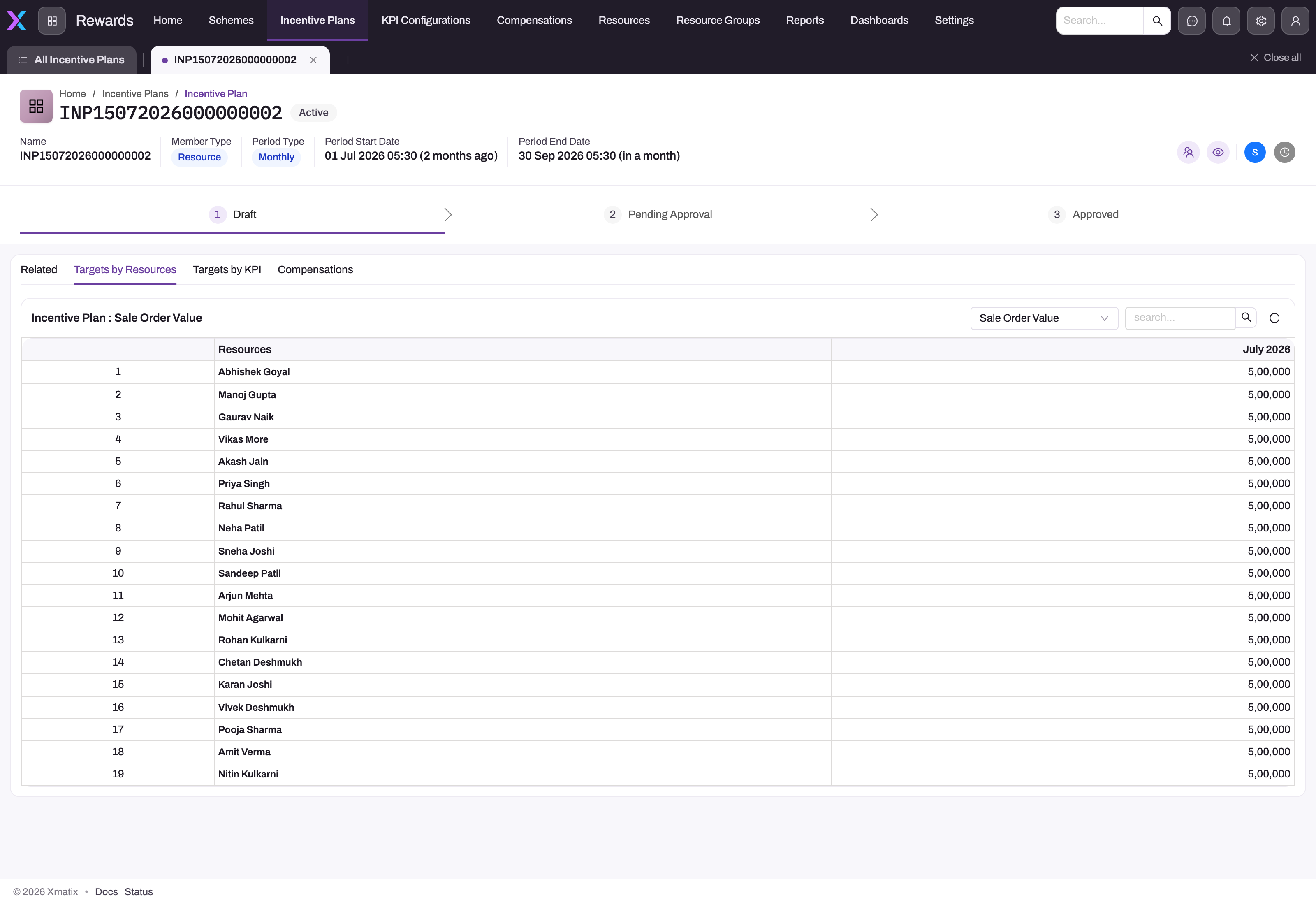
- 1
Targets by Resources — the participant-first view of the plan's Incentive Resource Target rows.
- 2
Pick the KPI Configuration whose quotas you are entering; the grid title repeats the choice.
- 3
Every enrolled member appears once. A member missing here has no Incentive Resource row and can never qualify.
- 4
One column per generated period. Cells are editable: type a quota and a Save button appears with the pending count — nothing is written until you click it. Zero or empty means the member scores nothing for that period.
- 5
Search finds a member by name; refresh reloads after an import.
Targets by Resources is a participant-first pivot of the plan's Incentive Resource Target rows: pick a KPI Configuration in the drop-down, and the grid lists every enrolled member down the side with one column per period. Cells are editable — type a quota, and a Save button appears with the count of pending changes; nothing is written until you click it. Use the search box to find a member and the refresh icon to reload after imports.
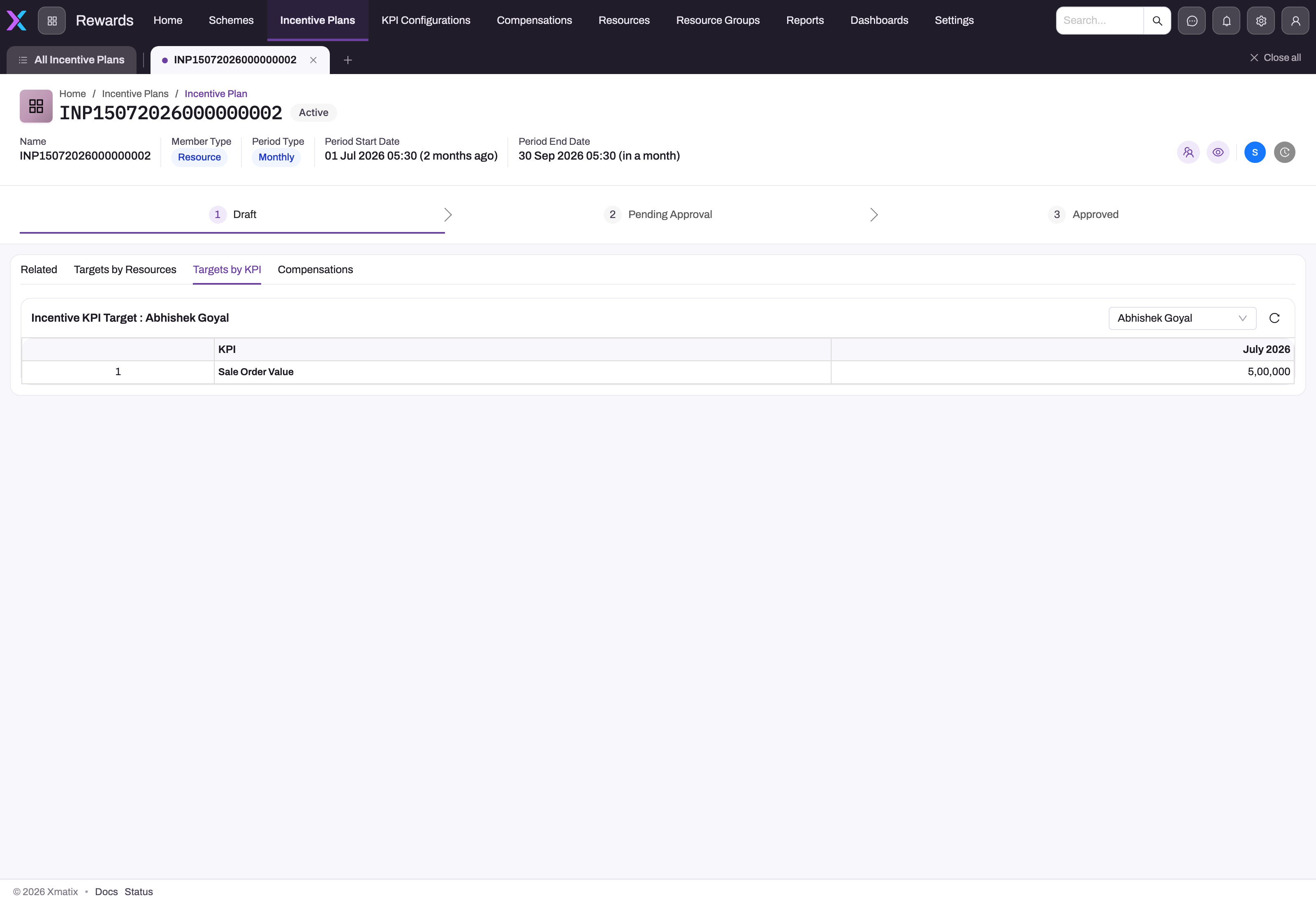
- 1
Targets by KPI — the measure-first view of the same Incentive Resource Target rows.
- 2
Select the member whose quotas you want to check; the grid title names the selection.
- 3
One row per KPI configuration the member has targets for. A KPI missing here means no assignment exists for this member.
- 4
The member's quota for the period. Achievement is computed as reached ÷ this value × 100, rounded down, before the slab bands are checked.
Targets by KPI is the measure-first view of the same rows: pick a member in the drop-down and the grid lists each KPI configuration with the member's quota per period. It is the quickest way to spot a member with a missing or zero quota for one KPI.
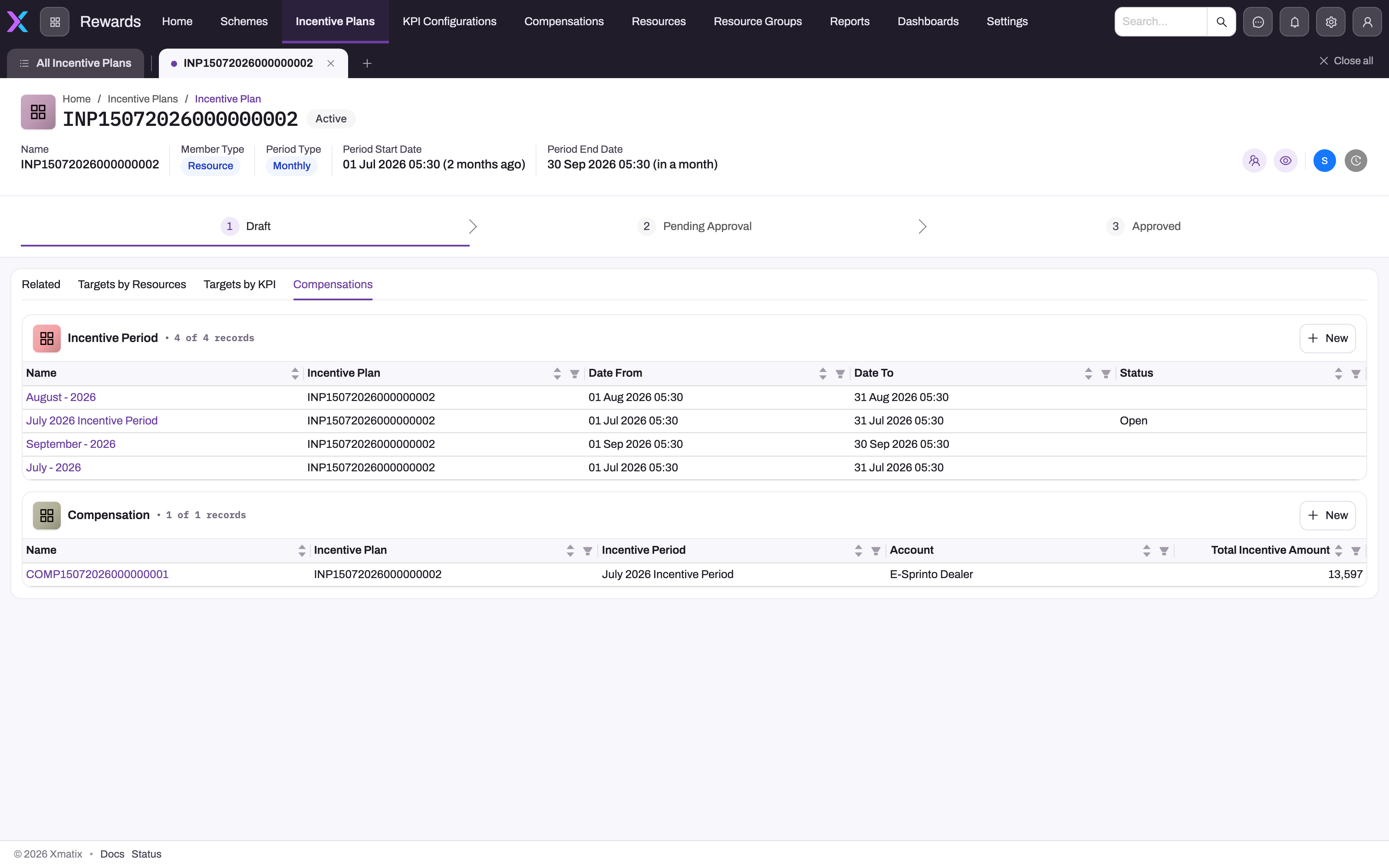
- 1
Compensations — periods and evaluated results for this plan.
- 2
Incentive Periods were generated on create from the Period Type and date range and are named after their dates. Add or delete rows by hand if the window changes; they are not regenerated.
- 3
Period Status is informational; the engine neither sets nor checks it.
- 4
Each Compensation header ties evaluated lines to one period and, where the plan is partner- or branch-scoped, one account or branch. Open it for the per-member lines.
- 5
Total Incentive Amount is a stored header figure — the engine writes amounts on the lines and does not roll them up here.
Compensations shows the plan's Incentive Period grid (Date From, Date To, Status) and the Compensation headers evaluated against the plan, with their Incentive Period, Account and Total Incentive Amount. Open a compensation to see the per-member lines and their achieved figures.
How the engine evaluates a plan
Evaluation runs when a compensation line is saved for a member, plan and period:
- The engine loads the plan's incentive lines (approved plans only), the member's target assignments, and the Performance KPI records for that plan and period.
- Per target, it sums the KPI records that match the member (by the plan's member type) and the target's filters, producing the reached value, and stamps it onto the compensation line so you can see what was counted.
- Achievement is computed as a percentage of the member's quota, rounded down: reached ÷ value × 100.
- The line's slabs are checked in sequence; the first slab whose band contains the percentage qualifies.
- Target results combine per the line's filter criteria; if the line qualifies, each qualified slab's reward is written to the compensation line.
Common questions
Why isn't my plan paying anything?
The most common reason is status: only plans with status Approved are evaluated — a draft plan is invisible to the engine, no matter how complete. After that, check that the member has an Incentive Resource Target with a non-zero value for the target and period, that the target's type is one the engine evaluates, and that KPI records exist for that plan and period. The troubleshooting page walks the full checklist.
Can different members have different targets in the same plan?
Yes — that is exactly what incentive resource targets are for. The target defines the measure once; each member's assignment carries their own value, and achievement is always a percentage of that personal value. Two reps on the same plan with values of 100 and 200 both hit 100% by reaching their own number. Enter them in Targets by Resources.
How do I write "target 1 and target 2, or target 3 alone"?
Set the line's Definition Filter Criteria to Custom Logic Is Met and its Definition Custom Logic to {1} AND {2} OR {3}. The numbers refer to the targets' sequence positions on the line. OR has lower precedence, so the expression reads as (1 and 2) or (3).
Can I change the period type after the plan is live?
No. Periods are generated when the plan is created, and once the plan has members or targets the period type — along with member type and the plan's scoping fields — is locked. To move from monthly to quarterly, create a new plan.
Does Copy Source Targets copy the quotas from another plan?
Not in the current release: saving with the box ticked clears it and copies nothing. Enter quotas in Targets by Resources or import Incentive Resource Target rows with Data import.