
xMatix Payroll turns a month of salary into ledger entries you can defend. A payroll run calculates every employee of one company for one payroll period from their assigned salary structure, an approval gate signs it off, the accrual posts into the same double-entry ledger as every other document, and a salary payment batch pays the net salaries in one posting. Everything the run does is an explicit, named action on the run record — nothing happens implicitly, and recalculating replaces the previous pass instead of stacking on top of it.
Where payroll lives
Open the App Launcher (the grid icon next to the xMatix logo), search for Payroll and select the app. Its top navigation carries the day-to-day records: Home, Resources (the people payroll pays), Payroll Runs, Payroll Adjustments, Loans & Advances, Payslips, Payroll Periods, Tax Computation (a month-by-month projected-versus-actual salary tax grid per employee), Reports, and under More the Full & Final Settlements, Dashboards and Settings.
The configuration records — Employees, Salary Structures, Payroll Components, Statutory Challans, Monthly TDS Projections, Tax Declarations and the statutory rule tables (PF Rules, ESI Rules, Professional Tax Slabs, LWF Rules, Salary Tax Slabs, Tax Regime Rules, Tax Surcharge Slabs, Tax Deduction Sections) — are not on the app's default top bar. Your administrator may have added some of them (Employees, typically) under More; otherwise type the entity name into the App Launcher's search box, where every entity you have access to is listed under All Entities. Access to each entity is governed by the ordinary security profile permissions, and the module as a whole is switched on per tenant through the Payroll module setting in Administration.
Read the payroll-run list
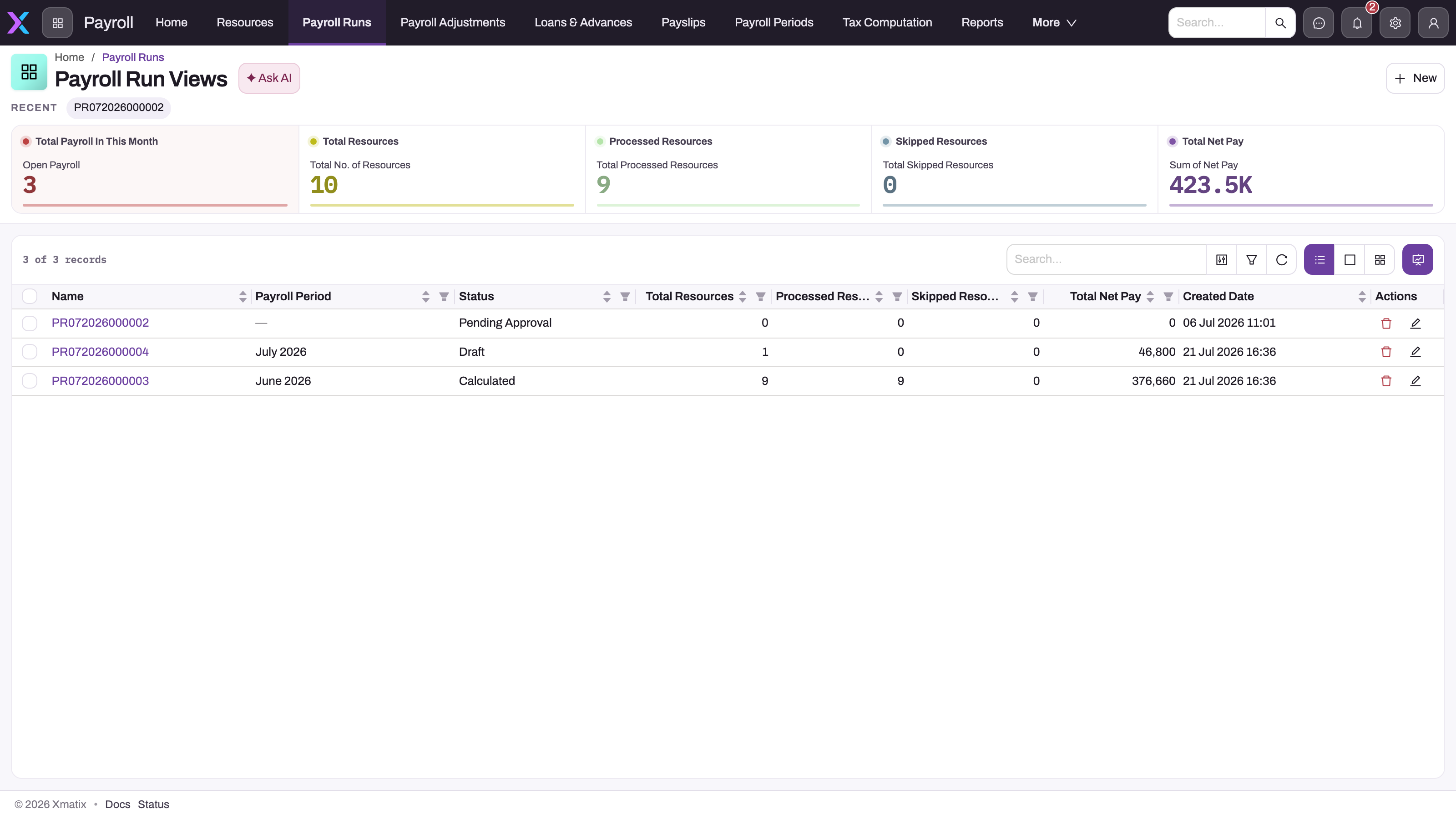
- 1
Payroll Runs on the Payroll app's top bar; Adjustments, Loans & Advances, Payslips, Payroll Periods and Tax Computation sit beside it, Full & Final Settlements under More.
- 2
Processed and Skipped Resources tiles: a non-zero skipped count means employees the calculation could not price — fix compensation or structure before posting.
- 3
Status is the lifecycle stage (Draft, Calculated, Pending Approval, Approved, Posted, Payment Generated, Paid); a Pending Approval run with zero resources was submitted before it was calculated.
- 4
Total Net Pay is the run-level control figure stamped by the last calculation; compare it with the posted journal and the salary payment batch.
- 5
Run names open the detail page where Calculate, Post, Generate Payslips, Generate Payment and Prepare TDS Challan live.
- 6
New creates only the run header for a company and payroll period — check the list for an existing run of that period first.
Payroll Runs is the control surface for the month. The tiles above the table summarise the visible population — open runs this month, total, processed and skipped employees, and the sum of net pay — and the columns carry the same figures per run: Payroll Period, Status, Total Resources, Processed Resources, Skipped Resources, Total Net Pay and Created Date. Read a row before opening it: a run whose skipped count is not zero has employees the calculation could not price; a run showing Pending Approval with zero resources was submitted before it was calculated. Names open the run's detail page; New creates the header for another period.
The mental model
Four ideas explain most of what you will see:
- The employee is a satellite of the person record. HR lifecycle and payroll configuration live on the Employee; the bank account, IFSC, PAN and UAN live on the underlying Resource (the person), and every posting, payslip and open item is keyed on that person — so expenses, loans and payroll all reconcile to one identity.
- Salary is a structure, not a number. A Salary Structure lists Salary Component lines — earnings, deductions, employer contributions, reimbursements — each with a calculation rule and, through its Payroll Component master, a ledger account mapping. The run evaluates the structure; posting follows the mappings.
- The run is the unit of work. Calculate, review, generate payslips, post (directly or through approval), generate the payment batch, pay — each stage is an action on the run, each is recorded on the run's status, and recalculating an unposted run replaces its previous pass.
- Statutory amounts are configuration, with one honest caveat. Professional tax is resolved from the configured slab table and salary TDS from a persisted monthly projection computed from the financial year's tax rule tables. Provident fund, state insurance and labour welfare fund, however, are deducted only as ordinary fixed or percentage components on the salary structure: the PF, ESI and LWF rule tables can be recorded but the calculation does not read them. Statutory deductions and challans states exactly what is computed and what is data entry.
The run lifecycle at a glance
| Stage | Action on the run | What changes |
|---|---|---|
| Draft | New | The header exists for a company and payroll period; nothing is calculated |
| Calculated | Calculate | Salary TDS is re-projected, every employee is priced, per-employee details and component lines are written, counts and net pay stamped |
| Review / Pending Approval / Approved | Submit to the approval process | Final approval posts the run automatically; rejection returns it to Review |
| Posted | Post (or approval) | One payroll journal dated on the period's pay date; a Payroll Payable open item per employee |
| Payment Generated | Generate Payment | A draft Salary Payment Batch with one line per employee with positive net pay |
| Paid | Pay on the batch | One bank journal settles every employee's open item; the run records its batch |
Payslips sit beside this chain rather than in it: Generate Payslips creates one Draft slip per processed employee at any point after calculation. There is no Publish action — Publish Status is an editable field on the slip whose only effect is to block recalculation of the run — and no employee self-service screen, so slips are distributed with the Print Payslip document; see Payslips.
What is in this section
- Employees and salary structures — the employee master, compensation records, structures and the payroll component catalog.
- Running payroll — the full monthly cycle from calculate to payment, with what each action checks.
- Payslips — what a payslip carries, generation, printing, and the draft/published gate as it actually works.
- Statutory deductions and challans — PT and TDS as computed amounts, PF/ESI/LWF as configured components, and depositing through challans.
- Income tax on salary — regimes, declarations, the monthly TDS projection and the Tax Computation grid.
- Adjustments, loans and advances — one-off pay items and installment recovery.
- Full and final settlement — closing out an exiting employee, and how the net is actually paid.
- Payroll run approval — the sign-off gate between review and posting.
- Expense claims through payroll — reimbursing approved claims with salary.
- Payroll configuration — the admin checklist: components, rule tables, control accounts.
- Troubleshooting payroll — symptoms, causes and fixes.
Payroll posts into the finance ledger — the accrual journal, the payable open items and the payment postings all follow the rules described in the finance documentation. If you are evaluating the product rather than operating it, start with the xMatix Payroll product overview or book a demo.
Common questions
Which records must exist before the first run?
A payroll company (the partner account whose payroll it is) with a Payroll Payable control account and a bank account; Payroll Components with GL and payable GL mappings; at least one Salary Structure with active component lines; Employees linked to Resources, with an active Resource Compensation record naming that structure; and a Payroll Period covering the month. Payroll configuration walks the checklist in order.
Why does a run show skipped employees?
An employee is skipped when the run cannot price them: no active compensation record, a compensation record without a salary structure, or a structure with no active lines. The skipped count is stamped on the run header so the gap is visible before anything posts.
Is payroll India-specific?
The statutory vocabulary is Indian — PF, ESI, professional tax, LWF, salary TDS with Old and New regimes — and the tax rule tables are keyed by Indian financial year. The calculation engine itself (structures, proration by payable days, adjustments, loan recovery, posting) is not tied to a jurisdiction.