
A subscription emails you a report or dashboard on a schedule. At each occurrence a background worker generates a fresh export — the report in your chosen format, the dashboard as a PDF — and sends it to your account's email address plus any additional recipients. Subscriptions are personal: each belongs to the user who created it, with their own schedule and settings, and the same report can carry a different subscription for every subscriber. A subscription stores the schedule and email settings only; it never stores a copy of the content.
Prerequisites
- Access to the report or dashboard — the bell appears on library rows and in the viewer only for content you can open.
- An email address on your user account; that address always receives the subscription.
- For dashboards, that dashboard subscriptions are switched on for your deployment (they are on by default; when off, dashboards show no bell).
Procedure
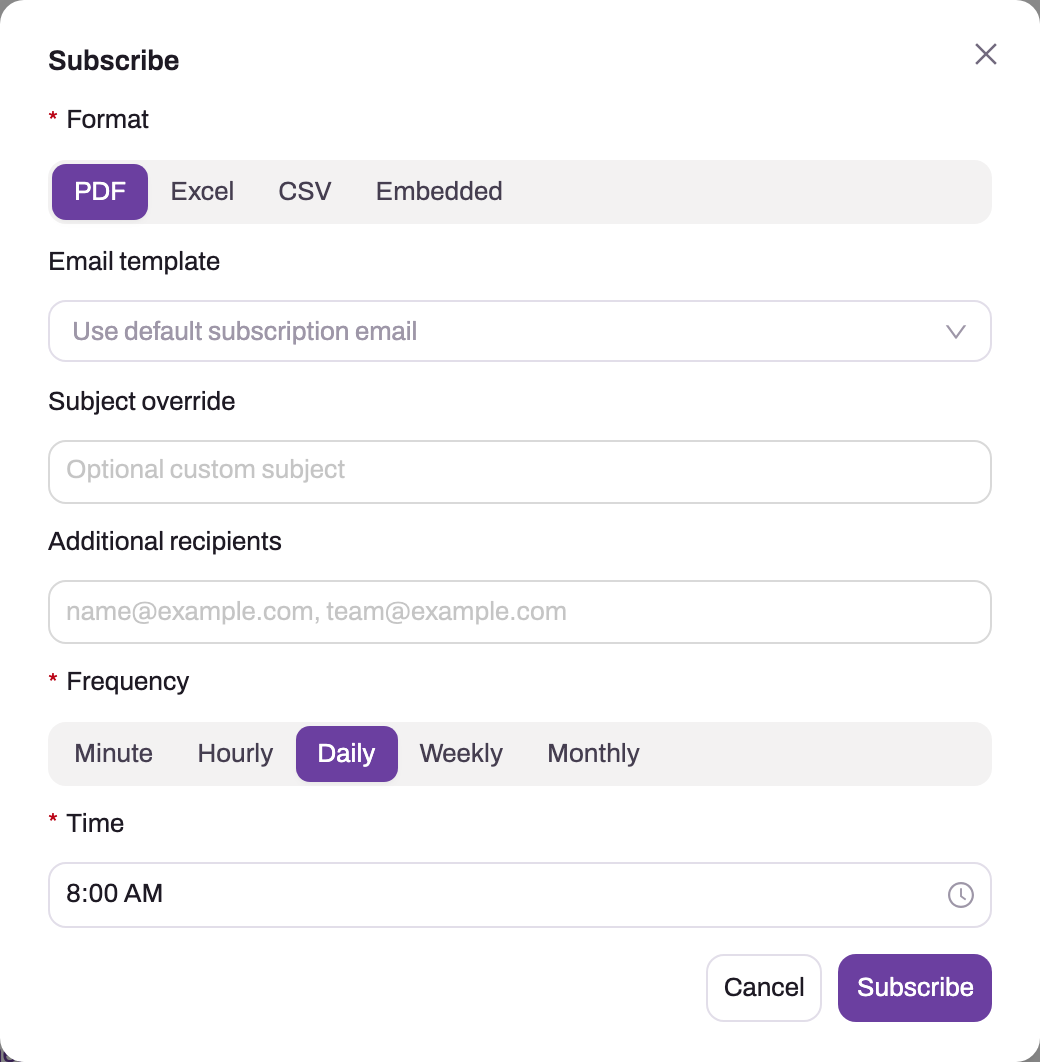
- 1
Format lists what this content supports — a grid report offers PDF, Excel, CSV and Embedded (the rows in the email body); a dashboard offers PDF only.
- 2
Email template (reports only) picks an organization template for subject and body; the default subscription email is used otherwise.
- 3
Subject override replaces the default 'Scheduled Report: <name>' subject.
- 4
Additional recipients is a comma-separated address list — everyone here receives the same export regardless of their access in xMatix.
- 5
Frequency: Minute and Hourly add an Interval (and minute past the hour); Weekly adds Day of week; Monthly adds Day of month; Daily, Weekly and Monthly take a Time.
- 6
Time is evaluated in UTC — 8:00 AM here means 08:00 UTC; Subscribe saves the schedule and the first email arrives at the next future occurrence.
Step 1 — Open the content and choose Subscribe
Choose the bell on the report or dashboard's row in the library, or in the viewer's toolbar (for reports it is also Subscribe in the actions menu). The Subscribe dialog opens. If it opens pre-filled with a Save button and an Unsubscribe button, you already have a subscription on this item and are editing it; a fresh dialog ends with Subscribe. Confirm the row you clicked is the intended content — the library allows two reports with the same name in different folders.
Step 2 — Pick the format
Format offers what the content supports. A grid report: PDF, Excel, CSV or Embedded. A document report: PDF, Excel or Embedded. A pivot report: Excel, PDF or Embedded. A dashboard: PDF only. Embedded puts the report's rows into the body of the email as a table instead of attaching a file — convenient for short lists read on a phone; PDF or Excel for anything long or for recipients who will work with the rows.
Step 3 — Adjust the email (optional)
Three optional settings shape the message. Email template (reports only) picks one of your organization's report-subscription templates for the subject and body; leave it on Use default subscription email for the standard message. Subject override replaces the default subject, which is otherwise Scheduled Report: or Scheduled Dashboard: followed by the name. Additional recipients is a comma-separated list of email addresses that receive the same export as you.
Treat additional recipients as a sharing decision: they receive the export whether or not they could open the content inside xMatix.
Step 4 — Set the schedule
Frequency and its dependent fields build the schedule:
| Frequency | Fields | Example |
|---|---|---|
| Minute | Interval — every 1, 2, 5, 10, 15 or 30 minutes | every 15 minutes |
| Hourly | Interval — every 1, 2, 3, 4, 6, 8 or 12 hours — and Minute past the hour (:00 to :55 in five-minute steps) | every 2 hours at :30 |
| Daily | Time | 08:00 |
| Weekly | Day of week (one or more days) and Time | Monday and Thursday, 07:00 |
| Monthly | Day of month and Time | the 1st, 06:00 |
Times are UTC. The schedule is stored as a cron expression evaluated in UTC, with no per-organization time zone: pick the UTC time that corresponds to the local hour you want the email to land, and revisit it when your region changes its clocks.
Step 5 — Confirm and wait for the first delivery
Choose Subscribe. The toast reads Subscribed, the bell fills, and the item appears in the library's Subscribed scope. Nothing is sent immediately: the first email arrives at the next occurrence after you subscribed (a monthly subscription created on the 5th for day 1 sends next month), and missed historical slots are never replayed. After the first delivery, check the subject, attachment type and content once before relying on the schedule.
Step 6 — Change or stop it
Choose the bell again to reopen the dialog with your stored values; change what you need and choose Save. Unsubscribe removes the schedule and the item leaves your Subscribed scope; emails already generated are not recalled.
What happens at send time
Every minute a scheduler checks each subscription's cron expression against the time of its last successful send. When an occurrence has passed, the worker exports the content and emails it, then stamps the send time. Knowing what that pipeline does and does not check avoids surprises:
- Reports are exported by the platform, not as you. The report's own query and filters define the rows; every recipient gets the same file, and no per-recipient access filtering is applied. Share the subscription's recipient list with the same care as the report's visibility.
- Dashboards are rendered as the subscriber. The PDF is produced under your own access with the dashboard's default filter values, so it matches what you see on screen — recipients you add receive your view.
- Deactivating or unsharing a report does not stop its subscriptions. The send checks only that the subscription is active and due and that the report still exists. A report hidden by the Active switch, or whose visibility was withdrawn, keeps being delivered until the subscriber unsubscribes or the report is deleted; deleting the report ends deliveries (the worker skips a subscription whose report is gone).
- A failed send is retried. Because the last-sent stamp moves only on success, a delivery that fails — an export error, an unreachable mail service — is attempted again on later scheduler passes (after a short suppression window that stops a failing job flooding the queue) rather than dropped.
- A schedule the platform cannot parse never fires, silently. Saving from the dialog always writes a valid expression; the situation only arises for schedules edited outside the dialog, and re-saving from the dialog repairs it.
- Only the next occurrence is honoured. If several occurrences pass while the worker is down, one delivery is sent when it resumes, not one per missed slot.
Expected result
The content appears in Subscribed with the reviewed format, recipient list and UTC schedule. At the next occurrence, you and the additional recipients receive one email with the attachment (or the embedded table), and reopening the dialog shows the same stored settings.
Common problems
- Nothing ever arrives. Work through the checklist in Troubleshooting analytics: confirm the item is still in your Subscribed scope, reopen the dialog and re-save, check that your user account's email address is correct, and look for the sender in spam or filtering.
- The email lands at the wrong hour. The schedule time is UTC, not your local time. Reopen the dialog and shift the time by your UTC offset.
- A recipient says they were not included. Additional recipients are a comma-separated list — check for typos and separators. Every listed address gets the same email; your own address is always included automatically.
- The dashboard email says the dashboard could not be rendered. Dashboard PDFs are drawn by a browser engine on the worker; if that host is not configured for rendering, the send fails and is retried. Report an unchanging failure to your administrator.
Common questions
Does each recipient get the data filtered for them?
No. One export is generated per delivery and every recipient gets the same file. For a report it reflects the report definition; for a dashboard it reflects the subscriber's own view. Neither is re-filtered per recipient — which is exactly why the recipient list deserves the same care as sharing does.
Can I subscribe someone else instead of myself?
You can add them as an additional recipient on your subscription — they receive every delivery you do. But the subscription remains yours: your schedule, your format, stopped when you unsubscribe. For a colleague who wants their own cadence, have them open the content and subscribe themselves.
What happens if the report changes after I subscribe?
Deliveries always render the current definition — the subscription stores the schedule and email settings, not a copy of the report. If the report's columns or filters change, the next attachment reflects the change; if someone saves a new column arrangement from the viewer, that is what arrives too. If the report is deleted, deliveries stop.